 Byblos Horizon
Growth Playbook
Scaling Shopify Stores Internationally: A Founder's Playbook
Mohamad Haidar
Founder of Byblos Horizon
Published June 13, 2026 · 8 min read · Updated October 24, 2026
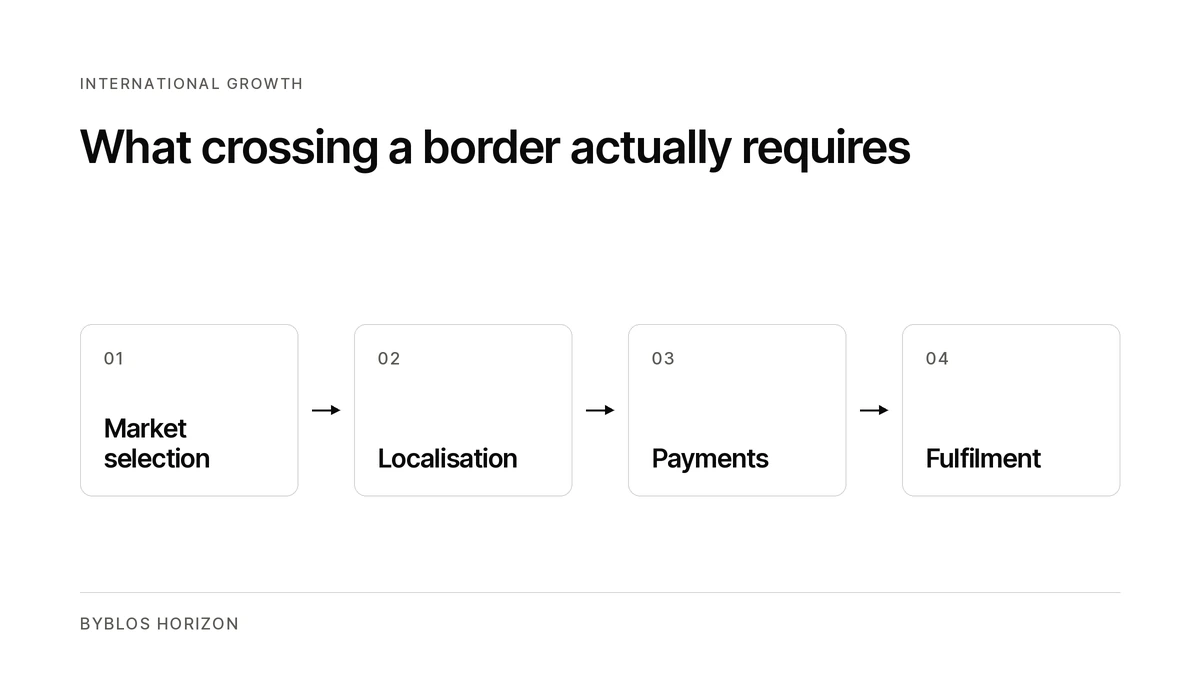
Scaling a Shopify store beyond your home market is rarely a translation problem. It's a distribution problem, a payments problem, a fulfilment problem, and, most of all, a positioning problem. At Byblos Horizon we work with founders shipping across Lebanon, the UAE, and France, and the same playbook keeps surfacing.
1. Pick markets that match your unit economics
Before you localise anything, model contribution margin per market. Shipping from Beirut to Riyadh is a different business than shipping from Paris to Berlin. Founders who pick markets by ambition instead of margin burn cash on the first 1,000 orders and never recover. Run the numbers for landed cost, duties, return rate, and customer acquisition before you touch the storefront.
2. Use Shopify Markets, not duplicate stores
Shopify Markets lets you serve country-specific pricing, currencies, domains, and languages from a single backend. Duplicate stores feel safer at first but fragment your inventory, your analytics, and your ad accounts. Unless you've a regulatory reason to split, keep one store and use market-level overrides.
3. Payments are a conversion lever, not a checkbox
In the GCC, adding Mada, Apple Pay, and Tabby or Tamara has moved checkout conversion by double digits on stores we run. That is our own figure from our client accounts, not a published statistic, and it will not hold for every catalogue or price point. In France, Cartes Bancaires and SEPA play the same role. Shipping with Stripe alone in either region quietly leaks revenue. Audit your payment mix per market every quarter, it's the cheapest growth experiment you'll ever run.
4. Localise voice, not just words
Machine-translated product copy reads like machine-translated product copy. Hire a native copywriter per market for your top 20 SKUs, your homepage, and your post-purchase emails. Leave the long tail to translation, but the surfaces that drive conversion deserve a human voice that sounds local.
5. Build a logistics partner before a marketing partner
A great ad with a 9-day delivery promise is worse than no ad. Lock in a 3PL or regional fulfilment partner in each market before you scale paid acquisition. In the UAE we lean on Dubai-based fulfilment for next-day reach; in the EU, a Netherlands or Germany warehouse hits most of the continent in 48 hours.
6. Treat each market's launch like a separate product launch
Different creative, different offer, different landing page, different first 90-day CRM flow. Founders who copy-paste their home-market funnel into a new geography almost always underperform. The brands that win treat market expansion as a series of product launches, each with its own thesis, its own KPIs, and its own retro.
Where to go from here
International scaling rewards founders who treat it as a system, not a sprint. If you are mapping out your next market and want a second pair of eyes on the plan, get in touch , we work with a small number of founders at a time across the MENA region and Europe.
Sources
- Shopify, About Shopify Markets, for the Markets section: that a single store can serve multiple countries, that each market can carry its own language, international pricing, and market-specific domains or subfolders such as example.com/en-ca or ca.example.com, that buyers can pay in a local presentment currency while the shop and settlement currencies are used for reporting and payouts, and that prices can be set by automatic conversion, a percentage adjustment, or fixed local prices in a catalogue price list.
- mada, the mada scheme, for Mada being the national payments scheme accredited by the Saudi Central Bank, which is why it is named as a requirement for the Saudi market rather than an optional extra.
- Shopify App Store, Tabby Pay Later, for Tabby being a buy now pay later provider in the Middle East with an app published by Tabby for Shopify stores, which is what makes it available to a store expanding into the GCC.
Sources opened and checked on 24 October 2026. Payment method availability and Shopify Markets behaviour both change, and Shopify ships breaking changes on its own schedule, so confirm current behaviour in Shopify's documentation and with each payment provider before building a market plan on it. We did not find vendor documentation we could verify for Tamara on Shopify, or for Cartes Bancaires and SEPA availability through Shopify in France, so treat those as items to confirm with the providers. The market-launch sequence, the fulfilment advice and the conversion figure above are our own practice and our own measurements from client stores, not published research.
Practical next steps
Connect international expansion to the underlying commerce work:
- review Shopify support across MENA markets.
- build market-specific storefront journeys.
- structure international search visibility.
Sources
- Shopify documents market management, localisation and international selling features. Shopify international sales guidance.
- Shopify documents market-aware commerce configuration for apps and storefronts. Shopify Markets developer documentation.
- Shopify documents checkout as a core part of its commerce platform. Shopify checkout research.
Related services
Related articles