AI Marketing
Beyond Prompts: How to Build AI Marketing Systems That Actually Generate Revenue
Beyond Prompts: How to Build AI Marketing Systems That Actually Generate Revenue
Byblos HorizonMohamad Haidar
Founder of Byblos Horizon
Published January 28, 2026 · 8 min read · Updated September 17, 2026
One of the biggest misconceptions in AI today is that a great prompt is all you need.
I see it constantly: businesses "adopting AI" by giving their team ChatGPT accounts, generating some content, and wondering why nothing changed in the P&L. Meanwhile, the companies quietly winning with AI aren't writing better prompts. They're designing better systems.
The future of AI won't be defined by who writes the best prompt. It will be defined by who designs the best AI systems. Let me show you the difference, with a real example from a system we built.
A real system: 3,500+ leads, scored and worked automatically
For AthleticQ, a SaaS platform in the fitness space, we built an AI-powered outbound engine with one clear objective: generate, score, segment, nurture, and reach highly targeted gym, fitness, and wellness leads at scale.
The system has processed over 3,500 leads. Not "generated some outreach copy", processed leads from start to finish: identifying prospects, enriching data, scoring fit, segmenting by readiness, personalizing outreach, and routing responses.
Here's what matters about that example: no single prompt does any of this. The value comes from architecture, a pipeline where each AI component does one job, feeds structured data to the next stage, and operates inside guardrails. That's what "AI in marketing" actually looks like when it produces revenue instead of demos.
Another example, closer to daily practice: I use AI alongside LinkedIn as a business development engine. Most people use AI to write posts. I use it to identify the right procurement managers, buyers, distributors, and decision-makers, qualify leads faster, and focus outreach where it actually matters. Same tools everyone has. Completely different output, because the workflow is designed, not improvised.
The anatomy of a production AI system
Building AI that a business can actually rely on involves an entire stack of decisions, and every one of them affects performance, accuracy, cost, and reliability.
Model selection and configuration. Which model, at which capability tier, at what temperature, for which task? Using a frontier model for everything is expensive; using a cheap model for judgment-heavy tasks is inaccurate. Production systems route each task to the right model, and this decision alone can change costs by a factor of ten.
Context and memory. An AI that forgets everything between interactions can't manage a lead pipeline or a customer conversation. Systems need designed memory: what to retain, what to summarize, what to discard, and how context flows between steps.
RAG, grounding in your reality. Retrieval-augmented generation connects the model to your data: your product catalogue, your pricing, your policies, your lead database. Without grounding, AI answers from general knowledge, fluently and wrongly. With it, the AI operates on facts. This is the single most important component separating toys from tools.
Guardrails. What is the system never allowed to say or do? Price commitments, legal claims, off-brand tone, hallucinated product details, production systems enforce constraints programmatically. You don't hope the AI behaves; you make misbehavior structurally impossible.
Structured outputs and tool calling. Real systems don't produce paragraphs; they produce actions, a lead score written to the CRM, a segment assignment, a follow-up scheduled, a WhatsApp message dispatched. Structured outputs turn language models from writers into workers.
Evaluation. How do you know it's working? Production AI needs continuous measurement: accuracy on known cases, drift detection, human review sampling. "It seemed good when we tested it" is not evaluation.
The final user experience. All of this is invisible to the customer or the sales rep who receives the output. The last mile, how the AI's work lands in a human workflow, determines whether the system gets used or quietly abandoned.
Why enterprises are moving to platforms
For companies beyond the experimentation phase, this is why serious platforms matter. I work extensively within the Microsoft ecosystem, and platforms like Azure AI Foundry exist precisely because enterprises need what individual prompting can't provide: orchestration across models, governance, security, evaluation infrastructure, and deployment at scale.
The pattern I see with growing companies in Lebanon and the GCC: experimentation happens on consumer tools, but the moment AI touches real customer data, real transactions, or real compliance requirements, the conversation changes from "which chatbot" to "which architecture." That shift, from tool to infrastructure, is the actual AI transformation.
And it comes with an unglamorous prerequisite: organizational hygiene. Licenses, permissions, data structure, access governance. One small misconfiguration across permissions or data access can compromise an entire deployment. AI amplifies whatever it's built on, including your mess.
Where marketing teams should actually start
If you run marketing for a business in Lebanon, the GCC, or anywhere in MENA, here's the honest sequence, not the hype sequence.
Start with one revenue-adjacent workflow, not "AI adoption." Lead qualification. Abandoned cart recovery. Customer support triage. Ad creative testing at scale. Pick one process where speed or volume currently limits revenue, and build a complete system for that single workflow.
Fix the data before the AI. Whatever workflow you chose runs on data, leads, orders, conversations. If that data is scattered and dirty, the AI's output will be fluent garbage. Budget as much time for data foundation as for the AI itself.
Design the human handoff from day one. Every good system has a boundary where humans take over, closing the deal, handling the exception, approving the edge case. Systems designed with the handoff get adopted; systems designed to replace people get sabotaged.
Measure in business terms. Not "messages generated", leads qualified per week, response rates, cost per qualified conversation, revenue influenced. If you can't draw a line from the system to a business number, you've built a demo.
The honest conclusion
AI in marketing is simultaneously overhyped and underused. Overhyped by people selling prompts and courses; underused by businesses that could be running scored-lead pipelines and intelligent retention flows today with well-understood technology.
The companies that win the next five years in our region won't be the ones that talked about AI most. They'll be the ones that quietly built systems, grounded in their data, wrapped in guardrails, measured in revenue, while everyone else was still prompting.
Frequently asked questions
What's the difference between using ChatGPT and having an AI system?
ChatGPT is a tool a person operates manually, one conversation at a time. An AI system is an automated pipeline, connected to your data, producing structured actions (scores, messages, CRM updates), running continuously with guardrails and measurement. The tool assists a person; the system does a job.
What is RAG and why does it matter for business AI?
Retrieval-augmented generation (RAG) connects an AI model to your actual business data, catalogue, pricing, policies, customers, so its answers are grounded in facts rather than general internet knowledge. It's the main technique preventing AI from confidently inventing wrong answers about your business.
How much does it cost to build an AI marketing system?
Far less than most assume, if scoped as one workflow rather than a company-wide transformation. The main cost drivers are data cleanup and integration work, not the AI itself. A single-workflow system typically pays back through saved labor and increased conversion within months.
Can AI really do lead generation?
Yes, with the right architecture. AI systems can identify prospects, enrich and score them, segment by readiness, personalize outreach, and route responses. Our system for AthleticQ has processed 3,500+ targeted fitness-industry leads this way. What AI can't do is fix an unclear offer or a bad product.
Does Byblos Horizon build custom AI systems?
Yes, AI systems design is one of our core services: lead engines, conversational commerce, retention automation, and AI-assisted content operations, built on production-grade architecture. See AI marketing services or book a consultation.
Curious what one AI system could automate in your business? Book a consultation bring your most repetitive revenue workflow.
Practical next steps
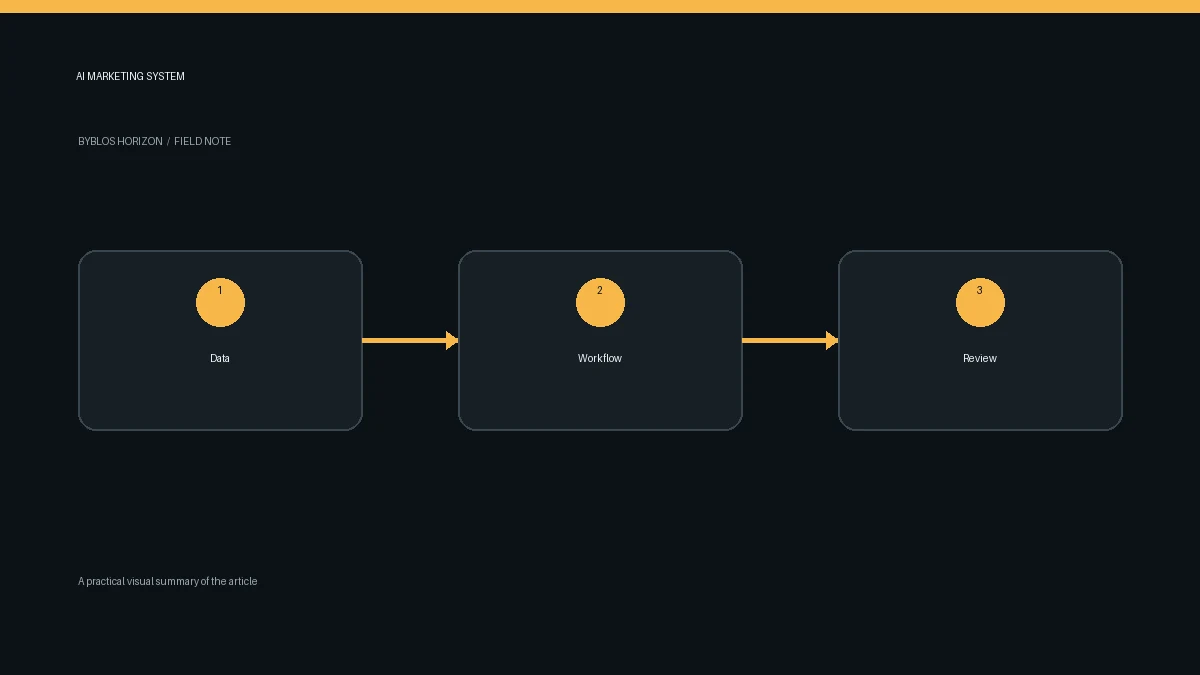
Turn isolated AI tasks into a controlled operating workflow:
- design repeatable automation around real tasks.
- add editorial controls to content production.
- connect AI workflows to the marketing programme.
Sources
- NIST publishes a framework for managing risks in the design, development and use of AI systems. NIST AI Risk Management Framework.
- Google documents how important customer actions can be measured as conversions. Google Analytics conversion documentation.
- W3C publishes standards for reviewing accessible digital output. W3C accessibility standards.