E-Commerce & Shopify
The Real Cost of Running an E-Commerce Business in Lebanon in 2026
The Real Cost of Running an E-Commerce Business in Lebanon in 2026
Byblos HorizonMohamad Haidar
Founder of Byblos Horizon
Published April 3, 2026 · 8 min read · Updated September 17, 2026
Fuel in Lebanon is approaching $30 for 20 liters. If you run an e-commerce business here, that number should terrify you more than any competitor.
Here's the chain reaction most store owners only understand after it hits their P&L: fuel prices rise, delivery companies immediately raise their fees, and even a "small" $0.25 increase per order becomes dangerous at scale. At 1,000 orders a month, that's $250 of pure margin gone. At 5,000 orders, it's $1,250 every month, forever, with zero corresponding increase in customer willingness to pay.
I've spent years scaling e-commerce operations in Lebanon and internationally, managing over $20M in ad and influencer spend across my career along the way. And I can tell you the businesses that die here don't die from bad products. They die from unit economics they never actually calculated. The same pressure shows up outside e-commerce too, which is why a latte in Beirut can cost more than one in Manhattan.
So let's calculate them.
Use the free Lebanon e-commerce cost calculator to test your own shipment, delivery, refusal and advertising assumptions. If you advertise on Google, see how USD and LBP pricing affects Google Shopping in Lebanon.
The Lebanese e-commerce cost stack
Selling online in Lebanon means operating a cost structure that most global e-commerce playbooks simply don't account for. Here's the full stack:
Delivery, the moving target. Delivery is your single most volatile cost. It's repriced by fuel, which is repriced by global markets and local supply. When your delivery partner raises rates, you face an impossible choice: absorb the cost (margin destruction), pass it to customers (conversion destruction), or raise free-shipping thresholds (average order value pressure). Most founders absorb it silently and wonder why profitable months became break-even. The wider picture is in why bad logistics is a hidden tax on commerce in Lebanon and MENA.
Payment collection. Cash on delivery still dominates Lebanese e-commerce, and COD is expensive in ways that never show up on a single invoice: higher return rates, failed deliveries you still pay for, cash reconciliation overhead, and delivery partners holding your revenue for days or weeks. Every COD order carries a hidden risk premium most founders never price in.
Electricity and connectivity. Your operation runs on generator subscriptions and redundant internet. It sounds trivial until you add up what keeping a warehouse, an office, and a packing station powered actually costs per month.
Import and inventory risk. If you import inventory, you're managing customs unpredictability, freight costs, and capital locked in stock, in a market where demand can shift with every economic or political tremor. Inventory depth that's "efficient" in Dubai is reckless in Beirut. And if US to Lebanon flight restrictions lifting eventually adds direct cargo capacity, the freight side of this equation could shift too, as I break down in what direct Lebanon-US flights would mean for e-commerce cargo.
Advertising in dollars, selling to a stretched consumer. Meta and Google charge you in fresh dollars. Your customer's purchasing power, meanwhile, has been through years of compression. Your CAC is global; your AOV is local. That squeeze defines everything.
The math that decides survival
Let me give you the framework I use with every store we work with. For each product, calculate the true contribution margin per order:
Selling price, minus product cost, minus real delivery cost (including your share of failed deliveries and returns), minus payment/COD costs, minus packaging, minus allocated ad spend (CAC), minus a volatility buffer of at least 5% for the costs that will rise mid-quarter, because in Lebanon, they will. Every one of those inputs, with its source, is set out in the calculator methodology.
If that number isn't meaningfully positive, you don't have a business; you have a subsidized hobby. And if it's positive only at your current delivery rate, you have a business with an expiry date.
Three numbers matter more than everything else:
Average order value (AOV). Delivery costs are per-order, not per-item. The single most effective defense against rising delivery fees is getting more value into each box. Bundles, volume offers, thresholds, cross-sells at cart, every dollar of AOV is a dollar of delivery cost dilution.
Repeat purchase rate. Acquisition in dollars is brutal. The stores that survive here are the ones where the second, third, and fourth orders happen without new ad spend, via WhatsApp flows, SMS, retention offers. If your business model requires paying Meta for every single order, fuel prices are the least of your problems.
Failed delivery rate. In a COD market this is a silent killer. Every failed delivery costs you the outbound fee, the return fee, the repackaging, and the opportunity. Reducing failed deliveries by even 2 3 percentage points often does more for profit than a full point of conversion rate.
Strategies that actually protect margin
Renegotiate delivery like it's your biggest supplier, because it is. Most founders accept delivery rate cards as fixed. They're not. Volume commitments, zone-based pricing, hybrid fleets (own courier for dense areas, partner for the rest), and consolidated dispatch days can move your per-order cost meaningfully.
Engineer AOV, don't hope for it. Your product page and cart should be doing structured work: anchor bundles, "complete the set" logic, threshold messaging ("add $8 for free delivery"), post-purchase upsells. Most Lebanese stores have none of this, which is why they feel every delivery increase at full force.
Shift COD to prepaid, gradually. Fintech adoption in Lebanon has reached a point where prepaid incentives work: small discounts for online payment, prepaid-only express delivery, wallet cashback. Every order you move from COD to prepaid removes an entire risk category.
Price with a corridor, not a point. Set prices with a built-in buffer that anticipates the next two delivery increases, and use offers, not base price cuts, for promotions. Offers can be withdrawn; price cuts become anchors you can't walk back.
Diversify beyond the border. The strongest Lebanese e-commerce operations I know treat Lebanon as one market of several, serving the GCC and the diaspora, where purchasing power is higher and margins can subsidize local volatility. Cross-border complexity is real, but it's a solvable problem; a single-market margin squeeze is not.
The opportunity hiding in all this
Here's the counterintuitive part: this hostile environment is exactly why Lebanese e-commerce is worth doing. The difficulty is a moat. Operators who master unit economics here can operate anywhere, and most of your competitors haven't mastered anything. They're running stores on template math in a market that punishes template math.
While they absorb every cost increase silently until the business quietly dies, you can be the operator who calculates, engineers, and survives. In this market, survival itself is market share.
Frequently asked questions
How much does delivery cost for e-commerce in Lebanon?
Rates vary by zone, weight, and partner, but the defining feature is volatility: delivery fees in Lebanon are repriced whenever fuel rises. Any business plan should model delivery as a variable cost with a built-in escalation buffer, not a fixed line item.
Is cash on delivery still dominant in Lebanon?
Yes, COD remains the dominant payment method, but it carries hidden costs: failed deliveries, returns, cash handling, and delayed settlement. Growing fintech adoption makes gradual COD-to-prepaid migration one of the highest-impact margin improvements available.
What profit margin should an online store in Lebanon target?
After true delivery costs, COD risk, ad spend, and a volatility buffer, healthy operations target a contribution margin that stays positive even after the next delivery fee increase. If your margin only works at today's rates, it's already at risk.
How can I increase average order value on my store?
Bundles, volume discounts, free-delivery thresholds, cart cross-sells, and post-purchase upsells. AOV is the most direct defense against per-order cost inflation, more value per box means delivery costs are diluted across a larger basket.
Does Byblos Horizon help with e-commerce profitability, not just ads?
Yes. We audit full unit economics, delivery contracts, COD exposure, AOV engineering, retention flows, before scaling ad spend. Scaling an unprofitable order model just loses money faster. See our e-commerce services.
Running a store in Lebanon? We'll audit your unit economics before we ever talk about ads. Book a consultation or read about our Shopify & e-commerce growth services.
Glossary: e-commerce metrics used in this article
- AOV (Average Order Value)
- Total revenue divided by number of orders in a period. Higher AOV dilutes per-order delivery and COD costs.
- CAC (Customer Acquisition Cost)
- Total acquisition spend divided by new customers acquired in the same period. Compare against gross margin, not revenue.
- ROAS (Return on Ad Spend)
- Attributed revenue divided by ad spend, on a per-channel or campaign basis. Useful for creative testing, misleading as a business KPI in isolation.
- MER (Marketing Efficiency Ratio)
- Total revenue divided by total marketing spend across all channels. A blended, business-level truthkeeper that survives attribution loss.
- COD (Cash on Delivery)
- Payment collected in cash on delivery of the order. Common in Lebanon and MENA; adds courier collection fees, RTO risk and reconciliation overhead.
Practical next steps
Put the cost categories into a working model:
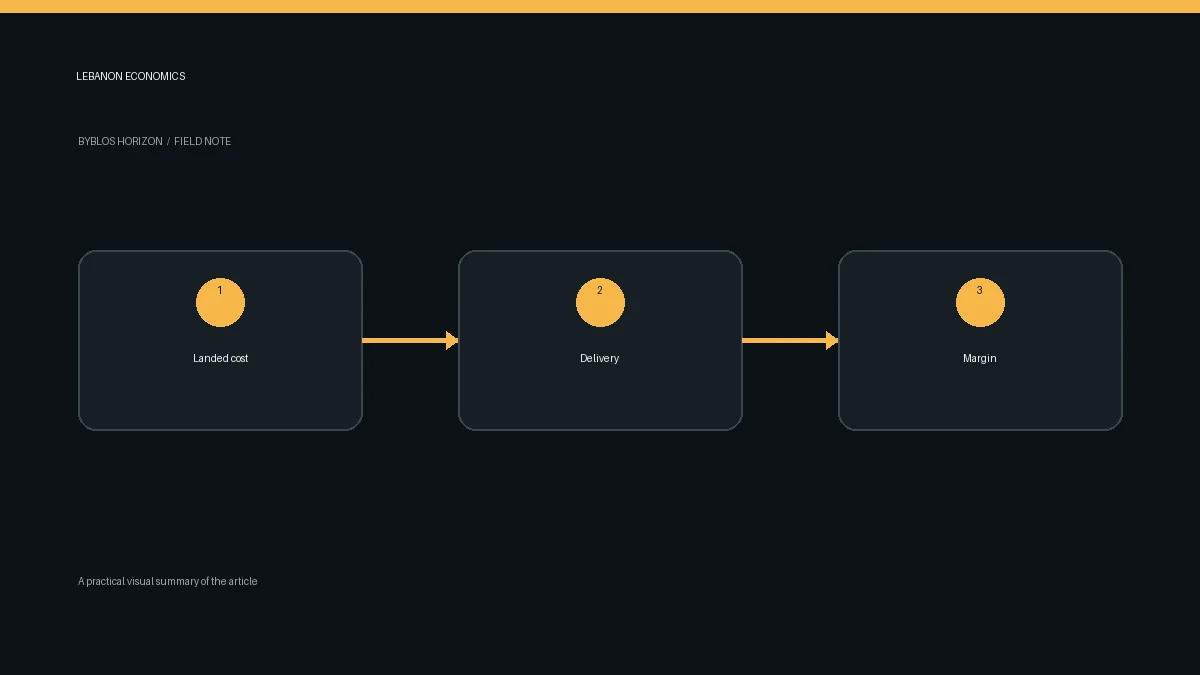
- calculate landed cost, cash need and contribution margin.
- connect store operations to unit economics.
- review e-commerce support in Lebanon.
Sources
- The World Bank publishes current economic context for Lebanon. World Bank Lebanon overview.
- Google documents how important customer actions can be measured as conversions. Google Analytics conversion documentation.
- Shopify publishes its current plan structure and included commerce features. Shopify pricing.
Related services
Related articles