MENA Market Insights
Why Lebanese Consumers Buy What Their Parents Bought, and What It Means for Your Brand
Why Lebanese Consumers Buy What Their Parents Bought, and What It Means for Your Brand
Byblos HorizonMohamad Haidar
Founder of Byblos Horizon
Published April 28, 2026 · 8 min read · Updated September 17, 2026
Walk through the coffee aisle at any Lebanese supermarket and you'll see something interesting: Starbucks and Dunkin' capsules sitting at $6.99 and $9.99 a box, right next to Lebanese coffee brands that cost a fraction of the price.
I'll tell you exactly what happens next. The Lebanese shopper looks at both, maybe picks up the Starbucks box out of curiosity, checks the price, puts it back, and grabs the same brand their family has been drinking for thirty years.
This isn't about money. It's about psychology. And if you're a brand trying to win shelf space, market share, or mindshare in Lebanon, understanding this psychology is the difference between a launch that sticks and a launch that quietly disappears.
In Lebanon, purchasing decisions are inherited before they're evaluated
Most marketing frameworks assume a rational customer journey: awareness, consideration, evaluation, purchase. In Lebanon, and across much of the MENA region, a huge portion of household purchases skip that funnel entirely.
We grow up watching our parents buy the same coffee, the same labneh, the same detergent. We see the same brands on the same supermarket shelves, pass the same billboards on the same highways, and absorb the same TV commercials at our grandparents' houses. By the time we're old enough to make our own purchasing decisions, the decision has already been made for us.
I call this inherited demand, and it's backed by four well-documented psychological principles.
Consumer socialization: your parents are your first marketers
Consumer socialization is the process by which children acquire the skills, knowledge, and attitudes needed to function as consumers, and the primary teacher is the family. In Lebanese households, where family structures are tight and multi-generational meals are the norm, this effect is amplified far beyond what you'd see in Western markets.
The brand of coffee served to guests isn't just a product choice. It's a signal of hospitality, of standards, of identity. Children absorb that signal for two decades before they ever compare prices.
The mere exposure effect: familiarity manufactures trust
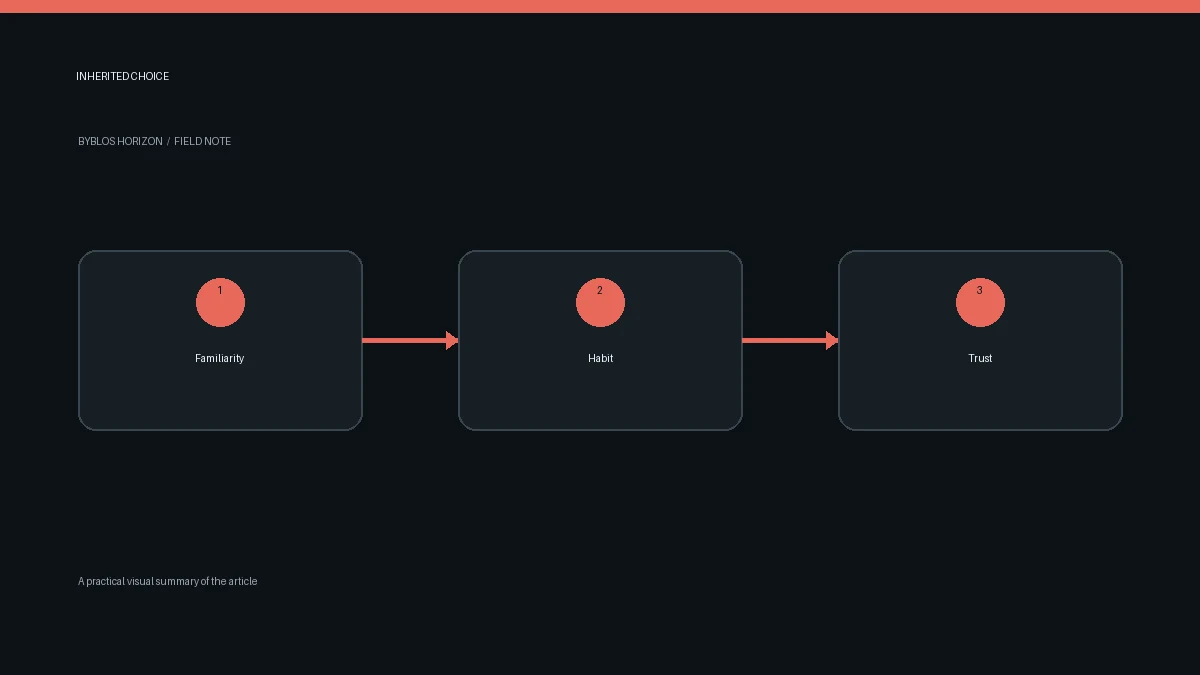
The mere exposure effect is one of the most replicated findings in psychology: the more frequently we encounter something, the more we like and trust it. Lebanese legacy brands have been accumulating exposure for fifty, sixty, seventy years: on shelves, on billboards and in homes.
A new entrant isn't starting from zero. It's starting from negative, because every exposure the incumbent earned is an exposure the challenger has to overcome.
Habit formation: the routine owns the product
Coffee in Lebanon isn't a beverage. It's a ritual, the morning cup, the after-lunch cup, the cup you make when guests arrive. Once a brand becomes embedded in a ritual, switching costs stop being financial and become emotional. You're not asking someone to change products; you're asking them to change a routine their household has run for decades.
Cognitive fluency: the brain prefers the easy choice
Our brains gravitate toward options that require less mental effort. A familiar brand is a pre-approved decision, no evaluation needed, no perceived risk. An unfamiliar brand, however good, demands cognitive work. On a routine grocery run, nobody wants to do cognitive work.
Why experience brands struggle on supermarket shelves
This brings us back to Starbucks and Dunkin'. Inside their cafés, these brands are powerful, but what they're selling isn't primarily coffee. It's the escape from the office, the atmosphere, the sound of the machines, the familiar experience. That's the product.
Put the same brand in a supermarket aisle and the entire value proposition collapses. There's no atmosphere on a shelf. There's no experience in a capsule box. Suddenly the brand is competing on completely different terrain: against household habits, against inherited loyalty, against local brands that already own the kitchen, and doing it at three times the price.
The lesson generalizes: a brand's strength in one channel does not transfer automatically to another. Your café brand equity, your Instagram following, your mall footfall, each lives in its own psychological context. Move channels and you have to rebuild the case for your brand from scratch.
What this means if you're a challenger brand in Lebanon
I'm not telling you the Lebanese market is closed to new brands. I'm telling you the front door is closed. Here's where the open doors are.
Target moments of routine disruption. Habits break when life changes, moving out, getting married, having a child, emigrating and returning. Marketing that reaches consumers at these transition points catches them while the inherited decision is temporarily unlocked.
Win the generation, not the household. Gen Z Lebanese consumers are the first generation whose brand exposure is dominated by social platforms rather than family shelves. They still inherit preferences, but the inheritance is weaker. A challenger brand that owns TikTok and Instagram in Lebanon today is planting the "family brand" of 2035.
Enter through occasions the incumbent doesn't own. Don't fight the legacy coffee brand for the morning ritual. Own the office coffee, the gym pre-workout, the late-night study session. Once you're in the house for one occasion, expansion is a much shorter journey.
Use experience to earn the shelf, not the other way around. If experience is your strength, build the experience first, pop-ups, cafés, sampling, events, and let retail follow the demand. Products that arrive on shelves without an experience behind them are just packaging next to a habit.
Respect the price anchor. Lebanese consumers post-crisis are hyper-aware of value. A premium price needs a premium story that survives the three seconds a shopper gives you in-aisle. If your story needs a paragraph, you've lost. It needs to work at a glance.
The billboard test
Here's a simple exercise I use when auditing brands in Lebanon. Stand in front of your product on a real shelf, next to its real competitors, and ask: what does a shopper who has never heard of us conclude in three seconds?
Not what your brand deck says. Not what your agency presented. What the shelf says.
Most challenger brands fail this test, not because the product is bad, but because everything about their presence was designed in a meeting room instead of an aisle. The incumbent, meanwhile, doesn't even need to communicate. It just needs to be recognized.
That's the real competitive landscape in Lebanon: recognition versus persuasion. Recognition wins by default. Persuasion has to be engineered.
Frequently asked questions
Why do global brands fail in the Lebanese market?
Most global brands underestimate inherited buying habits. Lebanese consumers form brand preferences through family exposure over decades, so a global brand entering retail competes against emotional routines, not just products. Brands that succeed usually enter through experiences or new consumption occasions rather than attacking established household categories head-on.
What is inherited demand?
Inherited demand describes purchasing decisions that are passed down within families rather than actively evaluated by the buyer. In Lebanon, categories like coffee, dairy, and staple foods are heavily inherited: consumers buy what their parents bought, driven by consumer socialization, familiarity, and habit.
How can a new brand build loyalty in Lebanon?
Focus on generational entry points (younger consumers whose habits aren't fixed), occasion-based positioning (owning moments incumbents ignore), experience-first launches, and consistency over discounts. Loyalty in Lebanon is built through repeated reliable exposure, not promotions.
Does consumer psychology differ between Lebanon and the GCC?
The principles are the same, but the weightings differ. GCC markets have younger populations, higher purchasing power, and faster brand turnover, so novelty plays a bigger role. In Lebanon, economic pressure and strong family structures make habit and value-for-money dominant factors.
How does Byblos Horizon use consumer psychology in campaigns?
We build strategies around how Lebanese and MENA consumers actually decide, mapping habit loops, exposure points, and switching moments before allocating a single dollar of ad spend. Psychology first, media second.
Want a brand strategy built on how your market actually behaves? Get in touch or explore our services for the Lebanese market.
Practical next steps
Connect consumer insight to distribution and relevant communication:
- review the wider Lebanon market context.
- test messages against meaningful customer actions.
- connect brand preference with distribution quality.
Sources
- The World Bank publishes current economic context for Lebanon. World Bank Lebanon overview.
- Google documents how important customer actions can be measured as conversions. Google Analytics conversion documentation.