MENA Market Insights
Speed Is the New Budget: Trend Marketing and Billboard Lessons from Lebanon
Speed Is the New Budget: Trend Marketing and Billboard Lessons from Lebanon
Byblos HorizonMohamad Haidar
Founder of Byblos Horizon
Published January 7, 2026 · 8 min read · Updated September 17, 2026
The most creative marketing execution I've seen this year didn't come from a record-breaking budget. It came from speed.
AXE took a viral meme, while it was still peaking, understood why people were engaging with it, and turned it into branded content almost instantly. No months of approvals. No committee sanding the idea down to nothing. Just cultural understanding and the organizational ability to act while the conversation was still happening.
That's what modern marketing looks like. And it exposes an uncomfortable truth for brands in Lebanon and across MENA: most of you are not losing to bigger budgets. You're losing to faster calendars.
The 24 48 hour window
Every viral moment has a lifespan, and it's shorter than your approval process. As a rule of thumb: if you move within 24 48 hours of a trend emerging, you can earn thousands of organic interactions. If you move in week two, you're the brand equivalent of explaining a joke.
This is a genuine opportunity for Lebanese brands specifically, for one simple reason: you don't need a million-dollar budget to benefit from trends. Trend-jacking is the great equalizer. The meme doesn't care about your media spend. It cares whether your response is fast, culturally fluent, and actually funny or insightful. A local brand with a sharp social team can out-earn a multinational's entire campaign with one well-timed post.
But speed without judgment is a liability. So let's build the system properly.
The trend-response playbook
Pre-authorize the lane. The reason brands miss trends is not creativity, it's approval. Solve it structurally: define in advance what's always safe (product humor, sports moments, pop culture), what needs one senior sign-off (anything touching public figures), and what's never touched (politics, religion, tragedy, non-negotiable red lines in our region). With lanes pre-agreed, the social team can move in hours, not weeks.
React to why it's viral, not what it is. The difference between AXE's execution and a thousand cringe brand memes: they understood why people were engaging, and built on the insight rather than just pasting a logo on the format. Before jumping on any trend, answer one question: what emotion is fueling this? If your brand can genuinely add to that emotion, go. If you're just wearing the meme as a costume, skip it.
Humanize, don't sell. Trend content that ends in a product pitch dies instantly. The entire value of the moment is showing your brand has a pulse, that real, culturally fluent humans work there. The sales impact is real but indirect: relevance today buys attention tomorrow.
Skip more than you take. A brand that hits two trends a month brilliantly beats a brand that hits ten awkwardly. Every awkward attempt costs credibility that the good ones then have to buy back.
The same lesson, in concrete: Lebanese billboards
Speed and cultural fluency don't just apply to memes, they're exactly what separates the billboards that work in Lebanon from the ones that die on the highway. I analyze outdoor constantly, and the patterns are remarkably consistent.
The ones that work are built on a real local insight. The best billboard I've stopped for recently was built on a truth every Lebanese person lives daily: generators, electricity pressure, dependence on mazout. Simple, direct, and rooted in shared experience. When the audience sees their own life in the ad, the ad does the work of a hundred impressions.
The ones that fail ask the viewer to decode. A billboard has a few seconds to work. I recently passed one built entirely around a frying sound "SHSHSH" in big letters. In a static format, at 80 km/h, the viewer has to decode the sound, understand the reference, and connect it to the brand. That's three steps too many. Clever that requires explanation is not clever; it's expensive confusion.
Product beats borrowed fame. One snack brand's earlier billboard leaned heavily on influencers, faces that had nothing to do with the product. Their newer iteration shifted focus back to the product itself: clarity, shelf recognition, brand ownership on the street. That's the right direction, and it's a general rule: outdoor is a recognition medium. Its job is to make you know the product when you meet it on the shelf, not to make you admire a celebrity.
The unifying principle across memes and billboards: respect the format's time budget. A meme gets one scroll-pause. A billboard gets three seconds. Ideas that need paragraphs belong in articles like this one, not on the highway.
Building a culturally fast organization
Here's the deeper point most brands miss: trend responsiveness isn't a social media tactic. It's an organizational capability, and it's built deliberately.
Staff for fluency, not just skills. The person running your social needs to genuinely live inside internet culture and Lebanese culture simultaneously, to know instinctively why the meme is funny and whether the joke lands in Arabic. This fluency can't be briefed in; hire for it.
Shorten the distance between noticing and publishing. Count the steps between "our team spots a trend" and "content is live." Every layer is a tax on relevance. Best-in-class is two steps: creator makes it, one owner approves it.
Watch the local conversation, not just global feeds. Lebanon generates its own viral moments weekly, economic absurdities, sports, cultural events. Local trends have less competition from global brands and land harder with your actual customers. A sports broadcaster jumping on a football meme within a day will always beat a global brand arriving on day five.
Debrief the misses. Every trend you saw but couldn't act on is diagnostic data: where did it stall? Approval? Fear? Creative capacity? Fix the bottleneck, not the individual miss.
The budget reframe
None of this means performance marketing and paid media stop mattering, they're still the engine of predictable growth, and I spend most of my professional life there. But the marginal return on speed is currently the highest in the industry, precisely because most organizations can't move fast. Slow is the norm. That's the arbitrage.
Culture moves at internet speed. Budgets move at committee speed. The brands winning attention in Lebanon and MENA right now are simply the ones that closed that gap.
Frequently asked questions
What is trend-jacking and does it work for small brands?
Trend-jacking means creating branded content that rides an existing viral moment. It works especially well for small brands because the currency is speed and cultural fluency, not budget, a sharp local brand can out-engage multinationals whose approval chains take weeks.
How fast should a brand respond to a trend?
Within 24 48 hours of the trend emerging. After that window, engagement drops sharply and the brand risks looking late rather than relevant. This requires pre-authorized content lanes so the social team isn't waiting on approvals.
What makes a billboard effective in Lebanon?
A single message decodable in under three seconds, built on a genuinely local insight, with strong product and brand visibility. The most common failures: concepts that require decoding, influencer faces disconnected from the product, and cleverness that doesn't survive highway speed.
Are there trends brands should never touch?
Yes, politics, religion, and tragedy are non-negotiable red lines, especially in the MENA region. A trend-response system should define these exclusions in advance so speed never overrides judgment.
Does Byblos Horizon help brands with real-time and cultural marketing?
Yes, we build trend-response systems (content lanes, approval design, cultural monitoring) alongside our performance marketing work, so brands capture organic cultural moments while paid channels drive predictable growth. Book a consultation.
Want your brand to move at culture speed? Talk to us we'll audit how many steps stand between your team and the moment.
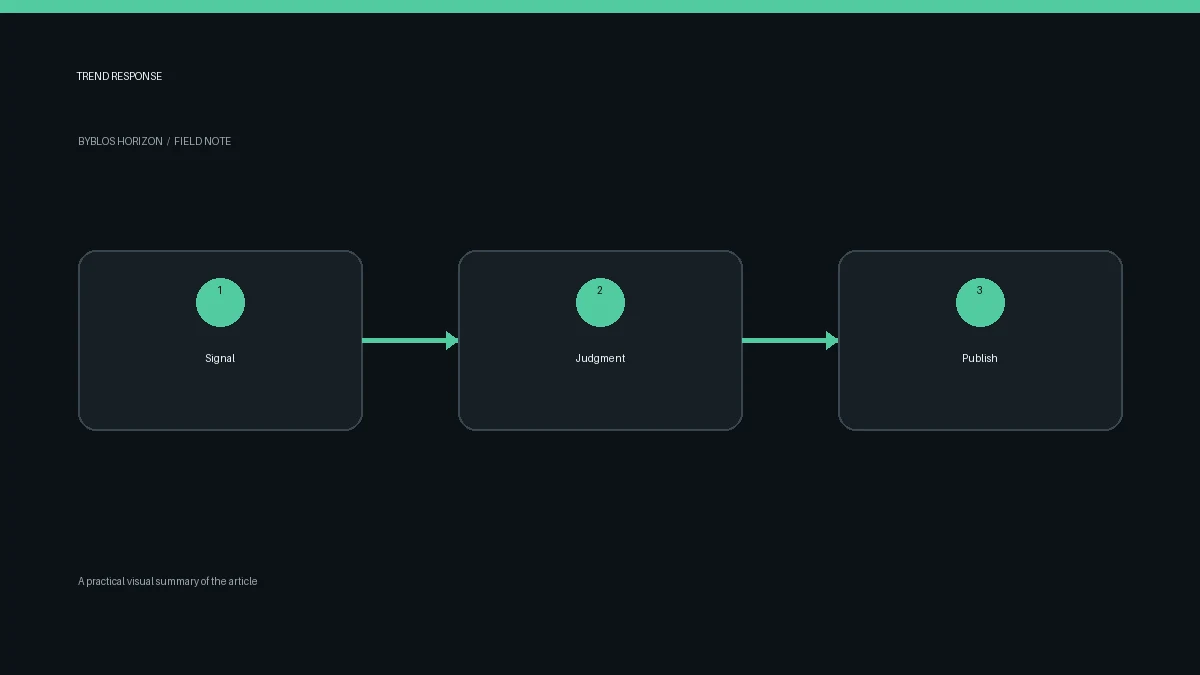
Practical next steps
Create a faster response without removing editorial control:
- build a controlled content production workflow.
- measure timely creative against commercial actions.
- check whether attention is commercially relevant.
Sources
- Google Trends provides a public view of changing search interest over time. Google Trends.
- Google documents how important customer actions can be measured as conversions. Google Analytics conversion documentation.
Related services
Related articles