 Byblos Horizon
MENA Market Insights
Can Marketing Outrun the Economy? Why Lebanon Needs to Rethink Where It Invests
An examination of Lebanon's investment culture, the limits of marketing, the economics of physical businesses, and why cross-border e-commerce could offer Lebanese entrepreneurs a more resilient path to growth.
- Marketing can move demand between businesses. It cannot create purchasing power that is not in the room.
- A physical venue in Beirut carries its costs in dollars and earns in a currency its customers no longer hold in the same quantity.
- Selling across borders is the one lever that lets a founder choose which economy they depend on.
Mohamad Haidar
Founder of Byblos Horizon
Published October 19, 2026 · 24 min read
ContentsShowHide
- 01Marketing cannot manufacture purchasing power
- 02More openings do not mean more opportunity
- 03When a good location becomes a liability
- 04How e-commerce changes the equation
- 05How large the opportunity really is
- 06The business model underneath it
- 07Why this is not an automatic solution
- 08Where capital should actually go
- 09Build locally, sell internationally
- 10The question to ask before the next investment
Executive summary
A business can execute well while the economy underneath it deteriorates. The useful question for Lebanese founders is not whether marketing can defeat economics, because it cannot, but whether a business can be designed to depend less on the performance of one country.
- 01Marketing shapes how well you capture demand. It cannot create purchasing power that households do not have.
- 02New openings are not evidence of a growing market. Entrants can redistribute the same spending rather than add to it.
- 03Concentrating capital in one location means betting on your own execution and on that neighbourhood's future at the same time.
- 04Cross-border e-commerce separates where a business is built from where its customers' money comes from.
- 05It is not an escape. Payment access, fulfilment and concentration risk all still apply, and in Lebanon they bite hard.
Walk through Beirut or Mount Lebanon and you'll find entrepreneurs still investing in new restaurants, cafés, retail stores, lifestyle concepts and commercial property. Some of these will succeed. Others will struggle. Some will close despite having a good product, an experienced operator and genuinely impressive marketing.
The more useful question isn't whether Lebanon needs another restaurant. It's whether founders are examining the economic conditions around an investment with the same seriousness they give to branding, location, interior design and customer experience.
What is excellent marketing worth if the economy around the business can't sustainably support its commercial ambitions?
For years founders have been told that a superior product, differentiation, effective advertising and customer experience are the fundamentals of success. They're. They're not sufficient. A business operates inside an economy, and that economy sets the purchasing power of its customers, the cost of capital, the availability of financing, the resilience of its supply chain and the predictability of future demand.
40%
Cumulative real GDP contraction, 2019 to 2024
World Bank, approaching 40 percent
4.2%
Estimated real GDP growth in 2025
A modest recovery, since interrupted
6.4%
Forecast contraction for 2026
World Bank, August 2026 projection
44%
Monetary poverty, 2022, five governorates
Against 12 percent in 2012
These figures measure different periods and different things. They shouldn't be added together, and the 2022 poverty figure isn't a nationwide 2026 rate.
Taken together they describe a particular investment problem: a business can execute its strategy competently while the economic environment supporting that strategy falls away underneath it. That should change how founders price risk. It should also change how we talk about marketing.
01
Marketing can generate demand. It cannot manufacture purchasing power.
Marketing is unusually good at influencing behaviour. It builds recognition, establishes trust, communicates value, lifts conversion and encourages repeat purchase. Its power has an economic ceiling.
Take a premium product at $300. The product is excellent, the advertising is compelling, the positioning is right, and consumers respond warmly to the campaign. A substantial share of that audience still can't comfortably afford it. The marketing team may post outstanding engagement and awareness, and those numbers may never become economically sustainable sales.
Lebanon's household data makes that distinction concrete. A 2024 World Bank poverty assessment reported monetary poverty reaching 44 percent in 2022 across five surveyed governorates, against 12 percent in 2012, with households cutting spending on food, non-food items and healthcare as they adjusted to the crisis. That is not an updated nationwide 2026 figure, but it is substantial evidence of weakened household purchasing power.
A population under pressure on essential spending can't necessarily sustain the consumption patterns a premium business assumes. No creative director, performance marketer or branding agency can resolve that on their own. An excellent campaign can't reliably persuade customers to spend money they don't have.
Businesses can adapt, of course, through price points, product ranges, financing, segments and positioning. Those adjustments demonstrate the weight of economics rather than an escape from it. Marketing improves how well a business captures demand. Economic conditions decide how much viable demand is there to capture.
02
Lebanon's investment paradox: more openings do not mean more opportunity
There's a difference between business creation and economic value creation. A new restaurant is an investment. A new café may create jobs. A new retail concept stimulates activity. None of that establishes that the market has enough demand to support them.
Lebanon has run this experiment before. BLOMINVEST research into the Lebanese restaurant industry across 2014 and 2015 found a revealing pattern: new establishments kept opening while sector performance deteriorated. The number of restaurants in Beirut rose by roughly 3.47 percent in 2015, even as real output and activity per outlet came under pressure.
More founders were competing for a market that wasn't expanding enough to support them. New businesses in that situation don't create much new demand. They compete to redistribute spending that was already happening.
This is why the visibility of new openings is an unreliable signal of economic health. A full restaurant can be unprofitable. A busy retail store can be cash flow negative. A business with an enviable social media presence can struggle to cover fixed costs.
None of which means Lebanon's physical businesses are unviable. It means performance has to be judged on revenue, margin, cash flow and durable demand rather than on popularity or on how many places opened this year. The question worth asking shifts from which concept is trending to which economic opportunity that concept is actually capturing.
03
The location trap: when a good investment becomes a geographic liability
Location is treated as one of the decisive factors in retail and hospitality, and it is. A strong location generates footfall, improves visibility and supports premium pricing. It also creates exposure.
A founder opening a physical business has to rent or buy. Renting gives flexibility but brings recurring obligations, renewal risk and rent increases. Buying creates an asset but ties up capital, exposes you to the property market and makes relocation harder.
The distinction people miss is that property ownership and business profitability are different things. You can own a valuable building and run an unprofitable restaurant inside it. Equally, rent isn't wasted money: it buys access to a location while preserving capital you could deploy elsewhere. The real question is which arrangement produces the better risk-adjusted return.
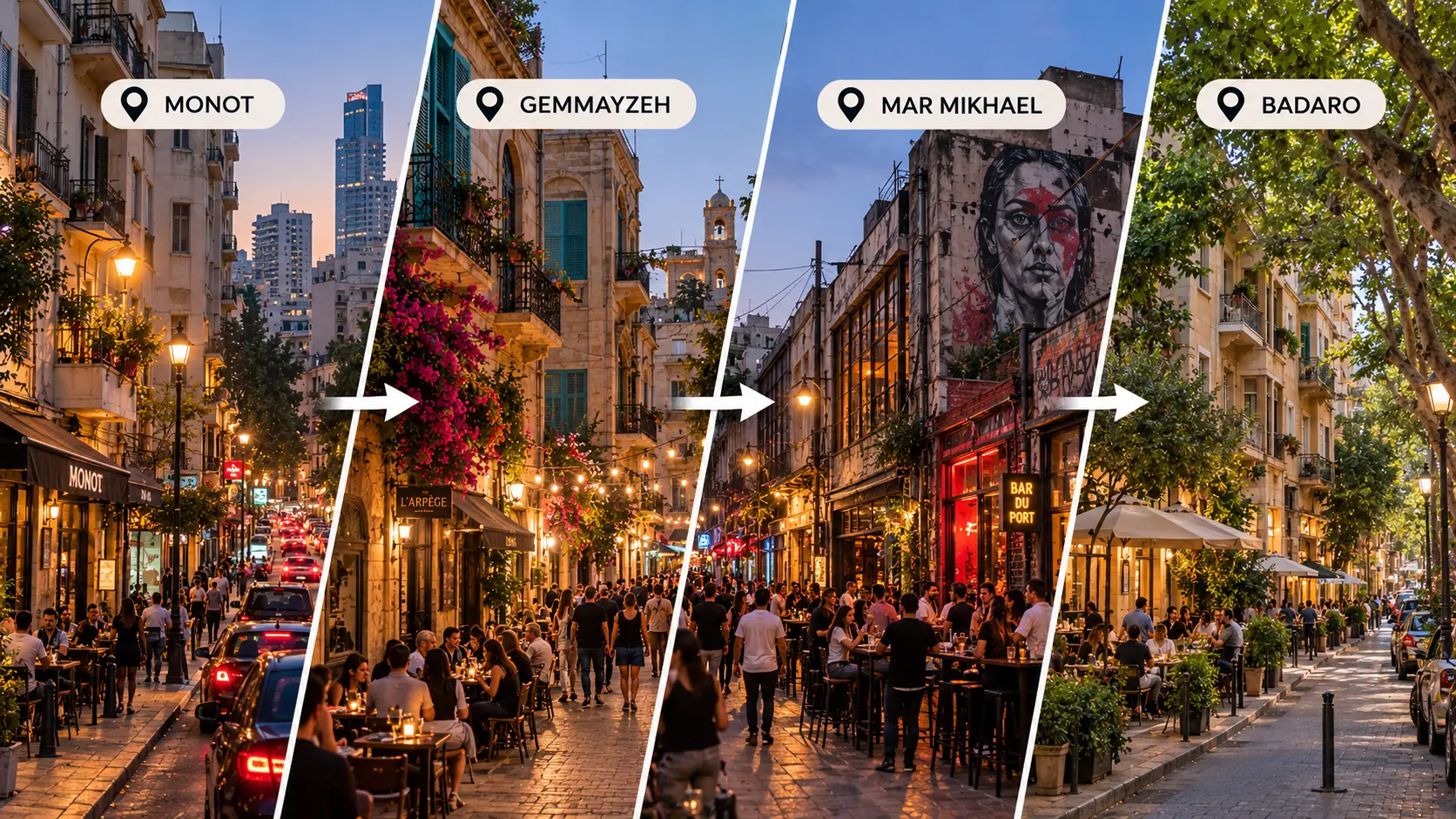
Beirut offers a useful history here. BLOMINVEST's November 2014 research documented restaurant and nightlife activity moving across the city, through a sequence that included Monot, Gemmayzeh, Mar Mikhael and Badaro. The shifts came over roughly three to five year periods. Rents, accessibility, parking and changing preferences all played a part.
01Monot
An earlier concentration of Beirut nightlife and hospitality investment.
02Gemmayzeh
Developed into a prominent destination for dining, entertainment and social activity.
03Mar Mikhael
Emerged as another major hospitality destination as commercial activity evolved.
04Badaro
Part of the subsequent expansion and diversification of the city's hospitality scene.
Historical shifts documented in BLOMINVEST research. These are illustrative neighbourhoods, not a ranking of current 2026 footfall.
This doesn't establish that every location fades after five years, or that no Beirut neighbourhood has held its footfall for decades. There's not enough consistent neighbourhood-level data to support that. What it does show is that commercial prominence can move substantially, even inside a compact city.
A business that invests heavily in one neighbourhood is making two bets at once: one on its own operating performance, and one on the long-term commercial appeal of that location. The second is largely outside the founder's control.
Figure
Two founders, $500,000 each, different exposure
| Buy the property | Keep the capital | |
|---|---|---|
| What the money does | Acquires a commercial property | Funds an operating venture, working capital or several market tests |
| Potential benefit | Ownership, appreciation, rental income, no third-party rent | Diversification, geographic expansion, less dependence on one site |
| Main exposure | Property market, single location, illiquidity | Execution risk, customer acquisition, no asset to fall back on |
| Cost of changing course | High. The asset has to be sold or let | Lower. Capital can be redeployed |
The right decision depends on future cash flows, not on the emotional appeal of ownership. For a physical business that means judging not only how desirable a location is today, but how the investment behaves if demand falls, the neighbourhood changes or the business needs to move. When capital is concentrated in one physical asset, changing strategy is expensive.
04
Why e-commerce changes the economic equation
A physical business mostly depends on demand inside a limited catchment. It can attract tourists, destination customers and online orders, but its economics are still shaped by where it sits.
E-commerce separates the location of a business from the location of its customers. A Lebanese founder can develop a product locally, build an online storefront, advertise to a specific segment internationally, and fulfil orders into markets where purchasing power and demand may be stronger.
Return to that $300 product. If the local addressable market is too small, the founder can investigate demand in Riyadh, Dubai, Paris, London or New York. The question stops being whether Lebanese consumers can afford it and becomes where it's most commercially viable.
That changes the investment model. A traditional business usually has to expand physically to reach another market. An online business can test international demand before committing to a storefront or a warehouse. Budget can be moved between markets, messaging adapted, and performance watched before larger spending is authorised.
05
How large is the opportunity, actually?
The global opportunity is substantial, and it should be read carefully. Broad estimates vary depending on whether researchers include consumer retail, business-to-business transactions, services or other electronic commerce.
UNCTAD reported that businesses across 43 economies generated close to $25 trillion in e-commerce sales in 2021. Much of that measure is business-to-business activity, so it shouldn't be mistaken for the addressable consumer retail market. More narrowly, U.S. Census Bureau data available through the St. Louis Fed shows e-commerce accounting for 16.4 percent of U.S. retail sales in the second quarter of 2026 on a non-seasonally adjusted basis.
Those two numbers together show both the maturity of online commerce and the continuing weight of physical retail. Online is no longer a niche channel. It's an established part of global commerce, supported by consumer familiarity, sophisticated advertising systems, international marketplaces and increasingly specialised logistics.
The size of the market isn't the revenue of any individual business. A $300 product doesn't succeed because billions of people have internet access. You still need a viable audience, a differentiated offer and profitable customer acquisition. Scale creates opportunity. It doesn't hand out market share.
For a Lebanese founder the most compelling thing about that scale is not the prospect of becoming a global corporation. It's the possibility of building a financially meaningful business without depending entirely on the spending capacity of the domestic market.
06
The real business model: acquisition, margin and retention
Launching an online store is easy. Building a profitable international one isn't.
A common error is assuming an international customer paying $300 is automatically worth more than a domestic customer paying the same. International fulfilment introduces costs that are lower or absent at home: shipping, duties, returns, payment processing, cross-border tax, localisation, and more expensive competition for advertising impressions. What matters is contribution margin, not revenue.
Illustrative model
Move the assumptions and watch what happens to the money you actually keep. The selling price is the number founders talk about. Contribution is the number that pays the rent.
- Selling price
- $300
- Product cost
- -$90
- Shipping
- -$40
- Customer acquisition
- -$45
- Payment fees, 4 percent
- -$12
- Returns allowance, 5 percent
- -$15
- Contribution per order
- $98
Monthly contribution
$34,300
Before fixed overhead, salaries, storage, duties, financing and capital investment. This is contribution, not net profit. Product cost is held at $90 so the other levers stay legible. Every percentage here's an assumption for illustration, not a measured industry benchmark.
The lesson the model makes visible is that access to wealthier markets doesn't guarantee profitability. A product that sells well in Dubai can still lose money if acquisition, delivery and returns consume the margin. Push customer acquisition cost up and shipping with it, and a healthy looking $300 order stops paying for itself.
This is where marketing performance has to be connected to financial performance. Impressions, click-through rate and return on ad spend are useful and insufficient. The numbers that decide whether the business survives are contribution margin, customer acquisition cost, lifetime value, repeat purchase rate and cash conversion.
Acquisition is usually the most expensive part of launching internationally. A business that must keep buying first-time buyers will struggle for margin even while revenue grows. A business that earns repeat purchases spreads that original cost across several transactions. Research associated with Frederick Reichheld and Bain, discussed in Harvard Business Review, has historically linked better retention to significant profit gains, including a frequently quoted range of 25 to 95 percent from a five point increase in retention. That's a historical, context-dependent finding, not a forecast for your store.
The practical implication is simple enough. Judge international expansion by the long-term economic value of the customers you acquire, not by how many you can acquire. Where a product has little natural repeat purchase, the same principle applies through referral, product extensions and accessories.
07
Why international e-commerce is not an automatic solution for Lebanon
An argument for e-commerce loses its credibility if it ignores the operational reality. Geographic flexibility doesn't mean every Lebanese founder can launch a functioning international business tomorrow.
Payments are the most immediate obstacle. Lebanon is not among the countries on Shopify's published list of jurisdictions supported by Shopify Payments, so merchants have to find compatible third-party processors. Beyond that sit lawful business registration, banking, customs, import rules, consumer protection and payment settlement in the destination market.
Product characteristics decide a lot. Small, light, differentiated products with healthy margins suit cross-border direct shipping. Bulky, fragile, perishable, low-margin or heavily regulated products meet far greater obstacles, and may need inventory inside the destination market rather than shipping from Lebanon.
In practice that can mean third-party logistics partners, stock held in more than one jurisdiction, diversified suppliers, or properly structured operations in target markets. The strongest version of this strategy doesn't swap one geographic dependency for another. It reduces concentrated risk wherever it finds it.
08
Where should Lebanese entrepreneurs be allocating capital?
The question isn't whether founders should abandon restaurants, property or physical stores. Lebanon needs productive investment in all of them. Successful physical businesses create employment, support domestic suppliers, hold communities together and contribute to recovery. A profitable restaurant is a better investment than an unprofitable online store. A well-located property producing dependable rent will beat a badly executed international retail business.
The objective isn't to rank industries. It's to improve the quality of capital allocation decisions. In a volatile economy, a few characteristics deserve more weight than they usually get.
Figure
What to weigh when the economy is unpredictable
| Investment characteristic | Why it matters |
|---|---|
| Geographic demand diversification | Reduces dependence on one consumer economy |
| Low irreversible startup costs | Limits the loss if an experiment fails |
| Strong contribution margins | Creates room for acquisition and operating costs |
| Operational flexibility | Enables faster adaptation when conditions change |
| Export or international revenue | Expands the reachable market beyond local demand |
| Retention and repeat revenue | Improves the predictability of future cash flows |
| Resilient fulfilment and payments | Reduces vulnerability to local disruption |
The case for e-commerce is strongest when these work together. A founder can validate demand before committing to inventory, test several segments, establish reliable fulfilment, and scale capital against actual performance. That sequence imposes a discipline that concept-driven investments often lack. Instead of committing a large sum upfront to a location whose future appeal is uncertain, capital goes in progressively as evidence arrives. That flexibility has financial value: it lowers the cost of being wrong.
09
A better model: build locally, sell internationally
Lebanon has real advantages for internationally oriented businesses: entrepreneurial experience, multilingual talent, creative capability, established diaspora relationships and familiarity with regional consumer cultures. None of that automatically produces a competitive product. It's a reasonable starting point.
The opportunity is to build businesses that use Lebanon as a base for creating value without requiring Lebanon to be the only source of revenue. For a founder building a premium consumer brand, that suggests a phased approach rather than an immediate physical store.
01Validate the product and its economics
Establish fit, realistic pricing, production costs and defensible differentiation before large commitments.
02Research purchasing power and demand
Evaluate specific segments in selected markets rather than assuming every wealthy country suits you.
03Test with controlled experiments
Run localised campaigns, measure acquisition cost, study conversion, collect real purchasing data.
04Build the operational infrastructure
Compliant payment acceptance, shipping, customs, inventory, returns and customer service.
05Scale on contribution and lifetime value
Increase investment only when the numbers show you can acquire and serve customers profitably.
06Diversify markets and operations
Reduce reliance on one economy, one supplier, one warehouse, one advertising channel.
This doesn't eliminate failure. It lets a founder test assumptions before committing large amounts of capital, and potentially grow beyond the limits of the domestic market.
There's a broader implication too. Lebanon can't build a sustainable economy out of businesses competing for the same pool of domestic spending. Export-oriented businesses, digital or physical, earn revenue from outside and bring demand into the Lebanese productive economy. A successful international store can create work for Lebanese manufacturers, designers, packaging suppliers, developers, marketers, customer service teams and logistics providers. That's a different proposition from moving local spending between competing establishments.
None of this is a substitute for macroeconomic stability, institutional reform, functioning banking or a reliable commercial environment. Those remain essential. Digital entrepreneurship can make individual businesses more resilient. It can't repair a national economy on its own.
10
The question to ask before the next investment
A business has to understand the external conditions its success depends on. For a physical business that means the stability of the surrounding market, the durability of local demand, the economics of its location and the consequences of tying capital to a fixed asset. For an online business it means international competitiveness, acquisition cost, payment access, margin, retention and operational resilience.
The distinction isn't that physical businesses are bad investments and online ones are good. It's that some models give you considerably more room to move when conditions change, and in Lebanon that flexibility should be treated as part of the return.
The country has been through years of deterioration, an interrupted recovery and repeated disruption to commercial activity. Against that background, founders should be careful about concentrating capital in investments that depend on the uninterrupted performance of one market. The ambition shouldn't be to open more businesses. It should be to build more businesses capable of surviving, adapting and growing when their environment changes.
Marketing can't outrun the economy. It never could. The more useful question is whether a founder can design a business that's less dependent on the economic performance of any one country. Cross-border e-commerce is one of the clearest ways to pursue that, not because it guarantees success, but because confining commercial ambition to a small and economically vulnerable domestic market places an unnecessary ceiling on what some Lebanese businesses could achieve.
The next generation of Lebanese founders shouldn't only ask what business they want to open. They should ask which economies they want that business to serve.
The operator checklist
What the winners will actually do
- Separate interest from effective demand before you price anything.
- Judge a market on revenue, margin and cash flow, never on how many places opened this year.
- Price the cost of being wrong: how much capital is locked up if you have to change course.
- Treat location as two bets, your execution and the neighbourhood's future.
- Model contribution per order before you model revenue.
- Fix retention before scaling acquisition, because acquisition is the expensive half.
- Check payment access and fulfilment before promising international delivery.
- Diversify where demand comes from and where orders are filled, not just one of the two.
If you are weighing a physical investment against building something that sells across borders, the Lebanon e-commerce cost calculator works through the unit economics with your own numbers, and the e-commerce growth and Shopify for MENA pages set out how we would approach it.
Sources and research notes
- [01]World Bank, Lebanon Economic Monitor, August 2026https://www.worldbank.org/en/country/lebanon/publication/lebanon-economic-monitor
- [02]World Bank, Lebanon Poverty and Equity Assessment, 2024https://www.worldbank.org/en/country/lebanon/publication/lebanon-poverty-and-equity-assessment-2024
- [03]BLOMINVEST, Uncovering the Lebanese Restaurant Industryhttps://blog.blominvestbank.com/
- [04]U.S. Census Bureau retail e-commerce statistics, via FREDhttps://fred.stlouisfed.org/series/ECOMPCTNSA
- [05]UNCTAD, business e-commerce sales and the role of online platformshttps://unctad.org/publication/business-e-commerce-sales-and-role-online-platforms
- [06]Shopify, supported countries for Shopify Paymentshttps://help.shopify.com/en/manual/payments/shopify-payments/supported-countries
- [07]Harvard Business Review, the value of keeping the right customershttps://hbr.org/2014/10/the-value-of-keeping-the-right-customers
Methodological note. Figures measure different periods and different populations. Where a source is historical it is described as historical rather than presented as current.
Methodology and what this article doesn't claim
This analysis draws on World Bank economic and household data, U.S. Census Bureau retail statistics, UNCTAD e-commerce research, historical BLOMINVEST sector analysis and payment platform documentation. Three limits are worth stating plainly.
The 2014 BLOMINVEST analysis evidences historical change in Beirut's commercial geography. It does not establish 2026 footfall patterns or prove that no location can hold its appeal for thirty years.
National GDP and household poverty figures establish context. They're not a substitute for sector-specific market research, and this article doesn't claim to have measured the total value of Lebanese investment flowing into food and beverage against e-commerce, because no sufficiently comparable dataset was established.
The profitability model is a sensitivity analysis built on hypothetical assumptions. It's not a forecast of returns.