LOGISTICS • INFRASTRUCTURE • E-COMMERCE • MENA
The Hidden Logistics Tax:
What Lebanon and MENA Really Pay to Move Goods
Mohamad Haidar
Founder & CEO, Byblos Horizon
33 min read
A train ride that turned into a cost question
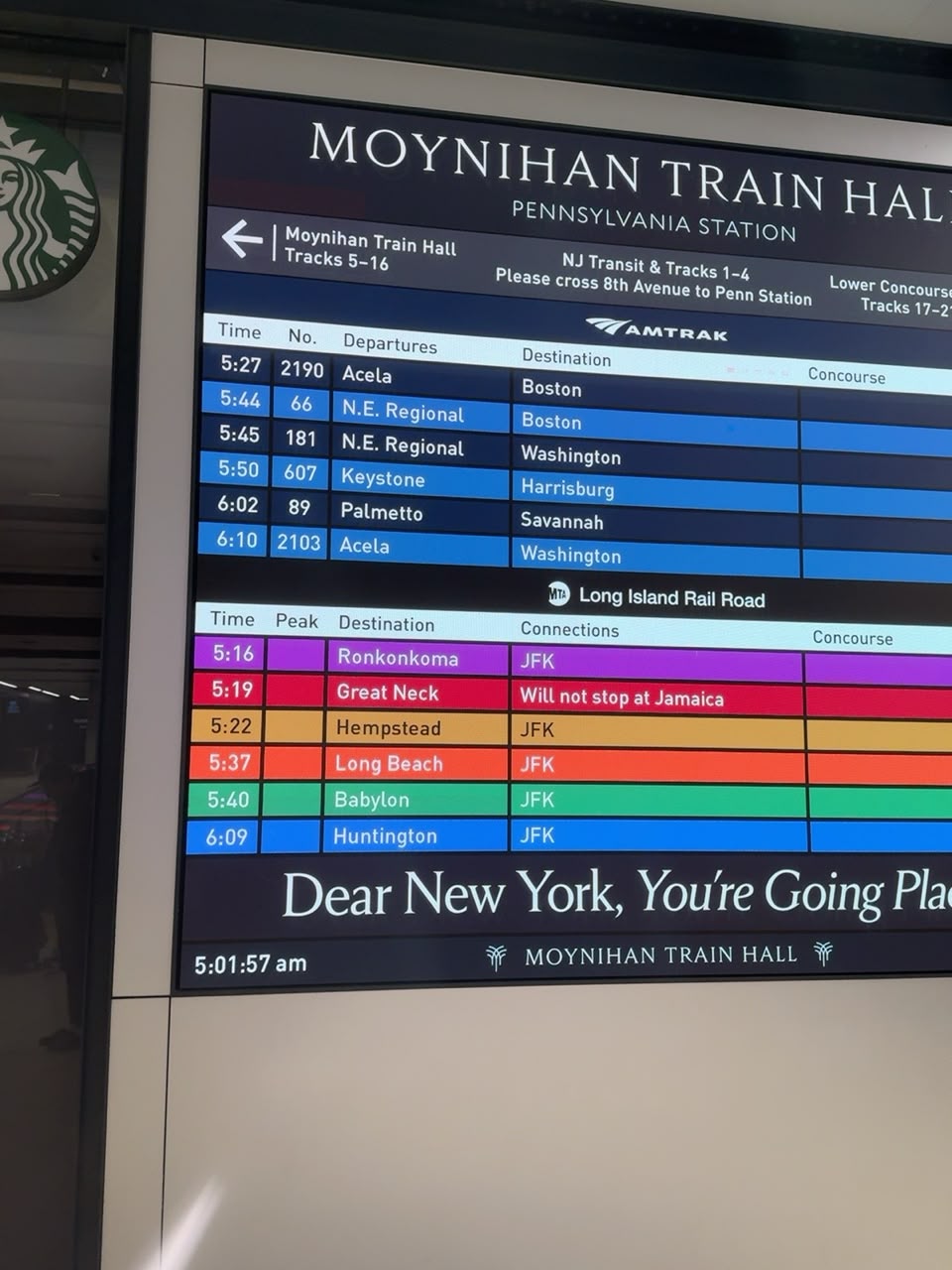
At 5:50 in the morning I was standing inside Moynihan Train Hall in New York, waiting for a train to Lancaster, Pennsylvania. The journey is roughly 250 kilometres. For comparison, Tripoli to Tyre is around 160 kilometres by road.
I boarded, sat down, opened my laptop and worked. A few hours later, I arrived.
Nothing about the journey was remarkable. That is exactly what made it remarkable to me. I had just travelled considerably farther than one of Lebanon's main north to south coastal journeys, while sitting at a desk and working.
Because I spend my working life with retail, e-commerce and logistics businesses, my mind did not stay on the train. It went to delivery vans sitting in Beirut traffic. Trucks crawling out of the port. Drivers losing hours every day. Fuel burning while vehicles barely move. Brakes, tyres and engines wearing out faster than the odometer suggests. Companies buying a third van because the two they own cannot finish enough drops in a day. Warehouses holding extra stock because nobody can predict when the next shipment lands.
Somewhere between New York and Lancaster the subject stopped being transport and became economics.
Route comparison
Distance, status and the cost of movement
≈250 km · operational passenger rail
- SOLID = OPERATIONAL
- DASHED = TENDER / DESIGN / CONSTRUCTION
- DOTTED = CONCEPTUAL REGIONAL CONNECTIVITY
New York to Lancaster carries passengers today. Tripoli to Tyre has no operating passenger railway. Tripoli to Abboudieh is at tender and design stage; links beyond it remain conceptual.
Congestion is not a traffic problem. It is a maths problem.
When we discuss the cost of doing business in Lebanon we talk about electricity, salaries, rent, fuel, tax, financing and currency risk. There is another cost sitting quietly inside almost every physical product sold in the country, and almost nobody puts it on a line item: inefficient movement.
For a person, congestion is frustration. For a company, congestion is arithmetic.
Take a delivery van that could complete ten drops in a shift. Because of congestion, poor routing and unpredictable travel times, it completes six. The business still pays for the vehicle, the driver's full shift, insurance, fuel, maintenance, warehouse handling, administration and financing. Nothing on the cost side went down. Output fell by 40 percent.
That is not a 40 percent problem. Cost per successful delivery rises by about 67 percent, because you are now dividing the same cost base across six drops instead of ten.
Run it with numbers. Say that van costs 180 US dollars a day to operate, all in: driver, fuel, insurance, maintenance reserve and a share of the depreciation. At ten drops, your last mile cost is 18 dollars per order. At six, it is 30. If your average order value is 60 dollars and your gross margin is 45 percent, you had 27 dollars of gross margin per order to work with. Last mile just went from two thirds of it to more than all of it.
That is the whole article in one paragraph. Nobody sent you an invoice for those four missing drops. You paid for them anyway.
And somebody absorbs it. Usually the business first, through compressed margin. Then the customer, through higher prices or higher delivery fees. Then the market, through fewer businesses that can afford to compete.
Delivery economics
The fixed cost base did not change
10 DROPS
$180
operating cost
$18 / successful delivery
6 DROPS
$180
operating cost
$30 / successful delivery
“Nobody sent you an invoice for those four missing drops. You paid for them anyway.”
What Lebanon's roads actually cost
This is not a feeling. It is documented. But the documentation needs dating honestly, because Lebanon's economy in 2026 is not the economy these studies measured.
On road condition, a 2025 World Bank assessment found roughly one third of the country's 6,500 kilometre main road network in moderate to poor condition and in urgent need of repair. An earlier and more granular World Bank appraisal, from 2017, put the main network at 15 percent good, 50 percent fair and 35 percent poor, out of a total network of about 21,705 kilometres.
The World Bank has also described Lebanon's infrastructure as the second main constraint on growth, with supply and quality materially below comparator countries. That assessment is from 2018.
On congestion, pre-crisis World Bank assessments illustrate the scale. Congestion was estimated to cost Lebanon more than 2 billion US dollars annually, while various studies placed the broader burden at roughly 5 to 10 percent of GDP. A separate World Bank analysis put the direct cost of congestion in Greater Beirut lower, with the number rising once wider externalities were counted. I want to be explicit about this: these figures are historical, not estimates of the 2026 economy. Lebanese GDP has changed radically since 2019, so treat them as an indication of order of magnitude and of the structural problem, not as a current measurement.
On road safety, the World Bank estimated the economic cost of road crashes in Lebanon at between 3 and 5 percent of GDP, in a 2017 project appraisal, citing a World Health Organization estimate of 1,088 road traffic fatalities in 2015. The Bank has separately asserted that Lebanon has one of the highest per capita road accident rates in the world, though that claim appears in a press release without a supporting ranking, so I would not lean on it.
One more honest caveat, because the internet is full of confident numbers here. Lebanon's most recent World Bank Logistics Performance Index result is quite old: a score of 2.72 and a rank of 79 out of 160 economies, in the 2018 edition. Lebanon was not included in the latest round. So I would be cautious with anyone presenting an LPI ranking as a current measure of Lebanese logistics performance. If you see one, ask which edition it came from.
None of this weakens the argument. The structural problem is documented, repeatedly, by the same institution, across a decade. What we lack is a current measurement, and the absence of measurement is itself part of the problem.
A truck in traffic is not late. It is idle.
I think this is the part businesses underestimate most.
When we see a truck stuck in traffic, we think the shipment is delayed. A logistics manager should see something harder: an expensive productive asset generating almost no productive output.
Fuel is only the opening cost. Stop and go driving accelerates wear on brakes, clutch and tyres. The engine accumulates operating hours regardless of distance covered. Cooling and hydraulic systems keep working. The driver keeps accumulating paid hours. Maintenance intervals arrive sooner relative to the productive kilometres the vehicle actually delivered. The extra drop that vehicle could have made is gone. And a late vehicle usually creates a second delay somewhere downstream, at the warehouse, the store or the customer.
That distinction matters when you talk about depreciation. Traffic does not change the straight line depreciation your accountant books each year. Economically, though, poor operating conditions absolutely raise the maintenance burden and the effective depreciation of the asset relative to the revenue it produced.
So the question is not how many years the truck lasted. It is how much productive work you extracted from it during those years. Those are two completely different calculations, and only one of them tells you whether you are running a good business.
Here is a test worth running on your own fleet. Take the total operating cost of a vehicle over the last twelve months and divide it by the number of successful deliveries it completed, not by the kilometres it covered. Then do the same for a vehicle running a less congested route. The gap between those two numbers is the part of your cost structure that has nothing to do with how well you run your business.
“A truck in traffic is not late. It is idle.”
The four costs nobody puts on an invoice
The hidden logistics tax is not one number. It arrives through four separate channels, and most businesses only notice the first one.
One: asset utilisation loss. Vehicles, drivers, warehouse labour and picking stations all cost the same whether they are productive or not. Congestion, poor routing, bad address data and unpredictable port clearance all reduce the output you get from a fixed cost base. This is the cost people can feel, though almost nobody measures it as output per asset per shift.
Two: working capital trapped in transit. Inventory moving is cash immobilised. Every day of transit is a day your money is in a container instead of in your bank or in your next purchase order. This cost never appears in the P&L at all. It appears in your cash flow statement and in the growth you could not finance.
Three: variance cost. This is the least understood of the four. Unpredictable lead times force you to hold safety stock, and safety stock is driven primarily by variability in demand and lead time, together with the service level the business wants to maintain. Average lead time determines cycle stock; uncertainty determines how much additional buffer you need on top of it. Improving your average transit time by three days is useful. Reducing the spread between your best case and worst case by three days changes how much buffer you have to carry at all.
Four: service failure cost. Failed deliveries, redelivery attempts, refused orders, refunds, replacement shipments, customer service time, negative reviews and the customers who do not come back. In an e-commerce business, service failure can become one of the largest hidden costs, especially when a failed delivery triggers redelivery, return to origin and customer service costs simultaneously. It is caused less by distance than by unpredictability and bad communication.
If you only measure the first one, you will optimise routes and wonder why margin does not improve. The other three can be just as important, and they are much easier to miss.
Cost anatomy
Four channels, one hidden tax
01
Asset utilisation loss
Output lost from vehicles, people and fixed assets.
02
Working capital trapped in transit
Cash immobilised before inventory becomes sellable.
03
Variance cost
Extra buffer created by unreliable lead times.
04
Service failure cost
Redelivery, returns, support and lost customers.
Predictability is worth more than speed
Let me put numbers on the second and third channels, because they are the ones operators find hardest to see.
If you hold 500,000 US dollars of merchandise in containers, that money is locked inside your supply chain until the goods are on the shelf and sellable. Logistics is therefore not only an operating expense. It is a working capital problem, and working capital is what limits how fast a profitable business can grow.
This is why a slower but highly predictable option often beats a theoretically faster one with wild variance. Businesses can plan around certainty.
Tell me a shipment arrives in exactly seven days and I can schedule staff, plan campaigns, manage stock and book warehouse capacity. Tell me it arrives in four days, or eight, or maybe twelve, and I need buffer stock. Buffer stock needs cash, space, insurance, forecasting and obsolescence risk. And if the product is seasonal or trend driven, the obsolescence risk is not a rounding error. It is the whole margin.
The arithmetic is unforgiving. A business carrying 60 days of inventory instead of 45 is holding an extra 15 days of cost of goods on its balance sheet. On 1 million US dollars of annual cost of goods, that is roughly 41,000 dollars of cash doing nothing. Scale that business to 5 million in cost of goods and the same 15 days of excess inventory is over 200,000 dollars, which for most Lebanese businesses is the difference between self funding growth and borrowing for it.
And here is the part that connects back to the roads. Variance in transit time is what forces those extra days. You do not carry safety stock because shipping is slow. You carry it because shipping is inconsistent. A congested, unpredictable network produces exactly the kind of inconsistency that gets paid for in trapped cash.
Serious logistics networks obsess over reliability, not only speed. A good system does not just move goods fast. It makes movement predictable, and predictability is what releases capital.
Working capital
Fifteen additional days of inventory
$1M ANNUAL COGS
60 days inventory vs 45 days inventory
≈ $41,000
additional cash trapped
$5M ANNUAL COGS
Same 15 excess days
≈ $200,000+
additional cash trapped
The delivery economics of Lebanese and MENA e-commerce
Now let me bring this out of the macro and into the place where I actually work, which is e-commerce and retail operations.
Everything above describes the environment. What follows describes what it does to a store's unit economics, and it is harsher than most operators realise, because the costs compound.
Delivery density is one of the biggest levers in last mile cost. Last mile cost per order is largely a function of how many drops a courier completes per hour in a given area. A courier doing 25 drops in a shift in dense Beirut has a fundamentally different cost per order from one doing 9 drops across Akkar. This is why national flat rate shipping quietly destroys margin: you charge one price and absorb a cost that varies by a factor of three depending on where the order came from. Most stores have never looked at contribution margin by governorate. When they finally do, they usually discover that a meaningful share of their order volume is unprofitable after true delivery cost.
Cash on delivery changes the entire risk profile. Cash on delivery remains highly relevant in Lebanon and in several MENA markets, although its importance varies dramatically by country and has declined substantially in parts of the GCC. Where it is still common, it carries three costs beyond the handling fee. First, reconciliation lag: your money sits with the courier before it reaches you, which extends your cash conversion cycle exactly when you are trying to shorten it. Second, cash handling and shrinkage risk. Third, and most damaging, refusal at the door. A refused cash on delivery order means you have paid forward logistics, reverse logistics, picking, packing and payment processing, and received nothing. The order is not a lost sale. It is a negative sale.
I want to be straight about the evidence here. I have not found a credible published figure for cash on delivery refusal rates specific to Lebanon, and the numbers circulating in industry decks for the region tend to trace back to vendor marketing rather than to any measured dataset. So do not trust a benchmark. Measure your own refusal rate, by courier and by city, and you will know more than any report will tell you.
Address quality is a logistics problem disguised as a data problem. Large parts of Lebanon do not have reliable street level addressing that a courier can navigate from. In practice, the address is a phone call: a building name, a landmark, a floor, a "call me when you are close." That means your delivery success rate is determined at checkout, by whether you captured a working phone number and enough locating detail, and then by whether anyone actually reaches the customer before dispatch. A store with a beautiful Shopify theme and a single free text address field is manufacturing failed deliveries at the point of conversion.
Returns and exchanges run on the same broken network. Reverse logistics in a congested, low density market costs more per unit than forward logistics, and it is slower, which means the item is out of sellable inventory for longer. For fashion and footwear, where return rates are structurally high, this is often what separates a store that looks profitable in its ad dashboard from one that is actually profitable.
Customer service load is a logistics output. A large share of inbound customer messages in e-commerce are variations of one question: where is my order. Every one of those messages is a labour cost created by an information gap, not by a product problem. If the customer knew where the order was, they would not be asking.
Put those together and the picture is clear. In this region, logistics is not a downstream operational detail. It is a primary determinant of whether an e-commerce business has a viable margin at all.
Where the hidden tax shows up in a Shopify P&L
Let me make this concrete, because this is the conversation I have most often with founders.
Walk down a real contribution margin statement for a Shopify agency in Lebanon in this region:
- Gross revenue
- Discounts and promotions
- Cost of goods sold
- Inbound freight, customs clearance and duty
- Warehouse and fulfilment labour, packaging
- Last mile delivery cost
- Failed delivery, refused cash on delivery and return to origin cost
- Payment processing and cash on delivery handling fees
- Customer service cost per order
- Returns and refunds
- Advertising and performance marketing spend
- Contribution margin
Now notice something. Logistics variance touches lines 4, 6, 7 and 9 simultaneously. Congestion and unpredictability do not raise one cost by a little. They raise four costs at once, and two of those four, failed delivery and customer service, are the ones most stores do not track per order at all.
Meanwhile almost all management attention goes to line 11, e-commerce marketing in Lebanon, because it is the one number that updates hourly in a dashboard and feels controllable.
This is the structural mistake I see most often. A store spends six months optimising return on ad spend from 2.1 to 2.6, which is real work and a real gain, while carrying a failed delivery rate and a customer service cost per order that together consume more margin than the improvement delivered. The ads dashboard is visible. The cost to serve is not. So the invisible cost keeps growing.
You can build the best acquisition funnel in the region. If logistics eats the margin behind it, you have not built a great business. You have built an expensive marketing machine.
That sentence is the reason I wrote this article, and it is the reason I keep dragging conversations about growth back toward operations. Growth that does not survive contact with the delivery network is not growth. It is volume.
Contribution margin
The Shopify P&L lines management can miss
- 1Gross revenue
- 2Discounts and promotions
- 3Cost of goods sold
- 4Inbound freight, customs clearance and dutyLOGISTICS
- 5Warehouse and fulfilment labour, packaging
- 6Last mile delivery costLOGISTICS
- 7Failed delivery, refused cash on delivery and return to origin costLOGISTICS
- 8Payment processing and cash on delivery handling fees
- 9Customer service cost per orderLOGISTICS
- 10Returns and refunds
- 11Advertising and performance marketing spendVISIBLE
- 12Contribution margin
“You can build the best acquisition funnel in the region. If logistics eats the margin behind it, you have not built a great business. You have built an expensive marketing machine.”
Lebanon understood this 130 years ago
The irony is that rail is not some futuristic idea Lebanon never tried.
The Beirut to Damascus railway was inaugurated on 3 August 1895. It ran 147 kilometres, 77 of them inside Lebanon, on a 1,050 millimetre gauge. The national network eventually reached just over 400 kilometres, with Rayak as the junction and main workshop complex, employing well over a thousand people, and coastal lines including Beirut to Tripoli and, for a period, Beirut to Haifa.
Freight was the point from the beginning. The Damascus line was built largely to move Hauran wheat to the new port of Beirut for European markets. Later it carried cement from Chekka. Rayak was also a break of gauge point between the narrow gauge Beirut to Damascus line and the standard gauge line toward Aleppo, which meant cargo had to be transferred there. That detail matters more than it sounds, and I will come back to it, because incompatible standards are still the thing that breaks regional corridors today.
War, changing transport patterns and decades of neglect dismantled the network in stages. Most standard gauge lines closed in the late 1970s. A limited northern freight service, petrol trains and a weekly run to the Chekka cement works, operated from 1985 until 16 February 1994. The last passenger service was the Peace Train, which ran between Dora and Byblos from 7 October to 25 December 1991 and carried 14,727 passengers across 49 operating days. Worth noting that the Railways and Public Transport Authority has publicly given 1996 as the date the locomotives stopped, so the exact final run is disputed.
Either way, it ended. And the institutional knowledge went with it, which is its own cost.
Lebanon railway history
Operation, closure and a modern tender
1895
Beirut–Damascus railway opens
1970s
Most standard-gauge lines progressively stop operating
1991
Peace Train passenger service
1994
Last documented northern freight service
2026
Tripoli–Abboudieh redesign / modernisation tender
TENDER / DESIGN
Rail is back on the agenda, and further along than most people realise
In May 2026 the Minister of Public Works and Transport, Fayez Rasamny, launched a tender at the Port of Tripoli for the redesign and modernisation of the Tripoli to Abboudieh line toward the Syrian border. The line is roughly 35 kilometres inside Lebanon, plus about 6 kilometres to physically reach the Syrian network, with a design speed of 140 kilometres per hour. It last carried traffic in 1975.
A joint Lebanese and Syrian technical team was formed in August 2026, and in September 2026 the Prime Minister commissioned updated engineering designs. The stated commercial logic is the port: Tripoli's container capacity would move from roughly 250,000 TEU toward 800,000 and eventually beyond 1.8 million TEU a year, with rail access opening routes toward Iraq, Jordan, the Gulf and Türkiye.
Be clear about what this is. It is a tender, a feasibility and design phase, and a bilateral technical committee. It is not an operating railway. Syria's own transport minister has described the connection as a long term project requiring preparation and coordination, and only about 1,052 kilometres of Syria's 2,852 kilometre network is currently operational.
But the idea is back on the policy agenda with a budget line attached to studying it. That is further than it has been in fifty years, and the choice of corridor is revealing. Nobody proposed Beirut to Saida. They proposed a port to a border. That is a freight decision, not a commuter decision, and it tells you how the ministry is thinking.
The regional map is filling in faster than the Lebanese conversation
Zoom out and the geography is obvious. The region sits between Europe, Asia and Africa. The Gulf holds enormous ports. Türkiye connects to European markets. Egypt controls one of the world's most important maritime corridors. Iraq sits naturally between the Gulf and Türkiye. Jordan sits between the Gulf, the Levant and the Mediterranean. Lebanon has Mediterranean ports.
On a map, this should be one of the world's great logistics crossroads. In practice, moving freight seamlessly between neighbouring countries remains unnecessarily hard. The World Bank has repeatedly identified inefficient logistics, customs friction, infrastructure gaps, inconsistent regulation and conflict as barriers to deeper regional trade integration.
The problem is not that the region has no trains. Several countries do. The problem is that the network is fragmented.
That is changing:
The GCC Railway. The GCC Rail Authority lists the planned regional project at 2,117 kilometres and targets operation in 2030. Freight is specified at 80 to 120 kilometres per hour, with ETCS Level 2 signalling. In May 2026 its director said implementation had reached roughly 50 percent, a figure given against a 1,700 kilometre network rather than the full 2,117, so it should not be read as half the final track being laid.
The UAE. Etihad Rail operates around 900 kilometres from Ghuwaifat to Fujairah, part of a roughly 1,200 kilometre plan. It has carried commercial freight since 2016 and launched passenger service on 30 June 2026.
Oman and the UAE. Hafeet Rail, a 238 kilometre link from Sohar to the UAE network via Al Buraimi and Al Ain, is a joint venture of Etihad Rail, Oman Rail and Mubadala. It reported 40 percent construction completion in April 2026, with trial operations targeted for the fourth quarter of 2027.
Iraq. In June 2025 the World Bank approved 930 million US dollars for the Iraq Railways Extension and Modernisation Project, covering 1,047 kilometres of the existing Umm Qasr to Baghdad to Mosul corridor, with signalling across the full length and track renewal or spot rehabilitation on a large part of it. It is the first tranche of a 2.5 billion dollar World Bank series, and the Bank's own documents tie it explicitly to a new east to west corridor from the Gulf through Iraq to Türkiye and Europe. New greenfield links toward Al Faw port and onward to the Turkish border fall under later stages of Iraq's Development Road, not under this World Bank project.
That distinction gets blurred constantly, so it is worth stating plainly. The headline Development Road megaproject, roughly 1,200 kilometres and estimated near 17 billion dollars, along with the Grand Faw Port, is a separate Iraqi led programme the World Bank is not financing. As of August 2026 Iraq put rail engineering designs at 95 percent and the Faw port tunnel at 86 percent. Designs and a tunnel, not a working corridor.
Türkiye and Saudi Arabia. On 9 June 2026 the two transport ministers signed two memoranda in Riyadh, on logistics cooperation and on railway technology. The day after, Türkiye's transport minister said publicly that the missing sections of a Gulf to Türkiye rail corridor are in Syria and Jordan, roughly 400 kilometres, with a feasibility study due before the end of 2026. A trilateral memorandum between Türkiye, Syria and Jordan had been signed in April 2026.
Read that carefully. Memoranda and a pending study are not a construction contract. No final route, schedule or financing plan has been announced.
The pattern across the region is consistent: national networks first, then bilateral links, then talk of corridors. We are in the middle of that sequence, not at the end of it. Anyone selling you a map with a continuous line from Beirut to Riyadh is selling you a slide, not a railway.
Regional network in motion
Different projects, different statuses
Why cooperation, not construction, is the hard part
Railways are the most cooperation dependent infrastructure there is. A road that stops at a border is still a useful road. A railway that stops at a border is a very expensive siding.
Making a corridor work requires agreement on customs procedures, security arrangements, signalling systems, technical standards, track gauge, insurance, cargo liability, operating rights, immigration, border processing and long term maintenance responsibility. Then it requires enough confidence from every government involved that those arrangements will survive for decades, because that is the horizon over which the investment pays back.
That is hard in a region that has experienced repeated conflict, border closures and diplomatic breakdown. And Lebanon is direct evidence of it: Rayak's break of gauge was a technical friction point built into the network from the start, and war removed the rest.
I want to be careful here, though, because it would be lazy to blame everything on politics. The fragmentation of the region's transport network is not only geopolitical. Economics, governance quality, investment capacity and freight volume all matter enormously. Some corridors were never built because nobody could make the numbers work, not because anyone objected. But geopolitics has unquestionably shaped which corridors survived, which disappeared and which were never connected at all.
The geography never changed. The political map did.
“The geography never changed. The political map did.”
Rail is the missing middle, not a replacement
Rail does not replace ships, trucks or aircraft. Framing it that way is how these conversations go wrong.
Air freight is fast and flexible and it earns its cost on high value or urgent cargo. A 2009 World Bank paper illustrated air freight at roughly 4 to 5 times the cost of road and 12 to 16 times the cost of sea per tonne kilometre. That figure gets quoted everywhere as a finding, so it is worth being precise: it came from four indicative 2009 price points in a footnote, not from a dataset, and air and ocean rates have swung violently since 2020. Use it as an order of magnitude and nothing more. If you are importing urgent electronics, air makes sense. If you are moving pallets of ordinary consumer goods by air, something upstream in your planning has already failed.
Sea freight remains almost impossible to beat for large international volumes, particularly from Asia. It runs on sailing schedules, port calls and handling windows. Excellent for scale, not always for speed, and its reliability is set as much by port productivity as by the vessel.
Road freight gives you flexibility nothing else matches, warehouse door to warehouse door, with no transfer and no terminal. Over thousands of kilometres it gets expensive in fuel, driver hours, border time, road wear and limited capacity per vehicle.
Rail sits in the gap, and its advantage is physical rather than rhetorical. Using US Department of Transportation figures cited in the World Bank's railway reform toolkit, rail freight averages around 165 tonne kilometres per litre of fuel against roughly 60 for road. Bulk rail costs are typically below 0.03 US dollars per tonne kilometre. Beyond 500 kilometres, moving containers by rail costs around 20 percent less than road, and the gap widens with distance.
The real opportunity is multimodal. Ship for international volume. Rail for high volume inland corridors. Truck for collection and final delivery. Air for urgent and high value cargo. Each mode doing what it is economically best at.
Picture a container landing at Beirut or Tripoli. Today almost its entire inland journey depends on trucks. Now picture the same container transferring to rail toward an inland freight terminal, with trucks covering the final 20 or 50 kilometres. The truck is still essential. It is just doing the part of the chain where trucks are strongest, which is first and last mile.
And notice what that does to the cost structure I described earlier. It is not only about the freight rate. Predictable scheduled line haul reduces variance, and reduced variance reduces safety stock, which releases working capital. The freight saving is the visible benefit. The capital release is often the bigger one.
Multimodal logistics
Each mode where it is economically strongest
Where rail does not make sense for Lebanon
This is the part that gets skipped, so let me say it plainly. Lebanon should not rebuild railways because it used to have them.
Rail infrastructure is enormously expensive. Lebanon is mountainous, which raises construction cost per kilometre sharply. Urban development has built over parts of the historic rights of way, which makes land acquisition slow, contested and expensive. And the economics of rail freight depend almost entirely on volume and distance, both of which are genuinely uncertain here.
The World Bank's own rail work is blunt about thresholds. Analysis of African networks found that lines carrying under 250,000 tonnes a year can rarely support more than routine maintenance, that few lines under 1 million tonnes a year justify major rehabilitation, and that new construction rarely clears economic hurdles below roughly 2 to 4 million tonnes a year. Those figures were calibrated for a different context and should be treated as an order of magnitude, not a rule.
The distance problem is sharper and harder to argue with. Rail's container cost advantage appears past roughly 500 kilometres. Lebanon's coastline is around 225 kilometres, and the Tripoli to Tyre road journey is around 160. The World Bank toolkit is explicit that when volumes are smaller and destinations more dispersed, road transport is usually the more efficient answer.
So a purely domestic Lebanese freight railway is a weak case on the published economics. The stronger case, and notably the one the ministry actually chose, is different: a short port to border link whose value comes from what it connects to rather than from the distance it covers. Tripoli to Abboudieh is not competing with trucks over 35 kilometres. It is trying to make Tripoli port a gateway to a network. That is a transit and gateway argument, and it lives or dies on whether the Syrian network and the corridors beyond it become real.
Which means the honest position is conditional. If regional connectivity materialises, a Lebanese port to border link has a plausible case. If it does not, Lebanon will have spent money on a 35 kilometre railway to nowhere. Anyone who tells you the answer with certainty right now is guessing.
Some corridors may never generate the freight to justify the investment. Others might. Some routes are better served by better buses. Some by properly maintained roads. Some by rail. Many by a combination. The objective should not be to bring trains back. It should be to find out where rail genuinely lowers the economic cost of moving people and goods, and to be willing to hear no.
The counterargument
Where rail does not make sense for Lebanon
Lebanon coastline
Tripoli → Tyre by road
Where cited rail container advantages strengthen
The domestic rail case is uncertain.
The regional gateway case is potentially stronger.
Think in corridors, not projects
For Lebanon I would reframe the question entirely. Not "should we build a train," but corridor by corridor.
Tripoli Port to the northern border. Tripoli to Beirut. Beirut Port toward the Bekaa and regional connections. Beirut to Saida to Tyre.
Then ask the questions that actually decide it:
- How many tonnes of freight, from where, to where, and in what direction is it imbalanced? An imbalanced corridor means half your trains run empty.
- Which industrial zones, ports and free zones would physically connect, and how many of them would actually shift mode?
- Where would intermodal terminals sit, and who pays for the handling equipment, which is often where these projects fail?
- How many passengers, realistically, priced against a bus?
- What does land acquisition look like after fifty years of building on the right of way?
- What is the return from reduced congestion and lower road maintenance, which is a public benefit, not a railway revenue?
- How much fleet capacity would businesses avoid buying?
- How much more predictable would deliveries become, and what is that worth in released working capital across the economy?
- And the question nobody asks: what happens on the other side of the border, and what is our plan if it does not happen?
That is a logistics conversation with numbers in it. It is not nostalgia, and it is not a ribbon cutting.
Corridor thinking
Questions to test, not approved routes
What operators can actually control right now
Here is the part I care about most, because I work with businesses, not ministries.
You cannot fix the roads. You cannot accelerate the Tripoli tender or the GCC Railway. What you can do is stop paying the hidden tax twice, by removing the self inflicted portion of it. In my experience with Shopify and Shopify Plus merchants across Lebanon and the GCC, the self inflicted portion can be substantial, and unlike the infrastructure problem, it is something the operator can actually control.
Measure cost to serve before you optimise anything. e-commerce training and consulting, broken down by city or governorate, by courier and by payment method, including failed delivery and customer service cost. Most stores cannot produce this number. Until you can, every logistics decision you make is a guess. This is the foundational revenue operations work and it is unglamorous, which is why it does not get done.
Price shipping by the cost you actually incur. Flat national rates hide a three to one cost spread. Zone based rates, a free shipping threshold set from real contribution margin rather than from a competitor's website, and a higher threshold for high cost zones. This is a pricing decision with a logistics input, and it is one of the fastest margin recoveries available to most stores.
Make the delivery promise accurate rather than fast. A realistic window that you hit reliably outperforms an optimistic promise you miss, on both conversion and on repeat purchase. And an accurate promise shown at the checkout step reduces the abandonment that vague shipping information causes. This is conversion rate optimisation and logistics working on the same problem, which is how it should be.
Fix address and contact capture at checkout. A validated phone number, a WhatsApp opt in, a landmark or nearest known point field, and governorate as a structured selection rather than free text. Many failed deliveries in this region begin with a data gap created at the point of conversion. Improving the checkout UX here is not a design exercise. It is a fulfilment intervention that happens to live on a product page.
Confirm cash on delivery orders before dispatch, automatically. In markets where cash on delivery is still common, this is often one of the highest return automations available to an e-commerce business. A WhatsaBot WhatsApp automation that confirms the order, states the delivery window and asks the customer to confirm they will be available and have the cash, sent before the parcel leaves the warehouse, can reduce refusals at the door. Every refusal you prevent saves forward logistics, reverse logistics, picking, packing and the margin on a replacement sale you now do not need to make.
Deflect the where is my order question with conversational AI. Proactive WhatsApp notifications at dispatch, at out for delivery, and on any exception, plus an AI agent that can answer order status and delivery window questions instantly, in Arabic, English or French. This is not a chatbot as a novelty. It is labour cost removal targeted at one of the highest volume customer service queries for e-commerce operators. Done properly it also improves the delivery success rate, because the customer knows when to be available. This is the exact problem we built WhatsaBot to solve, and the reason it is a WhatsApp first product rather than a web widget is simple: in this region, WhatsApp is where the customer already is.
Use AI where the task is genuinely repetitive, and be honest about where it is not. Generative AI drafts responses, summarises exception cases and writes the first version of product content. Agentic AI can chase a courier exception, open a claim and update the customer without a human in the loop. What AI does not do is compensate for a broken courier relationship or an inventory placement mistake. Automating a bad process just produces bad outcomes faster, and I would rather tell a client that than sell them a project.
Place inventory closer to demand. If a meaningful share of your orders come from one region, holding stock there changes the delivery density maths in your favour. A small forward stocking point can outperform a large central warehouse on cost per order, even at the cost of duplicated inventory, because it converts long low density routes into short high density ones.
Run courier scorecards by zone, not overall. Success rate on first attempt, average days to deliver, variance in days to deliver, refusal rate, damage rate and cost per successful delivery. Then split volume by zone according to who is actually best there. Almost no courier is best everywhere, and an aggregate service level agreement hides exactly the zone level failures that are costing you money.
Build one source of truth. Orders, fulfilment events, courier status, payment reconciliation and customer service tickets joined on the order. Without that join you cannot calculate true cost to serve, which means you cannot do any of the above. This is the least visible and most valuable work in the whole list.
None of this requires a railway. All of it requires the decision to treat operations as a growth function rather than as a cost centre.
Operational control
From order to delivery, with fewer information gaps
ORDER CONFIRMATION
SHOPIFY ORDER
↓
WHATSAPP CONFIRMATION
↓
CUSTOMER CONFIRMS
↓
DISPATCH
↓
OUT FOR DELIVERY
↓
DELIVERY / EXCEPTION UPDATE
ORDER STATUS
CUSTOMER
↓
WHATSAPP
↓
AI AGENT
↓
ORDER / COURIER DATA
↓
RESPONSE
What a connected region would actually change for e-commerce
Now put the two halves of this article together, because this is where the infrastructure story stops being policy commentary and becomes a business model question.
Today, selling across several MENA and GCC markets usually means duplicating inventory in each one. Not because anyone wants to, but because cross border movement is too slow and too variable to reliably serve a customer in one country from a warehouse in another. So you hold stock in Lebanon, stock in the UAE, stock in Saudi Arabia, and you carry the working capital cost of all three, plus the forecasting error of splitting demand three ways, plus the stranded inventory when one market outperforms and another underperforms and you cannot rebalance quickly.
Predictable regional freight corridors change that structurally. They make a hub and spoke model viable: fewer, larger fulfilment centres serving multiple countries on scheduled line haul, with local last mile partners. That means less duplicated stock, less trapped cash, better availability from the same total inventory, and a meaningfully different unit economics model for anyone trying to build a regional commerce business rather than several national ones.
It would also change what omnichannel means here. Consistent inland freight makes store replenishment predictable, which makes ship from store and click and collect operationally realistic rather than aspirational.
And it changes who can compete. Right now, cross border complexity is a moat that protects incumbents with capital to duplicate inventory. Lower that barrier and a well run Shopify business in Beirut can serve customers in Amman, Riyadh and Dubai without three warehouses and three finance teams.
That is the change worth watching. Not the trains. The trains are just the mechanism.
I would add one caution. None of this arrives on the timeline of a business plan. The GCC Railway targets 2030. Hafeet Rail targets trials in late 2027. Lebanon is at the design stage. So plan your next three years around the network that exists, and keep a clear view of the one being built, because the businesses that already have their cost to serve measured and their operations instrumented will be the ones able to take advantage of it on day one.
Connected MENA e-commerce
Inventory duplication versus a conceptual future
CURRENT MODEL
Lebanon warehouse
UAE warehouse
Saudi warehouse
Duplicated inventory
Duplicated working capital
Higher forecasting risk
CONCEPTUAL / DEPENDENT ON FUTURE INFRASTRUCTURE
Regional fulfilment hubs
+
predictable cross-border line haul
+
local last mile
Infrastructure is not only expensive when you build it
Whenever someone proposes infrastructure, the first question is what it costs. One billion? Five? Ten? Fair question.
Here is the question we ask far less often. What does not building it cost?
That cost is hard to see because nobody issues an invoice for it. It arrives in fragments. Ten more dollars of fuel. Another hour in traffic. A truck needing service sooner. A driver completing one fewer drop. A third van added to a two van fleet. Another warehouse opened. Extra safety stock. A customer served late. A refused order at the door. An importer paying for emergency air freight. A business quietly losing competitiveness.
Each item looks trivial. Multiply across millions of trips and thousands of companies over twenty years and it stops being trivial. And unlike a construction budget, this cost has no ceiling and no completion date. You pay it every year, forever, and you never get an asset at the end of it.
Lebanon already knows this model intimately. When the grid fails, businesses buy generators. When water systems fail, people buy water. When public transport fails, households buy cars. When connectivity is unreliable, companies buy backup internet.
We solve public infrastructure failures with private spending, and because everyone finds a workaround the system appears to function. The cost does not disappear. It gets redistributed onto households and businesses, it compounds, and it is regressive: the smallest businesses pay the largest share of it relative to their size, because they cannot spread a third van across enough orders to make it cheap.
Transport is no different. The generator model applied to logistics is every company running its own oversized fleet and its own oversized warehouse, because it cannot rely on the network.
What actually struck me in New York
Plenty of countries have better railways than the United States. That was not the revelation.
What struck me was how little the journey asked of me. I arrived, I boarded, I worked, I got off somewhere else. When infrastructure works like that, you stop thinking about it.
That might be the best single test of good infrastructure: it becomes invisible. Nobody in that train was having an opinion about rail policy. They were working, reading and sleeping, which is the point.
Back home, moving can consume attention, time, money and energy before the actual work has even started. That has a cost, for individuals, employees, businesses, logistics operators and eventually the whole economy. And because it is spread across everyone, nobody owns the problem.
The real product is not the railway
The real product is cheaper movement, faster movement, predictable movement and resilient movement. A train is one tool for producing it. Customs reform, port capacity, better maintained roads, digitised clearance and honest feasibility work are others, and several of them are cheaper and faster than track.
When enough of those tools connect, something larger happens. A country stops behaving like an isolated market. A port stops serving only its immediate hinterland. A warehouse gains access to several countries. A manufacturer finds new customers. A retailer carries less inventory risk. A logistics company gets more productive hours out of the same assets. Distance starts becoming economically smaller even though the map has not moved.
Standing in Moynihan Train Hall at 5:50 in the morning, I thought I was taking a train from New York to Lancaster. I ended up thinking about Tripoli, Beirut, Saida and Tyre. Then Beirut to Damascus. Then Jordan, the Gulf, Türkiye, Europe.
The conclusion was simpler than I expected.
Bad logistics is a hidden tax on everything.
Every lost hour, every unnecessary litre of fuel, every truck depreciating while barely moving, every container waiting, every extra warehouse, every refused order at the door, every emergency flight, every business carrying more stock than it should because it cannot predict the next shipment. We pay all of it.
So the question for Lebanon and the region is not where we should build trains. It is how much we are already paying because we do not have enough efficient alternatives, and whether anyone has ever bothered to put a number on it.
I suspect that number is far larger than most of us realise. And I suspect that the businesses that start measuring their own share of it, this quarter, will be in a much better position than the ones waiting for the infrastructure to arrive.
“Bad logistics is a hidden tax on everything.”
Frequently asked questions
Questions operators ask
What is a hidden logistics tax?
A hidden logistics tax is the cost a business absorbs from inefficient movement of goods without ever receiving an invoice for it. It appears as lower asset utilisation, working capital trapped in transit, safety stock held to cover unpredictable lead times, and the cost of failed or late deliveries. Because no single line item names it, most businesses never quantify it, and it ends up priced into the final product.
How much does traffic congestion cost Lebanon?
Pre-crisis World Bank assessments estimated the cost of traffic congestion in Lebanon at more than 2 billion US dollars a year, with various studies placing the broader burden at roughly 5 to 10 percent of GDP. These are historical figures and should not be read as estimates of the 2026 economy, since Lebanese GDP has changed substantially since 2019.
What condition are Lebanon's roads in?
A 2025 World Bank assessment found roughly one third of Lebanon's 6,500 kilometre main road network in moderate to poor condition and in urgent need of repair. A more granular 2017 World Bank appraisal rated the main network at 15 percent good, 50 percent fair and 35 percent poor, out of a total network of about 21,705 kilometres.
Did Lebanon ever have a railway?
Yes. Lebanon's railway network reached just over 400 kilometres. The Beirut to Damascus line opened on 3 August 1895, running 147 kilometres with 77 inside Lebanon, and Rayak served as the junction and main workshop complex. Freight was central to its purpose, originally moving Hauran wheat to the port of Beirut. The last documented freight service ran on 16 February 1994, and the last passenger service was the Peace Train between Dora and Byblos in late 1991.
Is Lebanon building a railway in 2026?
Lebanon is at the design and feasibility stage, not the construction stage. In May 2026 the Ministry of Public Works and Transport launched a tender for the redesign and modernisation of the Tripoli to Abboudieh line toward the Syrian border, roughly 35 kilometres inside Lebanon plus about 6 kilometres to reach the Syrian network, with a design speed of 140 kilometres per hour. A joint Lebanese and Syrian technical team was formed in August 2026 and updated engineering designs were commissioned in September 2026.
Will the GCC Railway connect to Lebanon?
There is no announced plan connecting the GCC Railway to Lebanon. The GCC Railway is a planned 2,117 kilometre system across the Gulf states targeting 2030. Separately, Türkiye and Saudi Arabia have discussed a corridor whose missing sections run roughly 400 kilometres through Syria and Jordan, with a feasibility study due by the end of 2026. Lebanon's own project targets a connection to the Syrian network at Abboudieh. Any continuous Lebanon to Gulf railway remains conceptual.
Why is rail cheaper than trucking for freight?
Rail is more fuel and labour efficient per tonne moved, but only above certain volume and distance thresholds. Using US Department of Transportation figures cited in the World Bank's railway reform toolkit, rail freight averages around 165 tonne kilometres per litre of fuel against roughly 60 for road. Bulk rail costs are typically below 0.03 US dollars per tonne kilometre, and beyond 500 kilometres container movement by rail costs around 20 percent less than road, with the advantage widening over distance.
Would rail actually make economic sense in Lebanon?
A purely domestic Lebanese freight railway is a weak case on the published economics, because rail's container cost advantage appears past roughly 500 kilometres while Lebanon's coastline is around 225 kilometres. The stronger case is a short port to border link whose value depends on the regional network it connects to, which is why the Tripoli to Abboudieh corridor was chosen. That case is conditional on regional connectivity actually materialising.
How does logistics cost affect e-commerce margin in MENA?
Logistics variance hits four separate lines of an e-commerce contribution margin simultaneously: inbound freight and clearance, last mile delivery, failed delivery and return cost, and customer service cost per order. Most stores track only advertising spend closely, so the logistics portion grows unmeasured. In many cases the unmeasured cost to serve consumes more margin than hard won improvements in return on ad spend deliver.
What is cash on delivery refusal and why does it matter?
Cash on delivery refusal is when a customer declines to accept and pay for an order at the door. It matters more than a lost sale because the business has already paid forward logistics, reverse logistics, picking, packing and payment handling and receives no revenue, making the order a negative contribution event. Cash on delivery remains highly relevant in Lebanon and in several MENA markets, though its importance varies dramatically by country and has declined substantially in parts of the GCC, so the refusal rate matters most to operators in the markets where it is still common.
How can a Shopify store in Lebanon reduce delivery costs?
Start by calculating cost to serve per order broken down by city, courier and payment method, including failed delivery and customer service cost, because most stores cannot produce that number. Then price shipping by zone rather than a flat national rate, capture a validated phone number and locating detail at checkout, confirm cash on delivery orders by WhatsApp before dispatch, and run courier scorecards by zone rather than in aggregate. These changes can recover meaningful margin that would otherwise remain hidden inside fulfilment and delivery costs.
How does WhatsApp automation reduce logistics cost?
WhatsApp automation reduces logistics cost in two ways. It confirms cash on delivery orders and delivery windows before dispatch, which lowers refusal rates and failed first attempts, and it answers order status questions automatically, which removes one of the highest volume customer service queries for e-commerce operators. Because WhatsApp is the channel customers in MENA already use, and because addressing in much of Lebanon is effectively phone based, it is also the practical place to resolve delivery coordination.
Who is Byblos Horizon?
Byblos Horizon is a marketing and growth studio founded in 2023, with offices in Beirut and Paris, working with e-commerce and retail businesses across Lebanon, MENA and the GCC. It is an official Shopify Partner, and its work spans Shopify and Shopify Plus development, e-commerce growth strategy, conversion rate optimisation, AI automation and AI agents, WhatsApp Business automation through WhatsaBot, performance marketing and branded content. Its legal entity is Byblos Horizon International Marketing Company Sarl.
Glossary
- Cost to serve
- The full cost of fulfilling one order, including picking, packing, last mile delivery, failed delivery, payment handling, customer service and returns. Distinct from shipping cost, which is only one component.
- Delivery density
- The number of successful deliveries a courier completes per hour or per shift within a given area. One of the major drivers of last mile cost per order.
- Cash on delivery
- A payment method where the customer pays when the order arrives. Still highly relevant in Lebanon and several MENA markets, though much less so in parts of the GCC. The source of reconciliation lag and door refusal risk.
- Return to origin
- A shipment that fails delivery and is returned to the sender, incurring both forward and reverse logistics cost with no revenue.
- Safety stock
- Inventory held to absorb uncertainty in demand and lead time. The required buffer depends on demand variability, lead time variability and the service level the business wants to maintain.
- Days of inventory
- How many days of cost of goods a business holds in stock. Each additional day represents cash that is immobilised.
- Tonne kilometre
- Moving one tonne of freight one kilometre. The standard unit for comparing freight cost and energy efficiency across modes.
- Modal split
- The share of freight or passenger movement carried by each transport mode.
- Intermodal
- Moving one loading unit, typically a container, across more than one mode without unpacking it. Depends on compatible handling equipment and standards at transfer points.
- First mile and last mile
- The collection leg from origin to the network, and the final delivery leg from the network to the customer. The legs where road transport is most efficient.
- Line haul
- The long distance leg between terminals, as distinct from collection and delivery.
- Break of gauge
- A point where two railways of different track widths meet, forcing cargo to be transferred. Rayak was one in Lebanon's historic network.
- TEU
- Twenty foot equivalent unit, the standard measure of container port and ship capacity.
- Logistics Performance Index
- A World Bank index scoring countries on customs, infrastructure, shipment reliability, logistics competence, tracking and timeliness.
- Conversion rate optimisation
- The practice of increasing the share of visitors who complete a purchase, including the shipping and checkout steps where delivery information affects abandonment.
- Contribution margin
- Revenue minus all variable costs of producing and delivering an order. The number that tells you whether an order was worth fulfilling.
- Revenue operations
- The joining of commercial, marketing, fulfilment and finance data into one operating picture, so decisions are made on unit economics rather than channel dashboards.
Research register
Sources & Further Reading
- 01World Bank, Lebanon Roads and Employment Project appraisal document, 24 January 2017
- 02World Bank, "Lebanon: Road repairs improve connectivity and create jobs," 17 November 2025
- 03World Bank, Greater Beirut Public Transport Project appraisal document, February 2018
- 04World Bank press release on Lebanon road repairs, 6 February 2017
- 05World Bank press release on Lebanon public transport and congestion cost, 15 March 2018
- 06World Bank Logistics Performance Index 2018 edition
- 07World Bank Logistics Performance Index, latest global edition
- 08World Bank, Connecting to Compete 2018
- 09L'Orient Today on the Beirut to Damascus line, 16 August 2019
- 10L'Orient Today on Lebanon's lost transport modes, 25 September 2021
- 11International Steam, operational record of Lebanon's final freight services
- 12Middle East Eye on Lebanon's vanishing railways, 3 September 2015
- 13Anadolu Agency on the Tripoli to Abboudieh tender, 15 May 2026
- 14Railway Gazette on the Lebanon and Syria cross border link, 2 September 2026
- 15Xinhua on the September 2026 Lebanese rail meeting, 16 September 2026
- 16GCC Railways Authority, project specifications
- 17Khaleej Times on the GCC Railway completion target
- 18Abu Dhabi Media Office, Hafeet Rail 40 percent completion, 21 April 2026
- 19Hafeet Rail official project site
- 20Gulf News on Hafeet Rail trial operations timing, 16 September 2026
- 21WAM on Etihad Rail passenger service launch, 2026
- 22World Bank press release, Iraq Railways Extension and Modernisation Project, 25 June 2025
- 23World Bank project page, P507282
- 24Saudi Press Agency on the Saudi and Türkiye transport memoranda, 9 June 2026
- 25Al Arabiya English interview with Türkiye's transport minister, 10 June 2026
- 26World Bank, Air Freight: A Market Study with Implications for Landlocked Countries, Transport Paper TP-26, 2009
- 27World Bank and PPIAF, Railway Reform: Toolkit for Improving Rail Sector Performance, second edition
- 28Richard Bullock, Off Track: Sub-Saharan African Railways, World Bank background paper, 2009
About the author
Mohamad Haidar
Mohamad Haidar is Founder and CEO of Byblos Horizon, a marketing and growth studio and official Shopify Partner with offices in Beirut and Paris. He has spent more than eight years in marketing and e-commerce across Beirut, Paris and Dubai, and works with e-commerce and retail businesses on Shopify and Shopify Plus development, e-commerce growth strategy, conversion rate optimisation, AI automation and AI agents, WhatsApp Business automation, and performance marketing across Lebanon, MENA and the GCC.
He holds an MSc in International Marketing and Brand Management from KEDGE Business School and a BS in Business Studies with a marketing concentration from the Lebanese American University, along with Microsoft AI certifications and Anthropic AI credentials. He teaches AI curriculum at LAU ACE and AUB CEC through The Claude Workshop.
Byblos Horizon builds WhatsaBot, a WhatsApp AI sales and support agent used by retailers across Lebanon and the GCC.
Talk to Byblos Horizon about digital marketing and e-commerce in Lebanon · LinkedIn