 Byblos Horizon
AI Marketing
The ROI of WhatsApp Automation for E-Commerce
Mohamad Haidar
Founder of Byblos Horizon
Published April 16, 2026 · 9 min read · Updated September 17, 2026
WhatsApp is the highest-intent messaging channel in MENA and one of the highest-ROI channels available to any e-commerce brand operating here. Yet most Shopify stores in the region are either running it manually through a personal number (illegal, unscalable, invisible to analytics) or ignoring it entirely. Here's what properly built WhatsApp automation actually contributes, with the number ranges we see in live client programmes.
Test how refusals, confirmation messages and delivery costs change profit in the Lebanon e-commerce cost calculator.
Why WhatsApp beats email in MENA
Open rates on WhatsApp marketing templates routinely exceed 80% in our client base, versus 20 to 30% for well-run email programmes. Click rates are 3 to 5x. Response rates are an order of magnitude higher, because WhatsApp is a two-way channel by default and buyers actually reply.
This doesn't make email obsolete. Email still owns the long-form and the broad-reach broadcast. But for the moments where intent is highest (cart, checkout, order updates, care), WhatsApp is the channel where the money actually is.
Abandoned cart: the flagship use case
Well-designed cart flows on WhatsApp recover 12 to 25% of abandoners in our GCC client base: roughly double what email alone recovers on the same audience. That range is our own figure from accounts we run, not a published benchmark. For a store with typical MENA fundamentals, that turns into 3 to 7% of total revenue. Worked through on an illustrative $200k/month store, that is $6k to $14k/month of recovered revenue on a WhatsApp cost of a few hundred dollars. Run it on your own numbers before budgeting against it.
The trick is sequencing. Fire WhatsApp at 30 to 60 minutes when intent is still hot, follow up with email at 4 to 6 hours, and drop a final WhatsApp nudge at 24 hours. Do not send email and WhatsApp within minutes of each other. That reads as spammy and burns the WhatsApp goodwill you're going to want for post-purchase.
Order updates and post-purchase
Utility-category WhatsApp messages are cheap: often a fraction of a cent per conversation. Push all your order confirmations, shipping updates, out-for-delivery pings and delivery confirmations through WhatsApp as utility templates. This does three things at once:
- Radically lifts NPS. Customers love the channel; email lands in a folder they don't check.
- Slashes support tickets. "Where is my order" queries drop 40 to 60% across the accounts we have built this on.
- Opens a 24-hour customer-service window where you can respond freely without paying per template.
Re-engagement and lifecycle
Winback flows on WhatsApp, 60/90/120-day inactivity, gated by category, add 5 to 10% of monthly revenue for mature retention programmes. Personalised replenishment nudges (for consumables) and cross-category recommendations (for gifting) hold higher click rates than any email flow you'll run.
Pair the WhatsApp winback with an email winback in a coordinated sequence, not in isolation. Our full approach to this pairing lives in the Klaviyo flows every store should run.
The compliance layer
WhatsApp compliance is not optional and it's not a technicality. Meta enforces it, and getting a number suspended in the middle of Ramadan is the kind of mistake you don't recover from that season.
- Explicit opt-in captured with a compliant checkbox at checkout or opt-in flow.
- Meta Business Verification completed. This is a hard prerequisite for reliable template access.
- Marketing templates only to opted-in profiles; never to a purchased or scraped list.
- Frequency capped. Two marketing sends per week is a sensible ceiling for most brands.
- Quality Rating monitored. A red rating drops send limits fast.
What good looks like
A production WhatsApp programme, run properly, looks like this. One Meta- verified business number, served through a certified BSP. Connected to Shopify for cart and order events, and to Klaviyo, or whichever CRM you use, for customer profiles. Tagged and routed in a shared inbox for the support team. And measured against contribution margin, not open rates.
On top of that, an LLM-backed assistant handling the first-touch service window means most customer questions get answered in Arabic or English within seconds, and only real edge cases escalate to a human. That's where WhatsApp stops being a marketing channel and becomes an operating advantage.
What it costs
BSP platform: typically $50 to $300/month depending on volume. Meta conversation costs: a few cents for utility, higher for marketing, priced per market (KSA and UAE are among the more expensive). Implementation and flow build: our WhatsApp automation programme covers setup, flows, LLM assistant, compliance and ongoing optimisation as part of a retention retainer or standalone build. It sits inside our broader AI marketing and AI marketing agency work.
Frequently asked questions
Do we need Meta Business Verification?
Yes. Required for reliable marketing-template access and to lift the daily conversation cap. Budget 1 to 3 weeks for the process.
Which BSP should we pick?
360dialog or Wati for most GCC and Levant brands; Twilio if you need enterprise volume, multiple numbers or deep custom integrations.
Can WhatsApp replace email?
No. Pair them. Email is still cheaper for broad reach and long-form. WhatsApp wins for transactional, urgent and personal: cart, checkout, order updates, care.
How is WhatsApp priced by Meta?
By conversation, not by message, categorised as marketing, utility, authentication or service. Utility (order updates) is cheap; marketing is not. Design flows accordingly.
Ready to make WhatsApp your highest-ROI channel? Book a consultation.
Practical next steps
Test the economics and design the journey together:
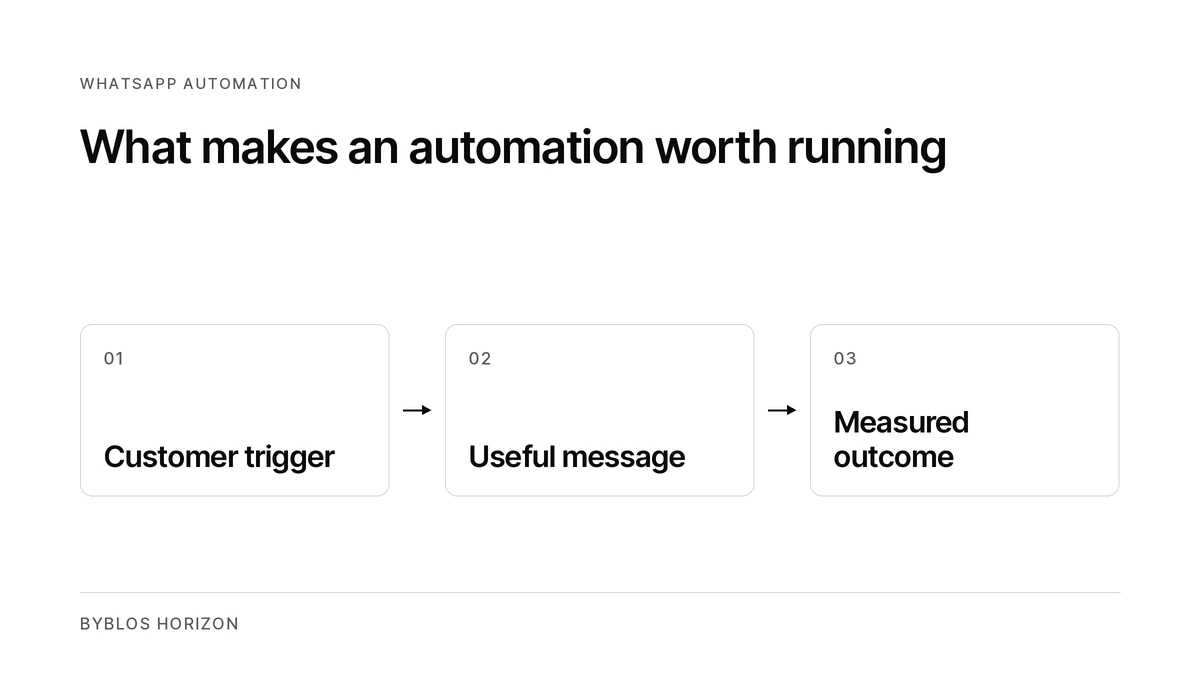
- calculate your real landed cost and profit.
- map useful messages to customer events.
- connect messaging to wider operational workflows.
Sources
- WhatsApp documents customer communication through its business platform. WhatsApp Business Platform.
- WhatsApp publishes the pricing framework for its Business Platform. WhatsApp Business Platform pricing.
- Google documents how important customer actions can be measured as conversions. Google Analytics conversion documentation.