 Byblos Horizon
MENA Market Insights
COD vs Prepaid in MENA: The Real Trade-Off
Mohamad Haidar
Founder of Byblos Horizon
Published May 18, 2026 · 9 min read · Updated October 24, 2026
Cash-on-delivery is the single most misunderstood line on a MENA e-commerce P&L. Global DTC playbooks pretend it doesn't exist. Local agencies over-defend it because they don't want the fight with founders. The honest position sits in the middle. COD still moves real volume in this region. The cost of running it is higher than most operators realise. And the shift to prepaid is both possible and profitable, if you handle it right.
Compare COD and online payment assumptions with the Lebanon e-commerce cost calculator, and read how delivery and logistics costs quietly tax every order in the region.
COD is shrinking selectively, not dying
In KSA and the wider GCC, COD share has fallen sharply over the last five years with Mada, Tabby, Tamara, Apple Pay and Benefit adoption. In parts of Egypt, Jordan, Iraq and Palestine it remains dominant. Category matters as much as geography: high-AOV fashion in Riyadh is now mostly prepaid; lower-AOV consumables in Cairo are still overwhelmingly cash.
The framing "should we drop COD" is the wrong question. The right question is: on this SKU, in this governorate, at this AOV, does the marginal cost of a COD order still make sense?
The true cost of a COD order
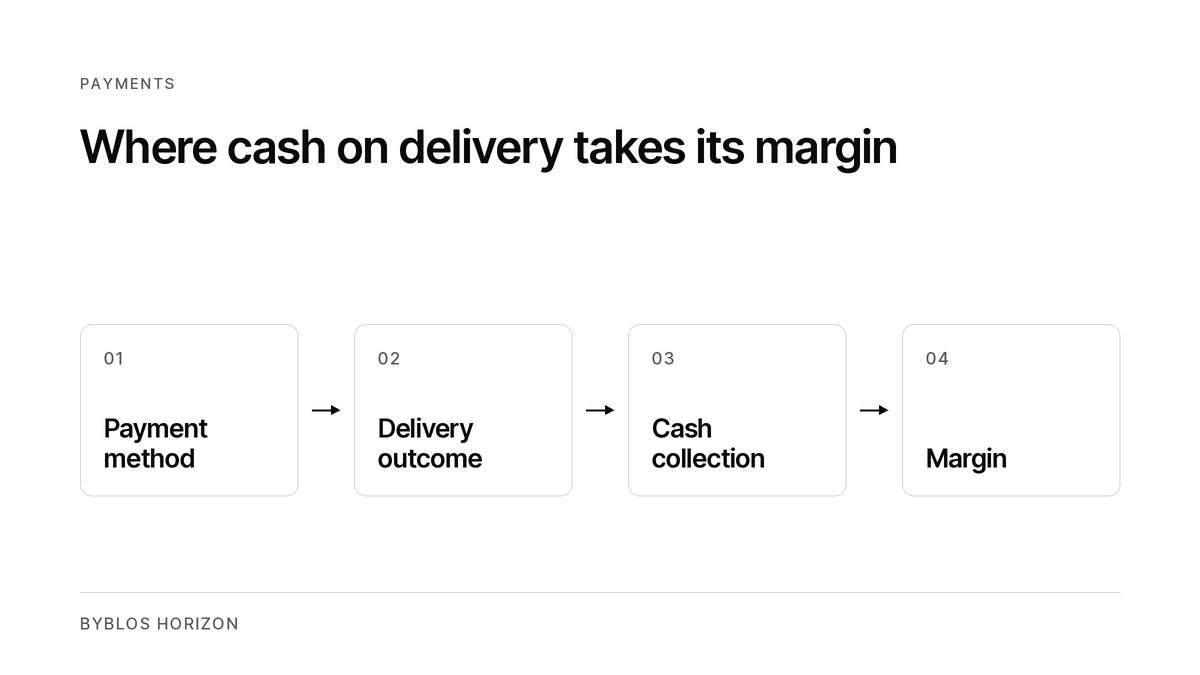
The sticker cost, the carrier's cash-handling fee, is usually only 2 to 4% of order value. The real cost stack is much bigger:
- Return-to-origin (RTO). COD orders typically see 15 to 30% RTO in fashion and 5 to 15% in other categories. Each RTO costs outbound and return shipping, warehouse handling, potential product damage, and the working capital tied up in the meantime.
- Cash cycle. Prepaid revenue is in the merchant account in 2 to 3 days. COD revenue arrives in 15 to 30 days depending on carrier. That gap is real working capital pain, especially in high-growth months.
- Fraud and impulse-cancel. COD invites lower commitment. A percentage of orders will cancel at the door or never be delivered, and the store eats the shipping.
When you stack all of that, the true landed cost of a COD order in fashion typically runs 8 to 15% of order value, versus 2.5 to 3.5% for a card transaction. Prepaid is cheaper per successful order even before you count the intangible improvements.
How to nudge prepaid share up without losing revenue
The mistake is to remove COD as a public policy change. That signals hostility to the cash-heavy customer segment and cuts revenue overnight. The better play is a quiet, structured migration:
- Prepaid discount. 3 to 5% at checkout for card/BNPL/wallet. Positive framing (a reward), not a COD surcharge (a penalty). Reward-framing consistently outperforms.
- BNPL prominence. Tabby and Tamara surfaced on PDP and cart, not buried at checkout. Split-payment is the biggest single lever for shifting cash-hesitant buyers to prepaid in the GCC.
- Regional COD-off. Turn off COD in known-high-RTO postal codes silently. Buyers in those zones see prepaid-only checkout without a public change.
- AOV threshold. COD available up to a threshold (say AED 400 / SAR 400), prepaid above. Reduces fraud exposure on high-value orders.
- Phone verification. Cheap OTP on COD capture. Cuts junk orders significantly with minimal friction on real buyers.
What to measure
Track prepaid share as a first-class KPI alongside AOV and conversion. Segment RTO by carrier, category and governorate. The aggregate number hides the fixable local issues. Watch cash-cycle days as a working capital metric, not a finance-only concern.
A well-managed MENA DTC store should be able to move prepaid share by 15 to 25 percentage points inside a year without hurting top-line revenue, and usually while improving contribution margin at the same time.
Where COD still makes strategic sense
Some categories and segments benefit from keeping generous COD access, at least for a while:
- New brand entering a market. COD is a trust bridge for first-time buyers.
- Categories with high inherent trust risk (unbranded, high-price beauty, high-price fashion).
- Markets and demographics where card penetration is low (parts of Egypt, Iraq, rural Levant).
Even in those cases, the goal is to convert repeat buyers to prepaid. The second order is where the prepaid discount hits hardest.
Getting this dialled correctly across a multi-market MENA store is one of the things we do inside our Shopify CRO and e-commerce CRO engagements. Full picture is at e-commerce growth agency.
Frequently asked questions
Should we drop COD entirely?
Usually no. In cash-heavy markets and cash-heavy categories, dropping COD costs 15 to 40% of revenue overnight. The better play is a gradual prepaid nudge: small incentive, smart friction, honest measurement.
What's a reasonable prepaid discount?
3 to 5% typically pays back through lower return-to-origin, faster cash cycles and lower per-order fulfilment cost. Anything above 7% usually costs more margin than it recovers.
Which markets are prepaid-dominant?
KSA (Mada dominant), UAE (cards + BNPL), Kuwait (KNET), Bahrain (Benefit). COD share is meaningfully higher in Egypt, Jordan and parts of the Levant.
How do we handle COD fraud?
Address validation on capture, phone verification for high-AOV orders, and a soft blocklist for repeat cancellers. High-risk regions can go prepaid-only without a public policy change.
Want us to tune your COD/prepaid mix? Book a consultation.
Sources
- Saudi Central Bank, e-payments share exceeds the Financial Sector Development Program 2022 target, for the shift toward prepaid in Saudi Arabia being real and measured rather than asserted. Electronic payments reached 62% of total retail payments including cash in 2022, mada recorded 7.2 billion point-of-sale transactions that year, up 40% on 2021, and 610 million online transactions, up 76%. These are 2022 figures, the most recent on SAMA's own news pages that we could open, and they support the direction described above rather than any specific COD share.
- Our calculator methodology, for the Lebanese cash on delivery share, door refusal rate and return fee per refused order, with the ranges we see and how each was derived. Those are the only numbers on this subject we publish with a method attached.
SAMA's page was opened and read on 24 October 2026. Everything else numeric in this article is ours or modelled and is labelled here rather than left to look like a published statistic. The return-to-origin bands, the cash-cycle day ranges, the 2 to 4% carrier cash-handling fee, the prepaid discount bands, the AOV thresholds and the 15 to 25 percentage point prepaid shift inside a year are Byblos Horizon's own figures from running stores across Lebanon and the Gulf. The 8 to 15% true landed cost of a COD order in fashion, against 2.5 to 3.5% for a card transaction, is modelled by stacking those same figures, not measured as a single number. The market descriptions, which countries are prepaid dominant and which remain cash heavy, are our read of the markets we operate in. Payment behaviour in this region moves quickly, so test these against your own carrier and category data before you plan around them.
Practical next steps
Model the payment decision before changing checkout policy:
- calculate your real landed cost and profit.
- reduce friction around payment choice.
- confirm and support orders through WhatsApp.
Sources
- Shopify documents checkout as a core part of its commerce platform. Shopify checkout research.
- Google documents how important customer actions can be measured as conversions. Google Analytics conversion documentation.
- WhatsApp documents business messaging capabilities used for order communication. WhatsApp Business Platform.
Related services
Related articles