 Byblos Horizon
E-Commerce & Shopify
The Real Cost of Running a Shopify Store in Saudi Arabia
Mohamad Haidar
Founder of Byblos Horizon
Published March 14, 2026 · 10 min read · Updated October 24, 2026
Saudi Arabia is the most valuable e-commerce market in the region and one of the fastest-growing globally. It's also one of the most rule-bound: ZATCA e-invoicing, VAT, Mada payment expectations, Arabic-first content, and a logistics geography that punishes brands who scope for Riyadh only. Here's the honest cost breakdown for running a Shopify store into KSA from launch to seven figures, with the line items most founders miss.
Licence and platform
The Shopify or Shopify Plus licence is the small line item. What actually matters is the KSA-specific app stack: ZATCA e-invoicing integration, Mada payment app, Arabic RTL theme (or a custom-built one), and a proper shipping-rules app for governorate-level ETAs. Budget $200 to $500/month in apps for a serious KSA setup, on top of the Shopify plan.
VAT and ZATCA e-invoicing
KSA charges 15% VAT on most goods and services. ZATCA Phase 2 e-invoicing, the "integrated" phase, is mandatory: your Shopify orders need to produce compliant, cryptographically signed e-invoices sent to ZATCA in real time. This is a solved problem on Shopify via approved apps, but expect a one-time setup fee of $500 to $1,500 and a small monthly subscription for the compliance layer.
Non-compliance isn't a warning; ZATCA has real enforcement teeth. Treat this as launch-blocking, not a post-launch to-do.
Payments
Mada is the dominant local card scheme and Saudi buyers reach for it first. Apple Pay adoption is very high. Tabby and Tamara BNPL are near-mandatory for any AOV above ~200 SAR. A store without BNPL surfaced on PDP and cart is leaving 15 to 25% of GMV on the table. Card processing rates typically run 2.4 to 2.9% for standard cards; BNPL 5 to 7% depending on merchant tier. COD share is falling but still meaningful in some categories.
For the trade-off between accepting COD and pushing prepaid, see COD vs prepaid in MENA.
Price chargebacks in properly, because Shopify Protect does not reach Saudi Arabia. It covers US stores only, and only eligible Shop Pay transactions authorised through Shopify Payments, which is not available to a Saudi-registered store. There is no platform safety net, so the controls that actually reduce disputes are operational: a recognisable billing descriptor, delivery evidence retained per order, and honest delivery promises.
Logistics
The three main carriers for Saudi DTC are SMSA, Aramex and Saudi Post (SPL), each with its own strengths. Riyadh and Jeddah delivery is cheap and fast; Dammam is cheap; secondary cities and the interior cost more and take longer. Budget realistic per-order fulfilment costs of 20 to 35 SAR for a small parcel, higher for cold chain or bulky goods.
Return rates in KSA are meaningfully higher than the UAE, especially in fashion. Build return handling into your P&L at 10 to 20% depending on category: running the model at 5% will bankrupt an assumption.
Content and creative
Arabic-first content by native speakers is non-negotiable in KSA. Machine-translated content is visible on first read and drops conversion and ad efficiency. Budget for:
- Native Arabic copywriter for all on-store copy, email and WhatsApp.
- Local UGC creator pipeline: Saudi-based creators in the target demographic.
- Dedicated Arabic ad-creative production; don't just dub English ads.
The Arabic-first build itself is walked through in the Arabic-first Shopify guide.
Ad spend and paid efficiency
Meta and TikTok CPMs in KSA are lower than the UAE but rising fast. TikTok in particular is dominant for Gen Z and younger millennial audiences. Google Shopping matters more than most GCC brands realise. Ramadan, Saudi National Day (September) and White Friday (November) concentrate demand and CPMs: plan cash and inventory around those windows.
Realistic first-year working media for a serious KSA DTC brand: $8k to $40k/month, scaling with revenue ambition. Anything less is a lifestyle business, not a growth business. Contribution-margin measurement matters more than blended ROAS.
Team and operations
Beyond agency spend, budget for Arabic-speaking customer service (in-house or outsourced), a warehouse partner with reliable KSA fulfilment, and a finance function that can handle ZATCA + VAT filings. A KSA commercial registration is worth having if you're serious about the market. It opens more payment options and simplifies logistics.
What a healthy KSA P&L looks like
Gross margin: 55 to 70% for the ambitious operator (below that, paid media doesn't math). Blended CAC recouped by second order. Contribution margin positive from month three post-launch. Retention rate that puts 30-day repeat above 20% by month six. If the numbers don't move in that direction, the plan needs a rethink, not more media spend.
If you want to run this properly, our Shopify & e-commerce service and Shopify agency in Riyadh pages cover engagement structure and pricing.
Frequently asked questions
What's ZATCA and do we need it?
ZATCA is Saudi Arabia's Zakat, Tax and Customs Authority, and it operates the mandatory e-invoicing regime (Fatoora). Phase 1 applies to all VAT-registered taxpayers. Phase 2, the integrated phase, arrives in waves rather than on one date for everyone: ZATCA selects each wave by VAT-subject revenue and notifies it at least six months before its integration deadline. Wave 25 covers taxpayers above SAR 187,500 in any of 2022 to 2025, with a deadline of 1 February 2027. Find out which wave you are in rather than assuming the deadline has passed or that it does not apply.
Is Arabic content really necessary?
For all non-expat categories in KSA, yes. English-only stores underperform sharply on both conversion and paid efficiency. Arabic is the language of the market.
How much does Ramadan matter?
It's often the second-biggest revenue season of the year after Q4, and for gifting or food it can be the biggest. Plan creative, offers and logistics 6 to 8 weeks ahead: see the full playbook link below.
Salla or Shopify?
Depends on catalogue, roadmap and market ambition. Salla is faster to launch and locally native; Shopify has the app ecosystem, headless options and international expansion path. Full comparison in the Salla vs Shopify vs Zid post.
Building or scaling in KSA? Book a consultation.
Sources
- PwC Worldwide Tax Summaries, Saudi Arabia, other taxes, for the 15% standard VAT rate, which the page dates to an increase effective 1 July 2020.
- KPMG, Saudi Arabia e-invoicing mandatory for taxpayers with revenue above SAR 187,500, for how ZATCA Phase 2 integration actually arrives. It is not a single switch-on date for everyone. ZATCA notifies taxpayers in waves and gives each wave at least six months' notice. The wave described here is the twenty-fifth, it covers taxpayers whose VAT-subject revenue exceeded SAR 187,500 in 2022, 2023, 2024 or 2025, and its Fatoora integration deadline is 1 February 2027. So read the statement above that Phase 2 is the current requirement as the direction of travel: your own deadline depends on your revenue band and the wave you were notified in, and that is worth confirming with your tax adviser rather than assuming.
- Saudi Central Bank, e-payments share exceeds the Financial Sector Development Program 2022 target, for mada being the national payment network and for the scale behind the claim that Saudi buyers reach for it first: 7.2 billion point-of-sale transactions in 2022, up 40% on 2021, and 610 million online transactions, up 76%. Electronic payments reached 62% of total retail payments in 2022. These are 2022 figures, the most recent we could open on SAMA's own pages, and the direction since then has been further growth rather than reversal.
- Shopify Help Center, supported countries for Shopify Payments, for Saudi Arabia not appearing on the published list, which is why a Saudi-registered store cannot reach Shopify Payments or the Shop Pay path that depends on it.
- Shopify Protect, chargeback protection for merchants, for the statement that coverage applies to US stores only, for coverage applying to eligible Shop Pay transactions authorised through Shopify Payments, for the limit to fraud-based chargebacks, and for the seven day fulfilment and tracking condition.
External sources above were opened and read on 24 October 2026. Everything else in this article is ours or modelled, and should not be read as a published statistic. The app stack budget, the ZATCA compliance setup fee, the card and BNPL rate bands, the share of GMV attributed to BNPL, the per-order fulfilment cost in riyals, the return rate bands, the working media ranges and the healthy P&L targets are all Byblos Horizon's own figures from building and running Gulf stores, not numbers taken from a report. Payment pricing is quoted per merchant and per tier, so treat every rate here as the starting point for a negotiation. ZATCA waves, VAT treatment and platform eligibility all change, so confirm current requirements directly before you plan around them.
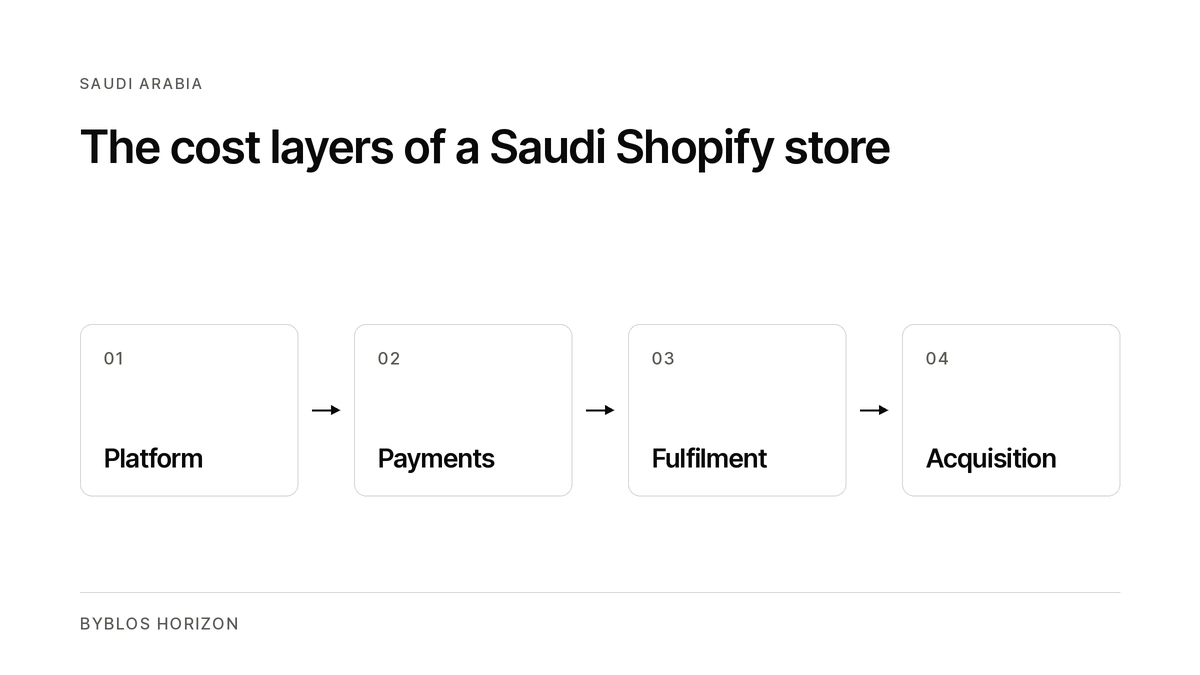
Practical next steps
Connect the cost model to the platform and market decisions:
- review the Saudi market requirements.
- plan the Shopify operating model.
- compare Shopify, Salla and Zid for Saudi Arabia.
Sources
- ZATCA publishes the official requirements and updates for electronic invoicing in Saudi Arabia. ZATCA e-invoicing guidance.
- Shopify publishes current plan information for merchants in Saudi Arabia. Shopify Saudi Arabia pricing.
- mada publishes official information about the Saudi national payment network. mada official website.