 Byblos Horizon
E-Commerce & Shopify
The Arabic-First Shopify Guide for MENA Brands
Mohamad Haidar
Founder of Byblos Horizon
Published May 28, 2026 · 10 min read · Updated October 24, 2026
Arabic isn't a translation layer. On a MENA e-commerce store, especially one serving KSA, Arabic is the product. Treating it as an afterthought is the single most consistent way we see brands throttle their own growth in the region. This is the working guide we use when we build Shopify stores intended to sell into Arabic-speaking markets from day one.
RTL is a build decision, not a plugin
Real right-to-left support means the entire layout mirrors: navigation, buy box, price rail, breadcrumb, review widget, checkout, email templates, WhatsApp templates. Most Shopify themes claim RTL support and deliver a partial mirror that breaks the moment you add a custom section or a third-party app. Build (or pick) a theme that has RTL as a first-class variant, and test every section and every app with the Arabic locale active.
Fonts matter as much as direction. Latin fonts rendering Arabic characters look childish and cheap. Use a proper Arabic display face (IBM Plex Sans Arabic, Cairo, Tajawal, or a licensed foundry cut) paired thoughtfully with the Latin type. Line height, letter spacing and paragraph rhythm all need Arabic-specific tuning.
Content: where the real investment sits
Native-written Arabic is the difference between "we have an Arabic version" and "we sell in Arabic". Machine translation is visible within a sentence, and Gulf buyers are unforgiving about it. Budget for:
- Native Arabic copywriter for PDP, category, home and email/WhatsApp copy.
- Arabic UGC and creator content: don't just voice-over English creative in Arabic.
- Arabic SEO research, keyword mapping and metadata. Arabic search intent maps differently to English.
- Arabic customer-service scripts, macros and knowledge base.
For a fuller view of Arabic SEO specifically, see Shopify SEO and e-commerce SEO.
Checkout, payments and the local wallet stack
Arabic checkout isn't just translation. Field order, address format, phone-number handling, currency display and payment method priority all shift. Some concretes:
- Address format follows local convention (district, street, building, floor for KSA).
- Phone number field with +966/+971/etc. defaulting to the store's primary market.
- Mada surfaced first in KSA; Benefit in Bahrain; KNET in Kuwait; Apple Pay everywhere.
- Tabby and Tamara BNPL surfaced on PDP and cart, not buried at checkout.
- COD available with a small prepaid discount to shift mix: see COD vs prepaid in MENA for the numbers.
Ads and CRM
Arabic-first extends past the site. Ad creative should be Arabic-native for KSA and Egypt, dual-language for UAE/Kuwait/Bahrain, English-first only for the diaspora and expat plays. Klaviyo templates need Arabic variants with the RTL toggle set correctly. WhatsApp templates should be submitted in Arabic to Meta from the start, not translated after approval.
Customer service. The invisible conversion lever
A large share of GCC buyers will DM before they buy. That is our own observation from running stores in the region, not a published statistic. If the reply comes back in English only, or takes six hours, the sale is gone. A properly built Arabic customer-service layer: human agents where volume justifies, LLM-backed WhatsApp assistant where it doesn't: is one of the highest-ROI investments an MENA e-commerce brand can make. See how we build the WhatsApp side in WhatsApp automation.
SEO consequences
Arabic SEO is a separate discipline, not a translation of English SEO. Keyword intent, competitor landscape, SERP layouts and content depth all differ. Investing early in Arabic category pages, Arabic content hubs and Arabic schema pays back over 12 to 18 months in non-brand organic traffic that most competitors will never catch up to, because they never invested in the language layer.
The two-line rule
Every Arabic string on the store, on every touchpoint, should pass this bar: a native speaker shouldn't be able to tell it was written for translation. If they can, rewrite it. That rule alone will move your Arabic conversion by more than any theme tweak.
If you want us to build or rebuild an Arabic-first Shopify programme, our Shopify & e-commerce and Shopify agency for MENA pages cover the engagement structure.
Frequently asked questions
Can we run one store or split by language?
One Shopify store with proper RTL and a language switcher usually beats separate stores. Multi-store fragments SEO, analytics and inventory, and only makes sense at very high scale or when catalogues differ meaningfully by market.
Do we need Arabic customer service?
For KSA and most of the GCC, yes. Buyers will WhatsApp before purchase; if replies come in English only, conversion drops noticeably. Kuwait and UAE are more forgiving but still reward Arabic.
How much does Arabic-first cost extra?
The tech side is small: properly built themes handle RTL natively. The real cost is native Arabic content and creative. Budget for a dedicated Arabic copywriter and, ideally, an Arabic UGC creator pipeline.
Machine-translated Arabic: how bad is it really?
Bad enough to be visible. Gulf buyers spot it inside a paragraph, and it signals that the brand doesn't take them seriously. Machine-translate at your own risk; edit natively before shipping.
Building an Arabic-first Shopify store? Book a consultation.
Sources
- Shopify Changelog, Admin now supports 3 new languages, dated 2 October 2026, for what Shopify itself does and does not handle in Arabic. Shopify states it released improved support for three right-to-left languages, Arabic, Urdu and Hebrew, across admin and storefronts, including checkout, customer accounts and the Horizon family of themes, and states that product pages and other merchant-owned content continue to display in the languages you have enabled. That is the platform side. The content investment described above is the part Shopify does not cover.
- mada, the mada scheme, for Mada being the national payments scheme accredited by the Saudi Central Bank, which is the reason it is listed first for Saudi Arabia rather than treated as one option among many.
- Shopify App Store, Tabby Pay Later, for Tabby being a buy now pay later provider in the Middle East with an app published by Tabby itself for Shopify stores, which is what makes surfacing it a configuration decision rather than a custom build.
Sources opened and checked on 24 October 2026. Three honest limits. Platform behaviour here is time-sensitive: Shopify's right-to-left support, theme behaviour and checkout surfaces change, so confirm current behaviour in Shopify's changelog and Help Center and by testing your own store rather than relying on this page. We did not find vendor documentation we could verify for Tamara on Shopify, or for Benefit in Bahrain and KNET in Kuwait, so treat those three as names to confirm with the providers, not as sourced claims. And the font, layout, content and customer service judgements in this guide are our working practice from building Arabic stores, not findings from a published study.
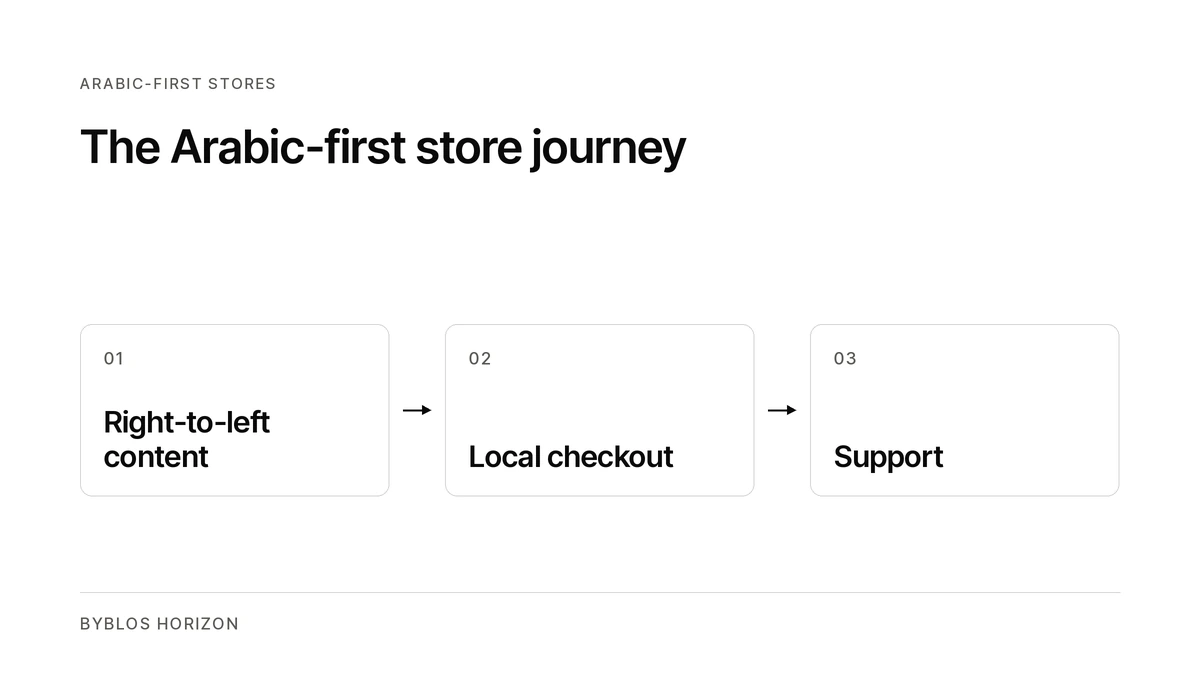
Practical next steps
Turn the language decision into a complete regional store setup:
- build Arabic and English journeys together.
- structure search pages for both languages.
- coordinate localisation across MENA markets.
Sources
- W3C documents the use of language direction for right-to-left content. W3C direction guidance.
- W3C publishes the accessibility standards used to assess web content. W3C accessibility standards.
- Shopify documents market-aware commerce configuration. Shopify Markets developer documentation.
Related services
Related articles