 Byblos Horizon
E-Commerce & Shopify
Why Shopify Is the Best E-Commerce Platform for Most Ambitious Brands

Mohamad Haidar
Founder of Byblos Horizon
Published September 6, 2026 · 15 min read · Updated September 17, 2026
A platform becomes powerful when it removes technical friction without hiding commercial reality.
The short answer: Shopify isn't the best because it can build a pretty website. It's the best overall choice for most growth-minded brands because it combines a strong storefront, high-performance checkout, secure hosting, extensibility, international selling, retail tools, automation and a deep commerce ecosystem in one operating foundation.
The wrong question produces the wrong platform
Whenever a founder asks me, "What is the best e-commerce platform?", I first challenge the question. Best for what? A single-product launch in Lebanon? A beauty brand expanding from the UAE into Saudi Arabia? A retailer operating physical branches and an online store? A manufacturer with complex B2B pricing? A marketplace with thousands of independent sellers?
There's no platform that's best for every conceivable business model. But if the question is more practical, what is the best overall platform for a brand that wants to launch quickly, sell reliably, improve conversion, connect marketing and operations, and still have room to scale, my answer is Shopify.
That conclusion does not come from a feature checklist. It comes from viewing e-commerce as a system. A functioning commerce business connects customer demand, merchandising, storefront experience, checkout, payment, inventory, fulfilment, customer support, acquisition, retention and profitability. The platform should make that system easier to operate. It should not become the system's permanent engineering problem.
Shopify's greatest advantage is not that it does one thing perfectly. It is that it performs the essential commerce jobs unusually well at the same time, while allowing a business to extend the parts that make it distinctive.
1. Shopify lets the business focus on commerce, not infrastructure
A custom commerce stack can sound sophisticated. It also creates a long list of responsibilities: hosting, security patches, performance, payment integrations, mobile responsiveness, uptime, checkout maintenance, app compatibility and deployment. Every hour spent repairing that foundation is an hour not spent improving the offer, creative, merchandising, retention or delivery experience.
Shopify packages the core infrastructure into the platform. Its plans include secure commerce hosting, unlimited bandwidth and TLS/SSL certificates, while Shopify states that its stores are PCI DSS Level 1 compliant by default. That does not eliminate a merchant's security responsibilities, but it removes a large amount of technical burden that smaller and mid-sized brands should not need to rebuild themselves.
This matters strategically. The real cost of software is not only the monthly fee. It is total cost of ownership: development time, maintenance, integration failures, lost sales during outages, dependence on one developer, and the opportunity cost of launching slowly. Shopify is often cheaper not because its invoice is always the lowest, but because it reduces the hidden cost of complexity. We break the regional numbers down in the real cost of running a Shopify store in the UAE.
My own proof: three markets, one reliable foundation
For me, this isn't a theoretical argument. I operate shops in Lebanon and the UAE, while also running a dropshipping operation serving Australia. Across these businesses, Shopify has supported approximately $1 million in sales without crashing or causing material platform bugs, even while handling different markets, fulfilment models and operating requirements.
The essential qualifier is proper engineering. Reliability does not happen simply because a business opens a Shopify account. The catalogue structure, theme code, applications, integrations, tracking, payment flows, inventory logic and automations must be designed and tested correctly. Poor implementation can make any platform feel unreliable. When the engineering is sound, Shopify's infrastructure can absorb growth without forcing the merchant to rebuild the business every time order volume increases. That is the work our Shopify development team does before anyone talks about design.

2. The checkout is a commercial asset, not a final page
Many teams spend weeks debating homepage design and then treat checkout as an administrative step. That's backwards. Checkout is where demand becomes revenue. Small increases in friction, slow loading, unfamiliar forms, weak payment options, surprise costs or poor mobile usability, can destroy value that was expensive to acquire through advertising.
Shopify has invested at a scale that an individual merchant cannot realistically reproduce. In a Shopify-commissioned study conducted by a global management consultancy, Shopify reported that its checkout converted 15% better than competing platforms on average and up to 36% better in like-for-like comparisons. Shopify also reported that Shop Pay could lift conversion by as much as 50% compared with guest checkout. These are the company's published results from a commissioned analysis, so they should be read with that context, but the strategic point remains strong: checkout performance is part of Shopify's core product, not a side project.
The value compounds as a brand scales. If paid media sends 100,000 qualified visits per month, the economic consequence of checkout friction is no longer theoretical. Better conversion can lower effective customer acquisition cost, increase the revenue produced by the same traffic, and create more room to invest in creative and growth. That's the core of our Shopify CRO work.

3. It balances speed with serious customization
Shopify is easy to start, but "easy" should not be confused with "limited." A founder can launch using a quality theme and native sections. A growing company can add custom theme components, advanced applications and deeper operational integrations. Larger organizations can move to Shopify Plus, customize more of the checkout and business logic, or use Shopify as the commerce engine behind a headless storefront.
That progression is important. Many platforms force a choice between simplicity and control. Shopify offers a more useful middle path: start with proven infrastructure, then add complexity only where complexity creates customer or operational value.
The discipline is to avoid overbuilding. A custom animation that slows the mobile site isn't innovation. Twenty applications that duplicate functions aren't an ecosystem strategy. Headless commerce isn't automatically superior. The best Shopify builds protect speed, clarity and maintainability while customizing the experiences that genuinely differentiate the brand.
4. The ecosystem turns Shopify into a commerce operating system
Shopify's App Store lists more than 8,000 apps. The number is impressive, but the strategic advantage is not volume alone. It is the ability to connect specialized capabilities: reviews, subscriptions, loyalty, search, returns, shipping, customer support, email, analytics, ERP, CRM and automation, without rebuilding the entire storefront.
For a serious brand, this means the platform can sit at the center of a wider operating stack. Shopify can be the transaction and catalogue layer while other systems handle warehousing, accounting, lifecycle marketing, customer service or business intelligence. Its APIs and developer tools also give teams a path beyond off-the-shelf applications when the business has genuinely unique needs.
There's a warning, however: every app adds cost, scripts, permissions and possible points of failure. The right approach is architecture, not accumulation. Each app should have a defined job, a measurable benefit and an owner. If two tools perform the same function, or an app is no longer contributing to revenue, efficiency or customer experience, remove it.
5. Shopify understands that commerce is now omnichannel
Customers do not think in channels. They may discover a product on Instagram, ask a question on WhatsApp, inspect it in a physical shop, purchase on the website and request support through another channel. The brand experiences one customer journey even if the company's internal teams see five different systems.
Shopify supports online storefronts, social and marketplace channels, the Shop app and physical retail through Shopify POS. Its core admin brings products, orders, customers and inventory closer together. That doesn't automatically create a flawless omnichannel operation, process design and integrations still matter, but it gives retailers a much stronger base than disconnected tools and duplicated product data.
For MENA retailers expanding from physical stores into direct-to-consumer commerce, this is especially valuable. The objective is not merely to "add a website." It is to connect inventory, customer data, promotions and service so the online and offline business stop competing with each other. This is the model we run as a Shopify agency across MENA.
6. International expansion becomes configurable rather than reconstructive
Regional expansion is rarely a matter of translating a homepage. Customers in Lebanon, the UAE, Saudi Arabia, Qatar and Europe may require different currencies, payment methods, product availability, prices, duties, delivery promises, languages, return policies and customer-support flows.
Shopify Markets is designed to manage market-specific configurations from one commerce foundation. Shopify's Spring 2026 release added more control over product availability, pricing, currency, promotions and localized themes by market and sales channel. This is the right direction: internationalization should be an operating model, not a collection of copied stores that drift apart. We covered the operating side in scaling Shopify stores internationally.
Still, localization must go beyond changing the currency symbol or adding Arabic. A Saudi customer should not see a Lebanese delivery promise. A UAE price should reflect that market's costs and competitive position. Arabic layouts must be checked properly on mobile, as we detail in the Arabic-first Shopify guide. Customer support, duties, returns and payment expectations need to match the actual country. Shopify provides the controls; the brand must supply the market intelligence.
7. Automation can protect margins as order volume grows
Shopify Flow allows merchants to build workflows using triggers, conditions and actions across the store and connected applications. A business can tag risky orders, route high-value customers, trigger low-stock processes, notify teams about exceptions or connect events to external systems. Shopify currently makes Flow available as a free app across its main Basic, Grow, Advanced and Plus plans, with some capabilities varying by plan.
This is where Shopify fits naturally with Byblos Horizon's view of AI and automation. The goal is not automation for a presentation. It is to remove repetitive work, speed up decisions and catch costly exceptions. An automation that prevents one fraudulent COD shipment or recovers one valuable customer can be more useful than an impressive dashboard nobody acts on, which is why we connect it to WhatsApp automation for confirmation and follow-up.

8. Shopify is building for the next interface of commerce: AI
The storefront will remain important, but it will no longer be the only place where product discovery and transactions happen. Customers are increasingly using conversational interfaces to search, compare and decide. Commerce platforms will need to expose accurate product, price and availability data to those interfaces while preserving control over orders and customer experience.
Shopify's Spring 2026 product direction makes this explicit. The company is extending Sidekick across the admin and selected applications, developing agent-oriented catalogue capabilities, and enabling store management and storefront development through tools such as ChatGPT, Claude and other AI environments. Some of these capabilities are new, evolving or dependent on eligibility and integrations; they should not be treated as universal maturity today. But strategically, Shopify is positioning commerce data to be usable wherever customer and merchant interactions move next.
That matters because future readiness isn't about adding an AI chatbot to a weak store. It is about having structured catalogue, inventory, customer and order data that intelligent systems can act upon safely. Shopify is increasingly designed around that foundation.
9. The platform improves quickly without forcing merchants to rebuild
Shopify now publishes more than 150 product updates twice a year through Shopify Editions. Not every update will matter to every merchant, and some announcements are early-stage. The broader advantage is the rate at which the shared platform improves. Search, analytics, checkout, B2B, retail, internationalization, automation and developer tools can evolve without each merchant funding a full rebuild.
Scale provides evidence that this infrastructure can handle serious demand. During Black Friday and Cyber Monday 2025, Shopify reported $14.6 billion in merchant sales, more than 81 million shoppers, a peak of $5.1 million in sales per minute, and 16% of orders crossing borders. Those numbers are reported by Shopify and are unaudited, but they demonstrate the magnitude of commerce the platform is engineered to support.
The MENA reality: Shopify is excellent, but the platform is often the easy part
This is the point many platform comparisons miss. In Lebanon and parts of MENA, the hardest problems aren't templates or product uploads. They're payment access, COD refusals, fake orders, inconsistent addresses, courier performance, return-to-origin costs, customs, currency volatility, customer trust and cash-flow timing.

Shopify Payments is available only in supported countries. As of September 2026, the UAE appears on Shopify's official list, while Lebanon does not. A Lebanese merchant therefore needs an eligible third-party payment provider, manual payment methods, COD, or an appropriately structured entity and banking setup that complies with all relevant rules. This should be designed before launch, not discovered after the store is finished. It is a core part of how we work as a Shopify agency in Lebanon.
COD can increase placed orders, but placed orders are not revenue. The business must measure confirmation rate, shipped rate, delivered rate, refusal rate, return-to-origin cost and the time between delivery and cash remittance. A campaign can show an attractive platform ROAS while the company loses money after failed deliveries, discounts, product cost, shipping, payment fees and customer support. We set out the full trade-off in COD vs prepaid in MENA.
In our region, the correct unit of truth is often profit per delivered order, not orders placed, and certainly not screenshots from an advertising dashboard.
Shopify helps because orders, customer records, inventory and integrations are structured. That makes it easier to connect verification flows, courier systems, WhatsApp communication, fraud rules and profitability reporting. But Shopify can't negotiate a better courier contract, create trust around an unknown brand or rescue a product with no margin. Those remain management responsibilities.
Why Shopify usually wins against the alternatives
| Option | Where it's strong | Typical trade-off | My view |
|---|---|---|---|
| Shopify | Fast launch, checkout, hosting, ecosystem, channels and scalability | Subscription, app costs and platform conventions | Best overall default for most growth brands |
| WooCommerce | Ownership, WordPress flexibility and content-heavy sites | More maintenance, hosting and plugin compatibility responsibility | Strong when WordPress control is central and the team can maintain it |
| Custom build | Maximum theoretical control | High cost, long delivery, security and permanent maintenance burden | Justified only when unique requirements create enough value |
| Marketplaces | Existing demand and easier discovery | Fees, competition and limited customer ownership | A useful channel, not a complete brand operating system |
| Enterprise suites | Complex B2B, governance or legacy integrations | Cost, implementation time and organizational complexity | Appropriate for specific enterprise requirements, not automatically better |
Shopify's advantage is the quality of the compromise. It gives up some of the unrestricted freedom of a custom system in exchange for speed, reliability and an enormous amount of shared commerce infrastructure. For most brands, that is an excellent trade. The full platform comparison sits in Shopify vs WooCommerce for MENA brands.
When Shopify may not be the best choice
Credibility requires saying where the recommendation stops. Shopify may be the wrong foundation in four cases. A true multi-vendor marketplace with unusual settlement logic. A highly regulated workflow that cannot fit the platform's architecture. A content-first publishing product where commerce is secondary. Or an organisation whose legacy systems and procurement rules dictate another enterprise stack.
Even then, the decision should be based on documented requirements and total cost, not on a developer's preference or the belief that custom software is automatically more prestigious. The question is not "Can another platform do this?" Almost any sufficiently funded team can make almost any platform do almost anything. The better question is: which option creates the greatest business capability with the lowest unnecessary complexity over the next three to five years?
What Shopify can't do for you
- It can't create product-market fit.
- It can't turn weak creative into efficient paid acquisition.
- It can't make an untrusted brand credible without proof, service and consistent delivery.
- It can't repair a margin destroyed by excessive discounting, high fulfilment costs or poor purchasing.
- It can't make bad data useful; tracking still needs to be implemented, tested and interpreted correctly.
- It can't replace merchandising judgment, regional knowledge or disciplined operations.
That's not a criticism of Shopify. It's the reason Shopify is valuable. A strong platform removes infrastructure excuses and exposes the quality of the actual business. Once the technology works, management must confront the offer, economics and customer experience.
The Byblos Horizon framework for a strong Shopify business
- 1. Economics before aesthetics: Model product cost, shipping, duties, payment fees, discounts, returns, COD failure and acquisition cost before choosing how much to spend on design.
- 2. Mobile conversion before decoration: Build clear navigation, persuasive product pages, fast assets, visible delivery information, proof and a checkout path with minimal friction.
- 3. Local operations before regional promises: Configure each market's currency, pricing, payments, product availability, delivery and support based on what the business can actually deliver.
- 4. Clean data before scaling ads: Verify catalogue feeds, analytics events, pixels and server-side connections where applicable. Reconcile marketing reports with Shopify orders and delivered-order results.
- 5. Automation around costly repetition: Automate order checks, tagging, notifications, inventory exceptions, customer follow-up and reporting where rules are stable and impact is measurable.
- 6. Retention before permanent discounting: Use email, WhatsApp, loyalty, replenishment, bundles and service to increase repeat purchase instead of training customers to wait for discounts.
- 7. Controlled complexity: Add applications, custom code, headless components or external systems only when the commercial benefit is clear and ownership is defined.
So, is Shopify really the best?
For most ambitious consumer brands, omnichannel retailers and growing e-commerce companies, yes: Shopify is the best overall platform available today. Not because it's flawless, and not because every feature is available equally in every country. It's the best because it offers the strongest combination of conversion, reliability, time to market, extensibility, ecosystem depth, international capability and long-term innovation.
More importantly, Shopify respects a fundamental business truth: technology should accelerate commerce rather than become the company's main operational burden.
The platform can support a first sale, a regional expansion, a retail network, a B2B channel or an enterprise replatforming. The merchant doesn't need to know every future requirement on day one. The foundation can evolve as the business earns the right to become more complex.
At Byblos Horizon, that is how we evaluate commerce technology. We do not begin with the theme. We begin with the business: the customer, the offer, the margin, the market, the acquisition model, the delivery promise, the data and the operating constraints. When those elements are designed properly, Shopify becomes more than a website builder. It becomes the commerce infrastructure on which a serious brand can grow. If you are building or scaling a Shopify business across MENA, you can book a consultation or explore our Shopify services. Examples of strong regional execution are collected in the best Shopify stores in MENA.
Frequently asked questions
Is Shopify really the best e-commerce platform?
For most ambitious consumer brands, omnichannel retailers and growing e-commerce companies, yes. Not because it is flawless or because every feature is available in every country, but because it offers the strongest combination of conversion, reliability, time to market, extensibility, ecosystem depth, international capability and long-term innovation in one foundation.
Is Shopify Payments available in Lebanon?
Shopify Payments is available only in supported countries. As of September 2026, the UAE appears on Shopify's official list while Lebanon does not. A Lebanese merchant needs an eligible third-party payment provider, manual payment methods, cash on delivery, or an appropriately structured entity and banking setup that complies with all relevant rules. This should be designed before launch.
Shopify or WooCommerce for a MENA brand?
WooCommerce is strong when WordPress control is central and the team can genuinely maintain hosting, plugins and security. Shopify is the better default when the priority is fast launch, checkout performance, reliability and an ecosystem that grows with the business.
When is Shopify not the right choice?
A true multi-vendor marketplace with unusual settlement logic, a highly regulated workflow that cannot fit the platform's architecture, a content-first publishing product where commerce is secondary, or an organization whose legacy systems and procurement rules dictate another enterprise stack.
Does Shopify guarantee reliability on its own?
No. Reliability depends on proper engineering: catalogue structure, theme code, applications, integrations, tracking, payment flows, inventory logic and automations must be designed and tested correctly. Poor implementation can make any platform feel unreliable.
What does Shopify not solve for a MENA merchant?
Payment access, cash-on-delivery refusals, fake orders, inconsistent addresses, courier performance, return-to-origin cost, customs, currency volatility, customer trust and cash-flow timing remain management responsibilities. The platform structures the data; it does not negotiate a courier contract or create margin.
Sources and verification
- Shopify pricing and platform features
- Shopify Checkout conversion study summary
- Shopify Editions: Spring 2026
- Shopify Flow documentation
- Supported countries for Shopify Payments
- Shopify 2025 Black Friday and Cyber Monday results
Editorial note: Platform features, availability and pricing can change. Shopify-supplied performance and sales figures are identified as company-reported or commissioned claims. Businesses should verify current country, payment and plan eligibility before implementation.
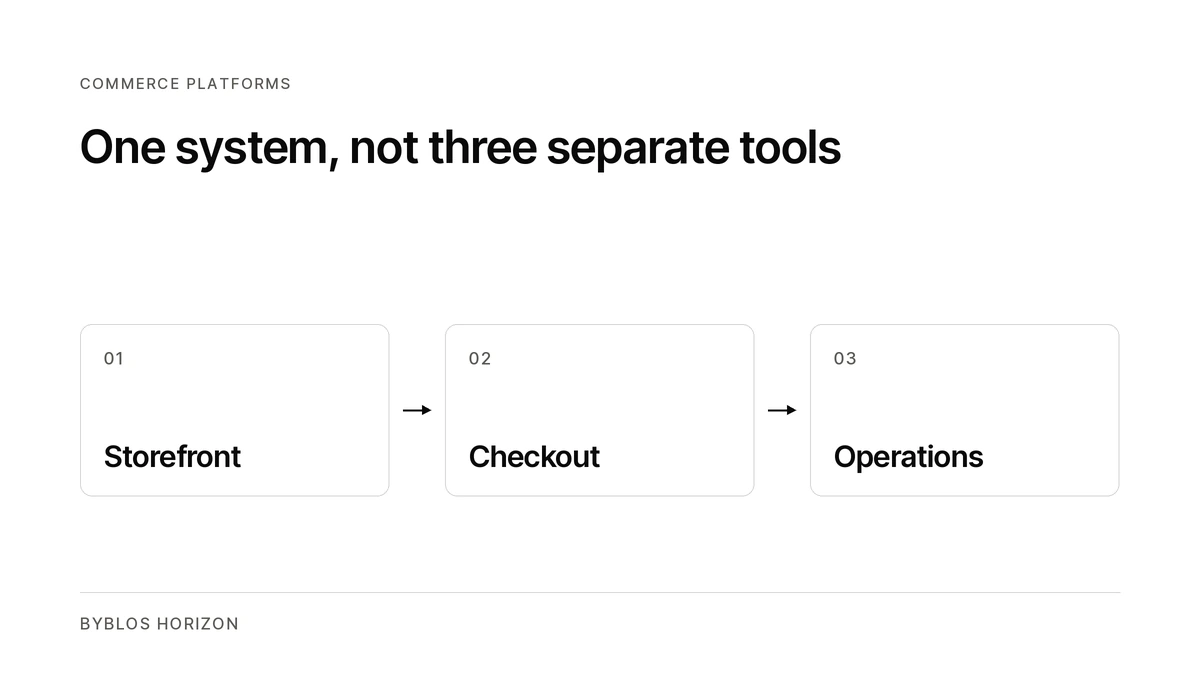
Practical next steps
The platform decision becomes practical when you connect it to implementation:
- build the storefront around real buying journeys.
- improve the path from product page to payment.
- adapt one Shopify operation across MENA markets.
Sources
- Shopify publishes its current plan structure and included commerce features. Shopify pricing.
- Shopify documents checkout as a core part of its commerce platform. Shopify checkout research.
- Shopify documents market-specific app behaviour and international commerce configuration. Shopify Markets developer documentation.
Related services
Related articles