E-Commerce & Shopify
10 Best Shopify Stores in MENA in 2026: What They Get Right
10 Best Shopify Stores in MENA in 2026: What They Get Right
Byblos HorizonMohamad Haidar
Founder of Byblos Horizon
Published August 25, 2026 · 14 min read · Updated September 17, 2026
Search for the best Shopify stores in the Middle East and you will find plenty of lists.
There is one problem.
Being on Shopify does not automatically make an e-commerce website good.
A beautiful theme tells you very little about whether a business merchandises properly, understands its market, reduces purchase friction, integrates physical and digital commerce, or has the infrastructure required to scale.
So we approached this differently.
At Byblos Horizon, we reviewed Shopify and Shopify Plus businesses across the UAE, Saudi Arabia, Lebanon, Egypt, Qatar, Morocco and the wider MENA region.
We looked beyond design and considered:
- Regional relevance
- Shopify and Shopify Plus implementation
- User experience
- Product merchandising
- Localization
- Conversion strategy
- Omnichannel execution
- Operational sophistication
- International scalability
- Brand strength
A note on methodology
This is an editorial selection, not a revenue ranking.
Most privately owned e-commerce businesses do not publish comparable GMV, conversion-rate or profitability data, so no list of this kind can honestly claim to rank businesses by financial performance.
The numbering is not a score either. These are ten examples presented for the different lessons they offer.
Company facts are linked to their sources throughout, while platform usage was cross-checked against public technology-detection data and published case studies.
This is our assessment of 10 of the strongest Shopify commerce executions coming out of MENA in 2026, and what other brands can learn from them.
1. Huda Beauty (UAE)
Category: Beauty
Platform: Shopify Plus
Founded in: Dubai, 2013
Market: Global
Huda Beauty is the obvious place to start.
What began in Dubai in 2013 has grown into one of the Middle East's most internationally recognized beauty brands.
But its importance from an e-commerce perspective is not simply its scale.
Huda Beauty understands something many brands still miss:
An e-commerce website is not a catalogue.
Products sit inside a wider ecosystem of tutorials, education, routines, collections, social proof and content.
That matters enormously in beauty.
A customer may discover a product through TikTok, Instagram, a makeup tutorial or an influencer recommendation. The website then needs to continue that journey instead of abruptly turning into a grid of product cards.
Huda Beauty connects brand storytelling and purchase intent effectively.
The customer is not only shown what to buy. They are given context around how to use it, why it matters and where it fits into a broader beauty routine.
The lesson
Your brand, content and store should behave like one system.
A customer moving from Instagram to your website should feel as though they are continuing the same conversation.
2. SQUATWOLF (UAE)
Category: Performance apparel
Platform: Shopify Plus / headless architecture
Founded in: Dubai, 2016
Market: Global
SQUATWOLF may be one of the most interesting e-commerce businesses to emerge from the region.
Founded in Dubai in 2016, the performance-wear brand has expanded internationally and built a presence across e-commerce, owned retail, wholesale and franchise operations.
Its Gulf expansion also demonstrates increasing operational complexity, with different models across markets and local warehousing supporting regional growth.
That matters because SQUATWOLF's technology footprint goes far beyond installing a Shopify theme.
Its commerce infrastructure combines Shopify Plus with applications, ERP, order-management systems, retail systems and international fulfilment operations.
And that is where the real lesson begins.
Many companies believe scaling e-commerce simply means increasing Meta or Google advertising budgets.
Eventually, it does not.
At a certain scale, growth becomes an infrastructure problem.
Inventory needs to synchronize. Orders must reach the correct warehouse. Returns need to work across countries. Retail stock needs to communicate with online inventory. Customer accounts, applications, fulfilment and CRM systems need to speak to each other.
SQUATWOLF represents what happens when a regional DTC brand starts operating like a global commerce company.
The lesson
At scale, your Shopify store is only the visible layer of a much larger operating system.
3. KAYALI (UAE)
Category: Fragrance
Platform: Shopify Plus
Origin: Dubai
Market: US, UK, UAE, Canada, Australia and selected European markets, alongside global retail distribution
Selling fragrance online comes with an obvious problem.
The one thing customers normally want to do before purchasing perfume is exactly what a website cannot provide:
Smell it.
That makes KAYALI particularly interesting from a conversion perspective.
Founded in Dubai and led by Mona Kattan, the brand launched its dedicated direct-to-consumer platform on Shopify Plus.
The platform initially launched in the US and UK and has since expanded its direct e-commerce operation into the UAE, Canada, Australia and selected European markets.
Its online experience includes strong fragrance storytelling, shopping by scent characteristics, layering recommendations and a custom Fragrance Finder designed to help customers narrow their choices.
This is what good conversion optimization looks like.
It does not begin with changing button colours.
It begins with identifying the customer's uncertainty.
The website cannot let you physically smell Vanilla 28.
But it can explain the scent profile, help users determine whether it matches their preferences, suggest complementary fragrances and position it within the wider collection.
That reduces one of the biggest barriers to purchasing fragrance online: uncertainty.
The lesson
Great CRO is not about adding more persuasion. It is about reducing uncertainty.
4. ELIE SAAB (Lebanon)
Category: Luxury fashion
Platform: Shopify Plus
Founded in: Beirut, 1982
Market: Global
ELIE SAAB deserves special attention because it demonstrates something Lebanese brands do not showcase often enough.
A company born in Beirut can operate at the highest level of international digital commerce.
The Maison began with a small Beirut atelier in 1982 and has since developed a global luxury presence across cities including Beirut, Paris, London, Milan, New York, Dubai, Riyadh and Doha.
Its Shopify Plus commerce infrastructure goes beyond a simple online store, incorporating integrations involving inventory, appointment booking, ERP and international tax management.
But ELIE SAAB faces a very different conversion challenge from a mass-market fashion retailer.
When customers may be purchasing products worth thousands of dollars, aggressive pop-ups, endless discount codes and urgency widgets can damage the very perception of luxury that drives the sale.
For luxury brands, CRO is often about removing friction without removing prestige.
ELIE SAAB combines editorial storytelling, visual presentation, collections and product discovery while preserving the high-touch feeling associated with the physical boutique experience.
It does not try to force the customer through a performance-marketing funnel that feels disconnected from the brand.
The lesson
Conversion optimization should never ignore brand positioning.
What improves conversion for a low-cost DTC brand could destroy trust for a luxury house.
5. The Giving Movement (UAE)
Category: Athleisure and streetwear
Platform: Shopify Plus
Founded in: Dubai, 2020
Market: Middle East retail footprint, ships worldwide
The Giving Movement launched in Dubai in 2020 with a proposition built around fashion, community, local production and charitable giving.
Its physical presence is now an important part of the brand.
The company operates extensively across the UAE while maintaining a broader Middle East retail footprint.
Its e-commerce operation extends beyond the region through worldwide shipping, including duty-free delivery across the GCC, UK and US.
What makes The Giving Movement interesting is that it does not attempt to hide its regional identity in order to appear international.
Instead, the Middle East is built into the brand story.
Its local manufacturing, regional stores, cultural relevance and charitable positioning become part of the proposition itself.
This is important because many MENA businesses assume international growth requires becoming visually and culturally generic.
It does not.
A brand can scale while remaining visibly rooted in the market that produced it.
The lesson
Localization does not always mean changing the language. Sometimes your regional identity is the competitive advantage.
6. Al Rugaib Furniture (Saudi Arabia)
Category: Furniture and home
Platform: Shopify Plus
Market: Saudi Arabia with broader GCC ambitions
Furniture is one of the more difficult categories to sell online.
Customers need more than attractive photographs.
They need dimensions. Materials. Availability. Delivery information. Payment options. Financing. And sometimes professional advice before committing to a high-ticket purchase.
Saudi Arabia's Al Rugaib Furniture handles that challenge through a major online catalogue on Shopify Plus combined with physical retail, interior-design services, bilingual Arabic and English experiences and flexible payment options.
This becomes especially important when a retailer has thousands of SKUs.
Many businesses assume that adding more products automatically improves e-commerce.
Often, the opposite happens.
As catalogues grow, customers become more dependent on navigation, search, filters, categories and high-quality product information.
Poor information architecture can make a large assortment feel like a disadvantage rather than a strength.
The lesson
The larger the catalogue, the more important information architecture becomes.
7. Swiss Arabian (UAE)
Category: Fragrance
Platform: Shopify
Founded in: UAE, 1974
Market: UAE, Saudi Arabia, Qatar, Oman, Kuwait, US and other markets
Swiss Arabian provides a completely different type of e-commerce case study.
Unlike many digital-native businesses on this list, Swiss Arabian has decades of heritage.
Established in the UAE in 1974, the fragrance house has grown into a significant regional retail and e-commerce operation.
What makes its digital strategy particularly interesting is its market-specific approach.
Swiss Arabian operates localized storefronts across several GCC markets rather than assuming one website can serve the entire region equally well.
That difference matters.
Saudi Arabia is not the UAE. Kuwait is not Qatar.
Customer expectations around payments, delivery, promotions, language, product preference and customer service vary across markets.
Yet many businesses launch a single English website, add a currency converter and declare themselves "GCC ready."
That is not localization.
The lesson
Internationalization is not translation.
Real localization reaches payments, logistics, merchandising, customer service, promotions and operations.
8. ariika (Egypt)
Category: Furniture and home
Platform: Shopify
Founded in: Egypt
Market: Egypt with broader MENA positioning
Egypt's ariika is another strong example of high-consideration e-commerce.
The company operates a substantial home-furnishings catalogue alongside physical stores, financing options and its Design Crew service.
That service layer matters.
The answer to a customer hesitating over an expensive sofa is not necessarily another discount.
Sometimes the customer needs advice. Sometimes they need measurements. Sometimes they need financing. Sometimes they want to see the item physically. And sometimes they simply need reassurance that what they are buying will work inside their home.
This is where ariika's combination of digital commerce and human guidance becomes interesting.
The website is not expected to carry the entire sales process by itself.
Instead, digital discovery can lead into consultation, physical retail, financing or additional support.
The lesson
Good e-commerce identifies why the customer cannot decide, and then builds the service needed to move that decision forward.
9. Store974 (Qatar)
Category: Gaming and electronics
Platform: Shopify
Founded in: Qatar, 2019
Market: Qatar with regional expansion ambitions
Store974 is an excellent example of category specialization.
Founded in Qatar in 2019, the business has grown into a major destination for gaming PCs, components, peripherals and related technology.
Its presence extends beyond e-commerce into major physical stores and partnerships with leading gaming brands.
Its online catalogue contains thousands of technically specific products.
That creates a very different customer journey from fashion or beauty.
A serious gaming customer may already know exactly what they want.
They are searching for a specific graphics card. A specific motherboard. A specific monitor. A specific configuration.
Their question is not necessarily: "Do I like this brand?"
It may be: "Do they have the exact item I need, can I trust them, and can they deliver it?"
Store974 also benefits from participating in the broader gaming and esports ecosystem.
That creates authority beyond product availability and price.
A generic marketplace can sell a graphics card.
Building credibility within the gaming community is harder to replicate.
The lesson
Niche authority can become a stronger moat than simply offering more products.
10. Wlidaty (Morocco)
Category: Baby, children and family
Platform: Shopify
Founded in: Morocco
Market: Morocco
Wlidaty may be the least internationally famous business on this list.
That is exactly why it deserves to be included.
The Moroccan e-commerce business focuses on mothers, babies and children and has built its proposition around the practical needs of local families.
Its commerce experience combines broad product selection with multilingual communication, card payment, cash on delivery, returns and fast local fulfilment.
According to its current delivery policy, qualifying orders placed before 2 PM in Casablanca and Rabat can receive same-day delivery, while deliveries to other Moroccan cities are generally targeted within approximately 24 hours.
None of this sounds as technologically dramatic as a headless international Shopify Plus architecture.
But that is not the point.
Wlidaty is not trying to become Huda Beauty.
It is solving the problems of its own customer.
That makes it a useful reminder that sophisticated e-commerce does not always mean sophisticated technology.
Sometimes it means understanding the market better than everyone else.
The lesson
The best e-commerce experience is not necessarily the most technologically impressive one. It is the one best adapted to the market it actually serves.
What the Best Shopify Stores in MENA Have in Common
After looking across these businesses, several patterns become difficult to ignore.
1. Brand Comes Before the Theme
Huda Beauty does not succeed because of its Shopify theme. Neither does ELIE SAAB. Neither does SQUATWOLF.
Technology enables the commerce experience. It does not create the proposition.
There is no Shopify template capable of replacing strong positioning, product-market fit and genuine brand equity.
A store can be technically perfect and commercially irrelevant.
The strongest brands on this list already understand what they represent, who they are selling to and why customers should care.
Shopify gives them the infrastructure to express that commercially. It is not the source of the brand itself.
2. Localization Goes Much Deeper Than Arabic
Arabic matters enormously across MENA, particularly when implemented properly with thoughtful RTL design.
But localization does not stop there. It includes:
- Local currencies
- Payment gateways
- Cash-on-delivery strategy
- Buy-now-pay-later options
- Shipping expectations
- Taxes and duties
- Returns
- Customer support
- Local promotions
- Product assortment
- Regional cultural behaviour
A translated US store is still a US store.
A business genuinely operating across MENA needs to understand that each market may require a different commercial setup.
The GCC itself should not be treated as one homogeneous consumer market.
3. Merchandising Is Decision Architecture
KAYALI's fragrance discovery, Al Rugaib's furniture catalogue and Store974's gaming products have almost nothing in common visually.
Yet all three are solving the same fundamental problem:
How do we help the customer decide what to buy?
That is merchandising.
It is not simply putting products into collections. It is designing the path between interest and decision.
For KAYALI, that means helping someone discover a fragrance they cannot smell online. For Al Rugaib, it means organizing a large furniture catalogue so customers can navigate confidently. For Store974, it means helping technical shoppers quickly locate exactly the component or specification they need.
Good merchandising reduces cognitive load.
Bad merchandising gives customers more choices without helping them make one.
4. Physical and Digital Commerce Are Merging
ELIE SAAB has boutiques. The Giving Movement has stores across the region. SQUATWOLF operates retail. ariika has physical showrooms. Store974 has major gaming locations.
The best e-commerce companies increasingly stop thinking about the website as an isolated sales channel.
The website, mobile application, physical store, warehouse, CRM, WhatsApp support and fulfilment network are all part of the same customer journey.
A customer may discover a brand on Instagram. Research products on the website. Ask a question through WhatsApp. Visit a physical store. Purchase through the app. Return through another channel.
The company still has to recognize that person as one customer.
That is omnichannel commerce in practice.
5. Operational Infrastructure Eventually Becomes the Growth Strategy
A company can survive its first few hundred orders using manual processes.
At thousands of orders, those same processes become liabilities.
The technology customers never see eventually becomes as important as the website they do see. That includes:
- ERP
- OMS
- Inventory management
- Warehouse systems
- CRM
- Customer service
- Marketing automation
- Analytics
- Returns management
- International tax systems
- Fulfilment infrastructure
This becomes particularly important for MENA businesses expanding across several markets.
Different countries mean different warehouses, currencies, taxes, delivery expectations, customer-service requirements and operational rules.
At that point, e-commerce stops being primarily a website project.
It becomes an infrastructure project.
And in many cases, the next growth bottleneck has nothing to do with advertising.
What MENA Brands Should Not Copy
There is one final lesson.
Do not copy these websites.
Copying Huda Beauty's navigation will not turn your business into Huda Beauty. Copying SQUATWOLF's design will not create SQUATWOLF's infrastructure. And copying ELIE SAAB's minimalism could actively damage conversion if your customer requires much more information before purchasing.
Instead, study the decision behind the feature.
Ask:
Why does KAYALI need a fragrance quiz?
Why does Al Rugaib need sophisticated category architecture?
Why does The Giving Movement benefit from physical retail?
Why does Store974 benefit from deep specialization?
Why does one brand need Shopify Plus while another can operate perfectly well on a simpler Shopify setup?
Why is financing important in one category but irrelevant in another?
Why does one market need cash on delivery while another does not?
Why does one brand need an ERP integration while another can still operate effectively with a simpler stack?
That is where the real value is.
Do not copy what another company built.
Understand why they built it.
The Bottom Line
Shopify has become an important layer of e-commerce infrastructure across MENA.
From globally recognized brands born in Dubai to specialist businesses in Lebanon, Saudi Arabia, Egypt, Qatar and Morocco, the region is producing increasingly sophisticated commerce companies.
But Shopify itself is not the competitive advantage.
The competitive advantage comes from what you build around it.
The strongest MENA e-commerce businesses combine technology with:
- Market knowledge
- Strong merchandising
- Brand positioning
- Customer experience
- Localization
- Logistics
- Payments
- Data
- Automation
- Operational infrastructure
That is the difference between having a Shopify website and building an e-commerce business.
At Byblos Horizon, this is how we approach commerce.
Shopify development, CRO, paid acquisition, localization, automation and the operational journey should not be treated as disconnected services.
They are parts of one system.
Because a store does not need to simply look impressive.
It needs to make buying easier.
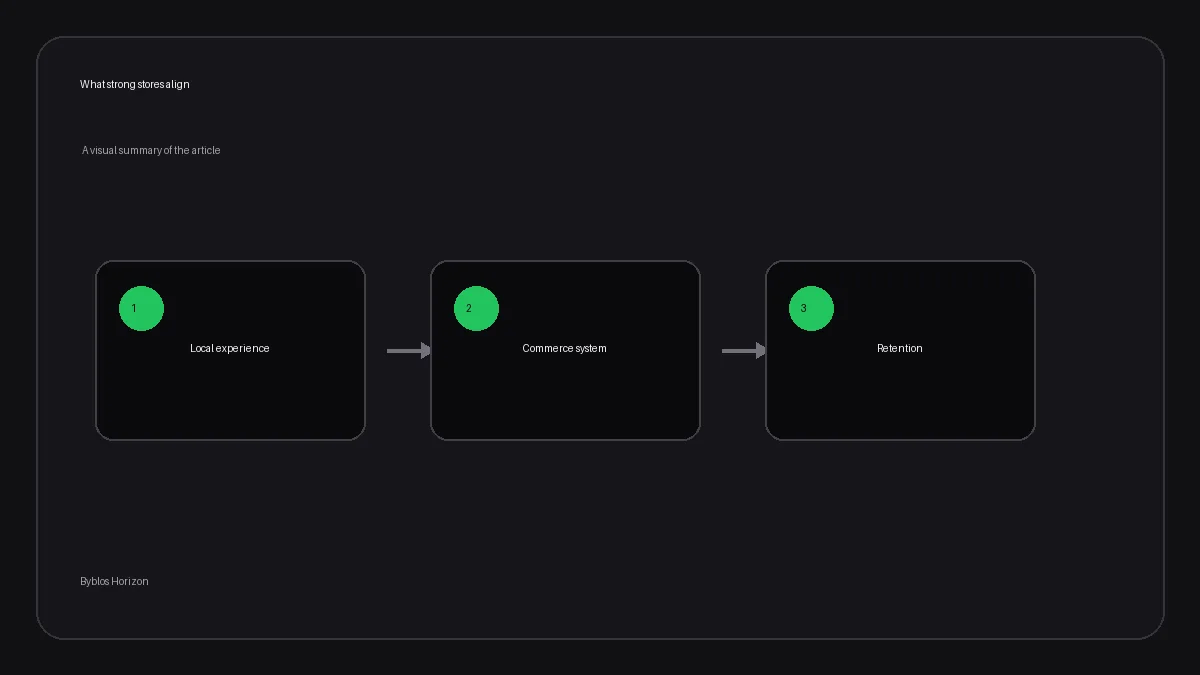
Practical next steps
Apply the patterns from these stores to your own operation:
- turn the storefront patterns into a build plan.
- prioritise the highest-friction buying steps.
- build repeat-purchase journeys after checkout.
Sources
- Shopify publishes its current plan structure and included commerce features. Shopify pricing.
- Shopify documents checkout as a core part of its commerce platform. Shopify checkout research.
- Shopify documents how commerce experiences can vary by market. Shopify Markets developer documentation.
Related services
Related articles