 Byblos Horizon
E-Commerce & Shopify
The Real Cost of Running a Shopify Store in the UAE
Mohamad Haidar
Founder of Byblos Horizon
Published March 5, 2026 · 10 min read · Updated October 24, 2026
The UAE is the most competitive premium e-commerce market in the region. Buyers expect fast delivery, polished checkouts, and DTC standards on par with London or New York. That premium expectation shapes every line of the operating cost. Here's the honest breakdown for running a Shopify store in the Emirates, from launch to seven figures.
Licence and structure
Serious UAE e-commerce operators register a mainland or free-zone company. E-commerce free zones (Dubai CommerCity, Meydan, IFZA) offer competitive setup and give access to local payment gateways and business banking. Budget AED 15k to 35k for setup and first-year fees, plus visa costs if you plan to sponsor a founder or key staff.
Licence and platform
Shopify or Shopify Plus licence + the standard MENA app stack (RTL theme or custom, Tabby/Tamara, WhatsApp BSP integration, ZATCA-style e-invoicing app if you also sell into KSA). VAT in the UAE is 5% and Shopify handles it natively at checkout. Expect $150 to $400/month in apps for a competitive UAE build.
Payments
Card processing typically 2.4 to 2.9% via Checkout.com, Network International, Amazon Payment Services or Stripe (via a UAE entity). Apple Pay adoption is very high. Tabby and Tamara BNPL are near-mandatory for any AOV above ~AED 300. Cross-border USD is available and important for brands serving the wider GCC.
UAE buyers are card-first. COD still exists in some categories but expect it to shrink further; a modest prepaid discount usually pushes the mix in the right direction. See COD vs prepaid in MENA.
Budget for chargebacks as a real line, because the safety net merchants assume they have does not reach here. Shopify Protect covers US stores only, and only eligible Shop Pay transactions authorised through Shopify Payments, which is why it does not apply to a UAE store even though the UAE is the one Gulf country where Shopify Payments is offered. Prevention is the whole defence: a recognisable billing descriptor, delivery evidence kept per order, and delivery dates written by operations rather than marketing.
Logistics
Fetchr, Aramex, DHL and a large field of specialised last-mile players. Next-day delivery is table stakes in Dubai and Abu Dhabi; same-day is a competitive differentiator in urban zones. Per-order fulfilment costs typically AED 12 to 25 for a small parcel with a mid-tier carrier. Return rates are lower than KSA but not trivial: 8 to 15% in fashion; less elsewhere.
Content and creative
The UAE audience is dual-language by default. English-first is fine for most categories, but Arabic quality matters: machine translation reads as lazy and cheapens the brand. For beauty, fashion, food and family categories, invest in native Arabic. For B2B and tech, English can carry more of the weight. Creative expectation is high: static and video, weekly refresh, real UGC creators, editorial photography that holds up next to global DTC brands.
Ad spend and paid efficiency
UAE CPMs are among the highest in the region. Meta and TikTok are the workhorses; Snapchat still meaningful in some youth segments; Google Shopping under-used but converts well. Ramadan, GITEX, DSF and Eid concentrate demand and inflate CPMs. Plan the media calendar around them, not in reaction to them.
Realistic first-year working media for a serious UAE DTC brand: $10k to $60k/month depending on category and ambition. Anything less is a lifestyle business.
Customer expectations
UAE buyers are demanding. They compare against Amazon.ae, Noon, and the best of global DTC. That means:
- Next-day delivery as default expectation in Dubai and Abu Dhabi.
- Real-time order tracking on WhatsApp, not just email.
- Zero-friction returns: 14 days minimum, most brands offer 30.
- Multilingual customer service, ideally over WhatsApp, within business hours.
Miss any of these and the review score drops fast, and UAE buyers read reviews before purchase.
What a healthy UAE P&L looks like
Gross margin 55 to 70%. Blended CAC recouped by second order. AOV higher than KSA (elevated basket sizes, premium categories). Repeat rate 25 to 35% by month six. Contribution margin positive from month two or three. If any of those lag, the fix is usually not more spend. It's tighter targeting, better creative, and a cleaner post-purchase experience.
Full engagement structure and pricing lives on our Shopify & e-commerce and Shopify agency in Dubai pages.
Frequently asked questions
Do we need a UAE trade licence?
For serious operations, yes. It unlocks local payment providers, mainland or free-zone bank accounts, and gives buyers confidence via a visible commercial registration on the site.
Is COD still meaningful in the UAE?
Shrinking but still present in some categories. Card and Apple Pay dominate; Tabby and Tamara are widely used above ~AED 300 AOV. Offer COD selectively with a prepaid nudge.
What about Ramadan and GITEX?
Ramadan is a top-two revenue season; expect elevated CPMs and late-night buying peaks. GITEX and DSF concentrate demand in retail and tech categories. Build the media calendar around them.
Arabic content: same as KSA?
Less critical than KSA but still meaningful. Dual-language is standard; native-quality Arabic pulls ahead in beauty, fashion and family categories.
Building or scaling in the UAE? Book a consultation.
Sources
- PwC Worldwide Tax Summaries, United Arab Emirates, other taxes, for the 5% VAT rate, which the page states applies to most goods and services.
- Shopify Help Center, supported countries for Shopify Payments, for the United Arab Emirates appearing on the published list, which is the basis for the statement that the UAE is the one Gulf country where Shopify Payments is offered. Saudi Arabia, Kuwait, Bahrain, Qatar and Oman are not on that list.
- Shopify Protect, chargeback protection for merchants, for the statement that coverage applies to US stores only, for coverage applying to eligible Shop Pay transactions authorised through Shopify Payments, for the limit to fraud-based chargebacks, and for the seven day fulfilment and tracking condition. Shopify Payments being available in the UAE does not change the US-stores-only condition.
External sources above were opened and read on 24 October 2026. The rest of the numbers here are ours, not published statistics, and should be read that way. The AED 15k to 35k licence and first-year fee range, the app stack budget, the card processing bands, the per-order fulfilment cost in dirhams, the return rate bands, the working media ranges and the healthy P&L targets are Byblos Horizon's own figures from building and running UAE stores. Free zone fees, processing rates and carrier pricing are all quoted per applicant or per merchant, so treat every figure as a starting point and get a current quote before you budget from it.
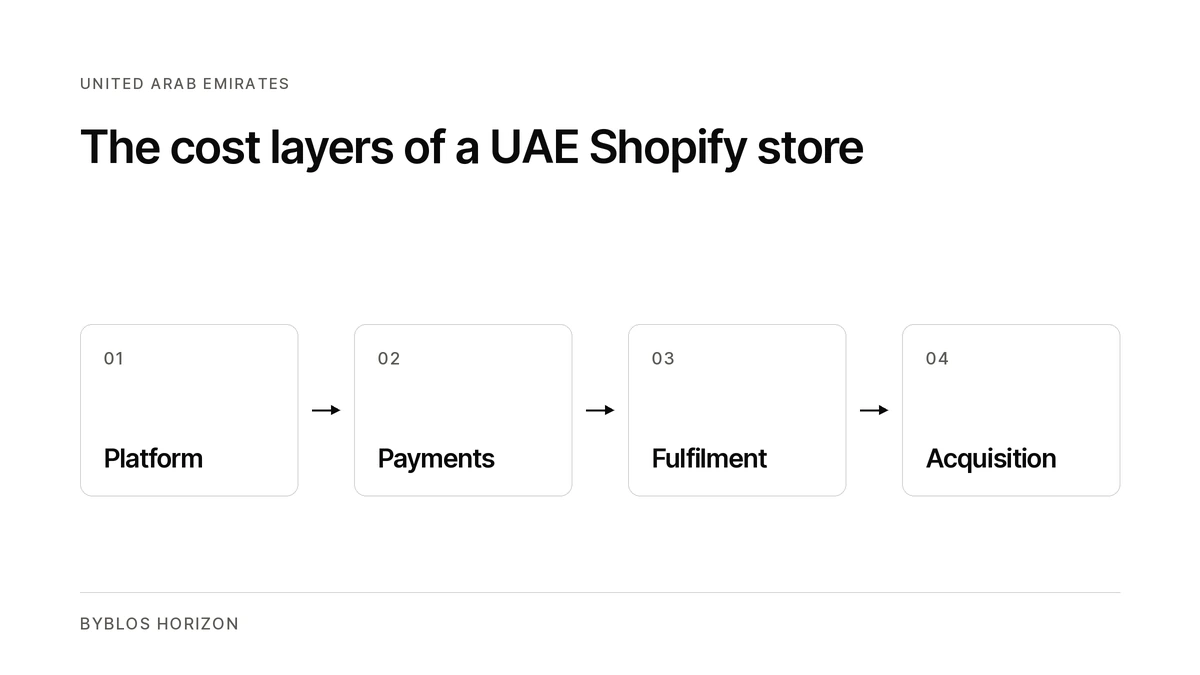
Practical next steps
Use these resources to connect store costs with market execution:
- review e-commerce support for the UAE.
- plan the Shopify operating model.
- compare payment economics across MENA.
Sources
- The UAE Federal Tax Authority publishes the official overview of value added tax. UAE Federal Tax Authority VAT guidance.
- Shopify publishes its current plan structure and included commerce features. Shopify pricing.
- Google documents how important customer actions can be measured as conversions. Google Analytics conversion documentation.
Related services
Related articles