 Byblos Horizon
MENA Market Insights
The Ramadan E-Commerce Playbook for MENA Brands
Mohamad Haidar
Founder of Byblos Horizon
Published May 5, 2026 · 10 min read · Updated October 24, 2026
Ramadan is not a marketing moment; it's a full season with its own rhythm, offer logic, creative language and logistics reality. Brands that treat it as "a two-week promo" leave most of the revenue on the table. Here's the playbook we run with GCC clients. The version tuned for real founder-led DTC brands, not the agency-deck version.
Ramadan is a season, not a week
Planning starts 6 to 8 months out for hero products, 3 to 4 months out for creative and offers, and 6 to 8 weeks out for media buy. Inventory decisions are the earliest: freight windows into KSA and the UAE tighten in the pre-Ramadan month, and running out of a hero SKU in week two is the classic own-goal.
The season itself has three distinct phases: pre-Ramadan (last week of Sha'ban, gifting for the family that's about to fast), the main month (with a late-night shopping peak after Iftar), and Eid (a completely different offer, creative and inventory profile). Each needs its own plan.
Creative
The dominant Ramadan creative language in the GCC is warm, family-oriented and understated. Loud discount creative underperforms. It reads as opportunistic in a moment when the audience wants brands to feel respectful.
- Palettes: warm neutrals, gold accents, deep greens and burgundies. Avoid neon and shouty red.
- Messaging: gifting, generosity, togetherness. Arabic-first for KSA; dual-language for UAE/Kuwait.
- Format mix: static gifting sets, short-form video showing product-in-use for Iftar/Suhoor, UGC.
- Ad-creative refresh cadence: weekly minimum. Ramadan CPMs punish stale creative faster than any other season.
Offers
The default lever for most brands is a site-wide percentage discount. That's usually the wrong lever. It commoditises the brand, trains next year's buyers to wait, and rarely lifts AOV. What actually works:
- Bundles. Ramadan gifting sets, family bundles, "iftar hosts" bundles. Bundle pricing hides the per-unit margin conversation and lifts AOV in the same move.
- Tiered free shipping. Set the threshold 15 to 25% above current AOV. Shipping is a serious purchase-decision factor across the GCC.
- Gift-with-purchase. A physical Ramadan gift with orders above a threshold. Especially strong in beauty, food and home.
- Countdown offers. Different offer each week of Ramadan, aligned to the season's rhythm. Keeps the story fresh and gives media a reason to cut new creative.
Channel timing
Ramadan totally rewires buying hours. Peak shopping shifts to late-night after Iftar, from roughly 21:00 to 02:00 local time. Every automated send, email, WhatsApp, ads, needs to be re-scoped to that window. Sending your usual 10am campaign during Ramadan is throwing spend into an empty room.
- Meta and TikTok: schedule delivery-optimised windows for late-night; expect CPMs to rise 15 to 40%.
- Email: send between 21:00 and 01:00 local time; A/B by market.
- WhatsApp: transactional messages any time; marketing broadcasts in the late-night window only.
- Google: keep bidding on Ramadan-intent keywords well before Ramadan starts.
Logistics
Ramadan working hours affect fulfilment. Warehouses run reduced schedules, driver capacity tightens, and customs windows change. Coordinate with your 3PL 6 weeks before the season starts. For KSA specifically, confirm inbound freight timing well before Sha'ban.
- Publish honest delivery ETAs: over-promising and under-delivering in Ramadan damages the brand for years.
- Buffer stock on hero SKUs at 1.5 to 2x normal cover.
- Plan return/exchange capacity for the Eid week: return volume spikes.
- Complete a real checkout, on a real address, in every shipping zone you sell to, before the season opens. From Admin API version 2026-10 a live rates app no longer attaches its rate to your shipping zones on install, so checkout can show no delivery option at all with nothing in the admin to warn you. Peak season is the worst possible time to discover that from a customer.
Eid
Eid is a different mode from Ramadan proper. The buyer profile shifts back toward daytime, the offer language moves to celebration and gifting, and the creative palette brightens. Eid al-Fitr especially is a high-AOV gifting week: build a dedicated Eid landing page, a dedicated bundle set, and a dedicated media buy. Treat it as its own release, not a Ramadan extension.
Payments, COD and BNPL during the season
Basket sizes go up in Ramadan; BNPL adoption goes up with it. Ensure Tabby and Tamara are surfaced on PDP and cart, not buried at checkout. In cash-heavy markets, offer a small prepaid discount to nudge share toward card and BNPL: see the trade-offs in COD vs prepaid in MENA.
What a good Ramadan looks like on the P&L
The ranges in this section are our own figures from running GCC client accounts through the season, not published statistics. The same applies to the CPM range in the channel timing section above and the late-night shopping window. They are what we have measured across our own accounts, they vary by category and by market, and nobody else has published them.
A well-run Ramadan season for a GCC DTC brand typically pulls in 20 to 35% of the year's revenue across Ramadan + Eid. AOV lifts 20 to 40% over baseline through bundles and gifting. Retention improves because first-time gifting buyers convert into repeat customers post-Eid. Blended CAC often drops thanks to elevated conversion rates on already-warm audiences.
If you want us to run this playbook with you, our paid media, retention and full growth engagements all include Ramadan season planning as standard.
Frequently asked questions
Does Ramadan actually move e-commerce revenue?
Enormously. For many DTC brands in KSA and the UAE, Ramadan plus Eid is the second-biggest season after Q4, and for gifting, beauty and food categories it's often the biggest.
Should we discount aggressively?
Bundles beat straight discounts in most categories. Gifting sets, family bundles and free-shipping thresholds hold margin better than 30%-off site-wide sales, which train buyers to wait every year.
How early should we start planning?
Creative shoots and inventory decisions belong in Q4 of the previous year. Media plans and offer architecture lock 6 to 8 weeks before Ramadan. Anyone starting in week one is already behind.
Do we need Arabic-first creative for Ramadan?
In KSA, yes: non-negotiable. In the UAE and Kuwait, dual-language is fine but the Arabic version should be a real translation, not a caption in the corner of an English asset.
Planning your Ramadan season? Book a consultation.
Sources
- Shopify Developer Changelog, carrier services will no longer be automatically added to the default shipping profile, dated 26 June 2026, for the live rates warning in the logistics checklist: from API version 2026-10, creating a carrier service no longer adds it to the shop's General shipping profile or its shipping zones, the app or the merchant has to add the rate to a profile, and Shopify states that if the rates are not added, merchants will not see them at checkout. That is why the pre-season checkout test is on the list.
- Shopify App Store, Tabby Pay Later, for Tabby being a buy now pay later provider in the Middle East with an app published by Tabby for Shopify stores, which is what makes surfacing it on the product page and cart a setup decision.
Sources opened and checked on 24 October 2026. Everything else in this playbook is our own operating practice and our own measurements from GCC client accounts, labelled as such above, rather than published research. Two time-sensitive notes. Shopify changes shipping, discount and checkout behaviour on its own schedule, so confirm the current API behaviour in Shopify's changelog before the season rather than after. And we did not find vendor documentation we could verify for Tamara on Shopify, so confirm that integration with Tamara directly. Ramadan dates move each year, so re-date the planning windows above against the current calendar.
Practical next steps
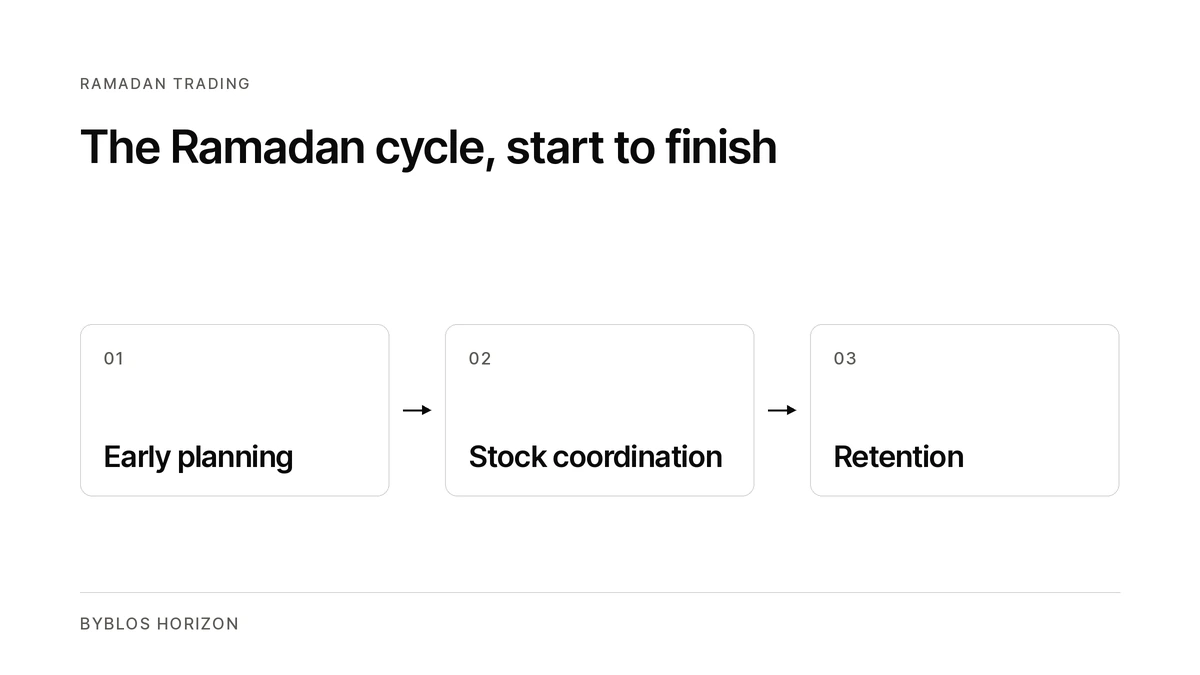
Coordinate the campaign across acquisition, store and retention work:
- plan paid demand around stock and delivery capacity.
- build pre-event and post-purchase customer journeys.
- remove checkout friction before peak traffic.
Sources
- Google documents the role of conversion measurement in campaign optimisation. Google Ads conversion guidance.
- Google documents how important customer actions can be measured as conversions. Google Analytics conversion documentation.
- Shopify documents checkout as a core part of its commerce platform. Shopify checkout research.