 Byblos Horizon
CRO & Websites
CRO Checklist for MENA E-Commerce Stores
Mohamad Haidar
Founder of Byblos Horizon
Published April 5, 2026 · 9 min read · Updated October 24, 2026
Most e-commerce stores in MENA leak conversion in the same predictable places. This is the 30-point checklist we run on every audit. The region-specific version, not the recycled Baymard summary. It's ordered by revenue leverage: the earliest items usually pay for the entire programme within a quarter.
Above the fold (mobile-first)
In the GCC stores we audit, mobile is consistently more than 80% of sessions. That is our own figure from client analytics, not a published statistic, and you should check your own number before acting on it. If your desktop hero is a static banner and your mobile version is a squashed crop of the same, you're already losing. The above-the-fold job on mobile is four things: land the value proposition in one sentence, show the price and any promo, prove social validation (review count, trust badges, press), and put an unambiguous CTA within thumb reach.
- Value prop legible in under two seconds: no clever wordplay, no video-only.
- Price and review count visible without scrolling.
- Primary CTA on the right thumb zone, sticky as soon as it scrolls out.
- Express payment buttons (Apple Pay, Tabby, Tamara) placed above product options where possible.
Product page
MENA buyers, especially in KSA and the UAE, do exhaustive due diligence before purchase. That means the PDP has to do the job a store associate would do in a physical shop: answer sizing, delivery, returns and authenticity before the buyer has to ask.
- Media quality: 6 to 10 images plus one 15 to 30s video per product; UGC blocks below the fold.
- Sticky buy box on scroll so the CTA is never more than a thumb away.
- Delivery ETA calculated dynamically by governorate/emirate, not a generic "3 to 5 days".
- Returns and warranty spelled out in plain Arabic and English on the PDP, not in a footer link.
- Upsell logic based on real basket data: bundle offers should exist because they actually convert.
- Urgency without lying: real stock levels only. Fake countdown timers get flagged by savvy Gulf buyers.
Trust
Trust is the single biggest lever in MENA. Founders underestimate this constantly. Buyers are wary of new DTC brands, especially in categories with a lot of low-quality dropshipping (beauty, fashion, home). Every trust element has to be present and every one has to feel earned.
- Star rating + review count visible on PDP, category and cart.
- Arabic customer-service badge if you sell into KSA/GCC (see our take in the Arabic-first Shopify guide).
- WhatsApp contact link on every page. Most GCC buyers will DM before they buy.
- Return policy in customer-friendly language, not legalese.
- Company info: real address, real trade licence number for UAE stores.
Checkout
Checkout is where the region-specific stack matters most. A Shopify checkout tuned for a US Direct-to-Consumer brand will bleed conversion in the GCC because it doesn't accept the payment methods buyers actually reach for. The rule: pay for one of every wallet in the market: Mada in KSA, Benefit in Bahrain, KNET in Kuwait, Apple Pay everywhere, Tabby and Tamara for BNPL.
- Express payment (Apple Pay, Shop Pay, Tabby, Tamara) shown before the standard flow.
- Guest checkout by default. Account creation is a post-purchase step.
- Minimum fields: no "company name" or "middle name" unless legally required.
- Address autocomplete with Google Places or a regional equivalent.
- COD available but with a small prepaid discount to shift the mix. See COD vs prepaid in MENA for the numbers.
Offers and merchandising
Discount depth isn't a growth strategy. What we consistently see is that bundle logic and tiered thresholds outperform blanket discounts on both AOV and margin. Gift-with-purchase works especially well in beauty and gifting categories; subscription discounts move the needle in consumables.
- Bundle logic tied to real cross-sell data, not gut feel.
- Free-shipping threshold set 15 to 25% above current AOV.
- Subscription option for anything consumable.
- Gift-with-purchase visibly promoted on cart and checkout.
Post-purchase
Most stores treat post-purchase as a receipt. It's the highest-intent moment you'll ever have with a customer. Use it. In the stores where we have built it, a well-designed thank-you page and post-purchase upsell added 5 to 10% to revenue with no additional ad spend. That range is ours, measured in our own engagements, not a published benchmark.
- Post-purchase upsell on the thank-you page (Shopify Post-Purchase or a native app).
- Order tracking on-brand, not "check your email in 3 days".
- Review request via WhatsApp + email 10 to 14 days after delivery.
- Winback flow triggered at 60/90/120 days by category: see the Klaviyo flows every store should run.
How to sequence the work
You don't run all 30 items at once. In our Shopify CRO engagements we sequence by expected impact and implementation cost. Structural fixes (broken mobile buy box, missing Apple Pay, address autocomplete) ship in week one. Trust and merchandising land in weeks two to four. A/B testing starts once the foundation is clean, because testing on a broken foundation just measures which flavour of broken is slightly less bad.
If you want us to run this checklist on your store, we do it as a fixed-fee audit that rolls into a Shopify CRO retainer or a full growth engagement. Most audits pay back inside 60 days.
Frequently asked questions
How much lift is realistic?
In our own engagements, 30 to 70% uplift on conversion rate is normal for stores starting under 1.5%. That is our figure from running these audits, not a published statistic. Above 3%, gains get smaller and slower, and the work shifts toward AOV and repeat rate rather than pure conversion.
Do we need to A/B test everything?
No. Structural fixes, a broken mobile buy box, missing express payment, a checkout that asks for the same address twice, ship without A/B testing. A/B testing is for judgement calls where the winner isn't obvious.
How long does a CRO programme take to show impact?
Meaningful signal within 60 to 90 days if your traffic supports it. Under ~30k sessions/month you're better off fixing the structural problems and running qualitative research than trying to A/B test everything.
Does CRO matter more than paid media?
They compound. A 20% conversion lift makes every dollar of ad spend 20% more efficient. That's usually a better ROI than the next 20% of media optimisation.
Sources
Most of the numbers on this page are ours rather than published statistics, and they are labelled as such in the sentences where they appear. The general checkout research this checklist is deliberately not a summary of is below, so you can compare.
- Baymard Institute, average documented online shopping cart abandonment rate, for the general checkout research referenced in the opening paragraph: Baymard puts the average documented cart abandonment rate at 70.22% across 50 studies, and estimates that fixing the checkout issues it has documented as solvable could raise a large site's conversion rate by about 35%. These are Baymard's global figures, not MENA figures, which is the gap this checklist exists to fill.
Checked October 2026. The mobile traffic share, the 30 to 70% uplift range and the 5 to 10% post-purchase revenue figure are our own measurements from client work, stated as ours in the text, and they are not drawn from any published report. The payment methods named here (Mada, Benefit, KNET, Apple Pay, Tabby, Tamara) and their availability on Shopify change, so confirm current support with your gateway before building a checkout around any of them.
Want us to run this audit on your store? Book a consultation.
Practical next steps
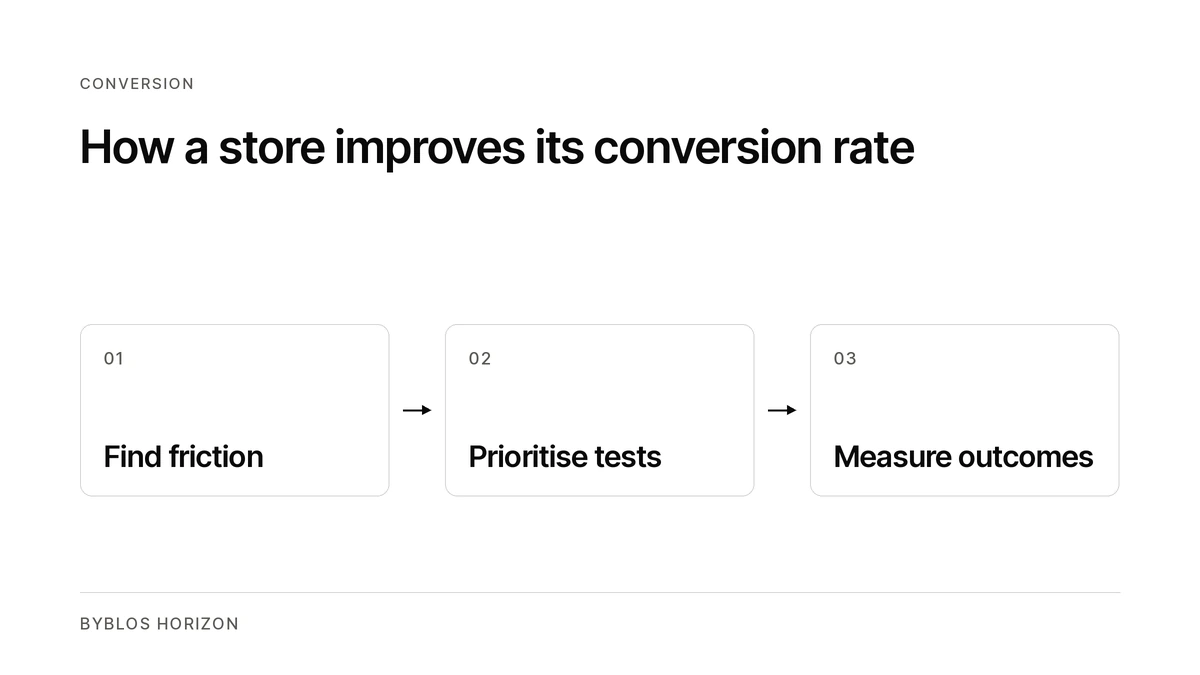
Turn the checklist into a focused testing plan:
- prioritise Shopify tests by commercial impact.
- review the full buying journey across platforms.
- rebuild pages where testing alone is not enough.
Sources
- Shopify documents checkout as a core part of its commerce platform. Shopify checkout research.
- Google documents how important customer actions can be measured as conversions. Google Analytics conversion documentation.
- W3C publishes the accessibility criteria used to review digital buying journeys. W3C accessibility standards.
Related services
Related articles