 Byblos Horizon
MENA Market Insights
Card Payments in Lebanon Rose 130%. What It Means for COD
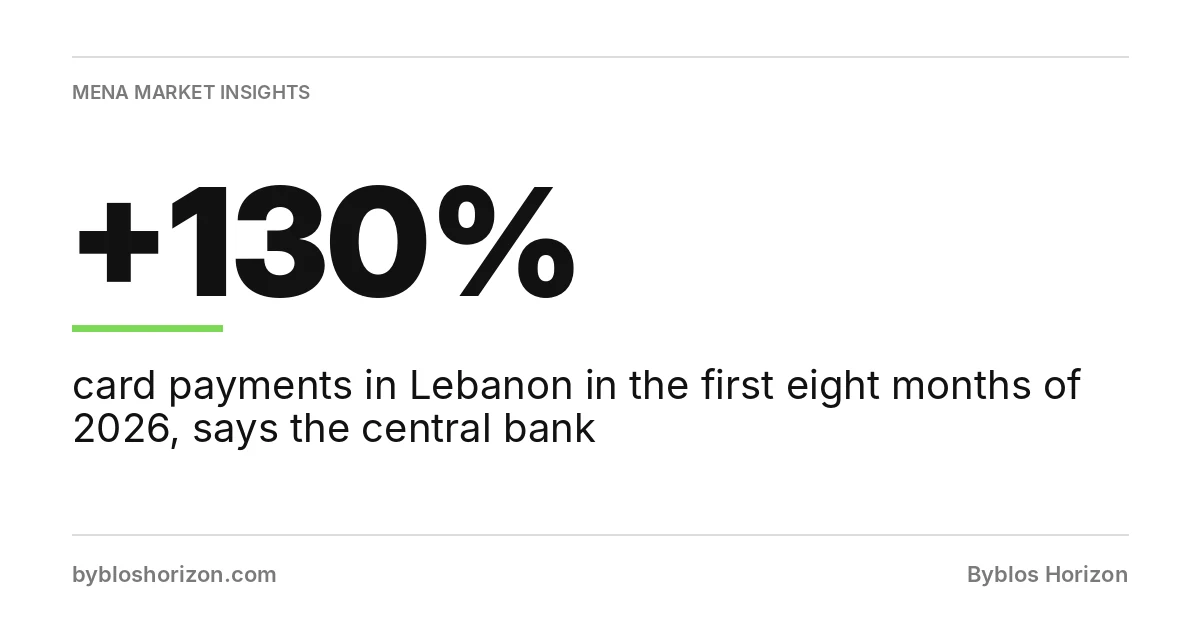
- Banque du Liban's deputy governor said card payments in Lebanon rose 130 percent in the first eight months of 2026 compared with the same period of 2025 (Al-Modon, 9 September 2026).
- L'Orient Today reports that the value of card transactions rose more than 50 percent, and that merchant fees on local cards are capped at 1.25 percent for fuel, supermarkets, hospitals, pharmacies and large bakeries.
- This does not prove online shoppers are leaving cash on delivery. The figures cover card use in general, and we found no official online only number.
Mohamad Haidar
Founder of Byblos Horizon
Published November 17, 2026 · 5 min read
In short: Lebanon's central bank says card use is growing fast and that it wants less cash in the economy. That is good news for any store that offers a card option. It is not proof that your customers are ready to give up cash on delivery, and the figures we found do not say so.
What Banque du Liban said
Deputy Governor Makram Bou Nassar held a press conference on measures to promote payment cards and electronic payments and to reduce cash. The Finance and Economy Ministries and the regional heads of Visa and Mastercard also took part (Al-Modon, 9 September 2026). The main figures, as reported:
- Card payments rose 130 percent in the first eight months of 2026 compared with the same period of 2025 (Bou Nassar, as reported by Al-Modon and L'Orient Today).
- The value of card transactions rose more than 50 percent. Bou Nassar said growth could have been higher if the war and security situation had not weighed on spending (L'Orient Today).
- Cheques also grew. L'Orient Today reports fresh dollar cheques up 124 percent in number and 108 percent in value, and fresh lira cheques up 142 percent in number and 105 percent in value. Their total value rose from about $500 million to more than $1 billion for fresh dollar cheques.
Where cards are being installed
Al-Modon reports about 1,100 electronic payment devices at fuel stations, out of 3,200, and about 1,200 at pharmacies, out of 3,600. It also says 180 supermarkets belonging to 75 companies now rely fully on electronic payment devices. The Finance Ministry has 38 devices installed across all governorates, out of 52 planned. This is in shops and public offices, not in online stores.
What is still unclear
- The fee cap is described two ways. L'Orient Today reports that a Banque du Liban circular caps the merchant discount rate on local cards at 1.25 percent, and the interchange fee at 0.9 percent, for fuel stations, supermarkets and mini-markets, hospitals, pharmacies and large bakeries, from 15 June. The page does not show the year of the circular. Al-Modon describes a cut of about 1.25 percentage points and gives no caps. The two reports do not match, so check the circular itself before you rely on either.
- Online stores are not named. The sectors in the cap are physical businesses. We did not find any statement that the cap applies to e-commerce.
- Surcharges. L'Orient Today reports that the Economy Ministry's director general said merchants who add a 2 to 3 percent surcharge for card payments break the rules. We did not find whether this covers online stores. Ask your bank or a lawyer before you add or remove one.
- Some shares have no period. The report gives card shares by sector, such as for restaurants and supermarkets, without saying which periods it compares, so we do not repeat them.
What it means for an online store
This section is our own reading, not a sourced claim.
- Offer a card option next to cash on delivery. The direction is clear, even if the online share is unknown. Customers who already pay by card in shops are more likely to accept it online. Our guide to payment gateways for Shopify in Lebanon, linked below, explains what is available.
- Measure your own share. The only number that matters for your store is the share of your orders paid by card, and how it changes month by month. Your Shopify admin already has it.
- Do not hide a card surcharge in the price. If the ministry's position applies to online sales, a surcharge is a risk. If it does not, a surcharge still pushes customers back to cash.
The wider context
L'Orient Today reminds readers that Lebanon has been on the FATF grey list since October 2024 over weaknesses in its controls on money laundering and terrorist financing, and that the central bank links less cash to better transparency and tax compliance. Mastercard announced a $100,000 collaboration with Banque du Liban to support digital payment adoption among small businesses and women entrepreneurs, and Visa plans initiatives worth more than $400,000 in Lebanon in the near future. Those last two are plans, not completed projects.
Our view
The 130 percent rise is a good sign for the whole market. But we do not know the starting level, we do not know how much of it is online, and a store that depends on cash on delivery still has to run the numbers on collected orders. Our note on cash on delivery versus prepaid shows why. If you want help adding a card option without raising your failed delivery rate, our team can set it up.
Frequently asked questions
How much did card payments rise in Lebanon in 2026?
Banque du Liban's deputy governor said card payments rose 130 percent in the first eight months of 2026 compared with the same period of 2025. L'Orient Today reports that their value rose more than 50 percent (Al-Modon, 9 September 2026, and L'Orient Today).
Does this mean online shoppers in Lebanon are leaving cash on delivery?
Not from these figures. They cover card use in general, in shops and public offices as well as online, and we found no official online only number.
What is the Banque du Liban fee cap on cards?
L'Orient Today reports a cap of 1.25 percent on the merchant discount rate for local cards in fuel, supermarkets, hospitals, pharmacies and large bakeries, from 15 June, without showing the year. Al-Modon describes a cut of about 1.25 percentage points. The two reports differ, so check the circular.
Can I add a surcharge for card payments on my Lebanese store?
L'Orient Today reports that the Economy Ministry says merchants who add a 2 to 3 percent surcharge break the rules. We did not find whether this covers online stores, so ask your bank or a lawyer first.
Should my Shopify store in Lebanon offer card payments?
Yes, next to cash on delivery, if you can. Measure the share of orders paid by card in your own Shopify admin and watch how it changes each month.
Sources and what we could not confirm
- Al-Modon (9 September 2026), in Arabic, for the press conference, the 130 percent figure, the device counts and the supermarkets. Independent Beirut outlet.
- L'Orient Today (undated page), for the value rise, the cheque figures, the surcharge statement, the FATF context and the Mastercard and Visa plans. The page we opened shows no publication date, and its figures come from officials at the press conference.
- L'Orient Today, BDL caps merchant fees (undated page), for the 1.25 percent and 0.9 percent caps and the 15 June start. The page gives the circular's day and month but not its year.
Not confirmed in what we read: the exact date of the press conference (Al-Modon published on 9 September 2026 and describes it as already held), the year of the fee cap circular, any online only card figure, and whether the cap or the surcharge rule covers e-commerce. We will update this page when Banque du Liban publishes the underlying data.