 Byblos Horizon
MENA Market Insights
Only 305 Lebanese Shopify Stores Publish a WhatsApp Number
Lebanese merchants know the sale happens in a chat. Their storefronts do not say so. The gap between those two facts is where a refused parcel comes from, and it is the cheapest thing on this list to fix.
Mohamad Haidar
Founder of Byblos Horizon
Published November 3, 2026 · 8 min read
Ask any Lebanese merchant how a sale actually closes and you will hear the same thing. Someone sees the product, messages to ask whether it is in stock, asks what delivery costs, asks whether they can pay cash. Then they order.
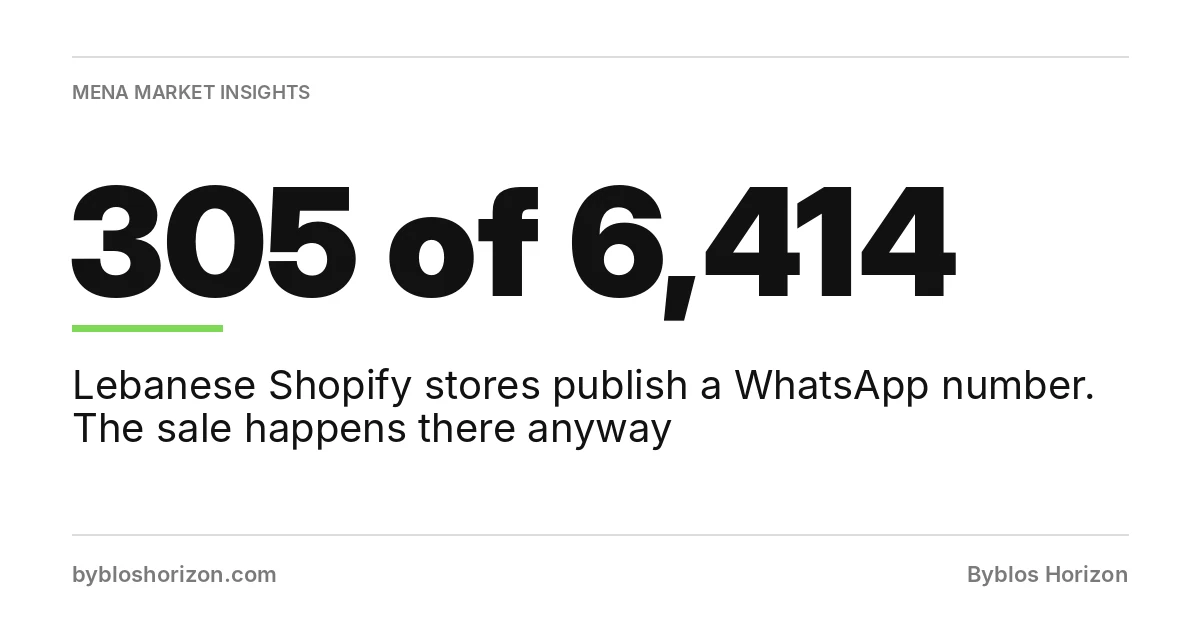
Now look at what those merchants publish. Of 6,414 live Shopify stores in Lebanon, 4,123 put Instagram on the storefront and 305 put WhatsApp. Sixty four percent against under five. TikTok, at 1,411, is on four and a half times more storefronts than the channel where the conversation happens.
That is not a marketing oversight. In a cash on delivery market it is an operational one, and it has a price.
What a refused parcel actually costs
Most merchants price a refusal as the courier fee. It is not.
Take a $40 order at a 40 percent contribution margin, so $16 of gross profit. When that parcel comes back you lose the $16, you have paid roughly $5 to send it and about $2.5 to get it back, and you have already paid for whatever advertising produced the order. Before a single cent of ad spend, that is $23.5 a parcel.
On our own figures, around 60 percent of Lebanese orders are cash on delivery and about 15 percent of those are refused. On 100 orders that is nine parcels that travel out, travel back and earn nothing, costing roughly $212 before advertising. Those are our numbers from running Lebanese stores, not a published statistic, and your own rate is the one that matters.
Why a phone number changes that
The useful thing about refusals is that most of them are not fraud. People change their mind, are not home, ordered on impulse at midnight, or were never quite sure and found out too late to say so politely.
Every one of those is a conversation that did not happen. A buyer who can ask before ordering either buys with more certainty or does not order, and a sale you never made costs you nothing. A buyer you can reach before dispatch either confirms or cancels, and a cancellation before the parcel moves is free. The expensive outcome, the one you pay for three times, only happens when there is no way to talk.
That is the whole mechanism. It is not sophisticated and it does not need software. It needs the number to be findable.
What the app data says about who has done this
The install figures tell the same story from the other side. Judge.me, for product reviews, is the most installed app on Lebanese Shopify stores at 1,577. Klaviyo, for email, is at 679. Dondy, which does WhatsApp marketing, is at 640, and a chatbot builder at 619.
So roughly a quarter of stores have collected reviews, and about one in ten has wired WhatsApp into the store properly. Half publish an email address and 42 percent a phone number, neither of which is the channel a Lebanese buyer reaches for when they want to know whether something is in stock.
The market has optimised for the parts of e-commerce that look like e-commerce elsewhere, and under-built the part that is specific to selling here.
The order to do it in
Put the number on the storefront. Not in the Instagram bio, on the site, where a buyer deciding at the product page can see it. This takes minutes and nineteen out of twenty of your competitors have not done it.
Confirm before dispatch. One message before the parcel leaves. This is the single change that moves the refusal rate most, and it works whether you send it by hand or automatically.
Then automate, once answering by hand is the bottleneck. Order status, stock, delivery timing: the same three questions, over and over. Automate those and keep a person on anything that costs money or makes a promise. Going straight to automation before the number is even published is solving the second problem while the first one is open.
What this is not
A WhatsApp link is not a strategy and it will not save a store that has no demand. The 305 stores that publish one are not succeeding because of it. The claim here is narrower and more boring: in a market where a large share of orders are agreed in a chat and paid in cash at the door, making the chat possible is unusually cheap relative to what a refused parcel costs, and almost nobody has done it.
We have written separately on what Lebanon's 6,414 Shopify stores actually look like, on why cash on delivery breaks the efficiency ratio you are reporting on, and on which payment routes actually work in Lebanon. You can also put your own refusal rate into the calculator and see what it does to a month.
Questions people are asking
How many Lebanese Shopify stores list WhatsApp?
305 of 6,414, under five percent, according to Store Leads as of 30 October 2026. By comparison 4,123 list Instagram and 1,411 list TikTok. The figure counts what is detectable on the storefront, so a store whose only WhatsApp link sits in its Instagram bio would not be counted.
Why does a WhatsApp link reduce refused deliveries?
Because most refusals are not fraud, they are people who changed their mind, were not home, or were never certain in the first place. A buyer who can ask a question before ordering, and be reached before dispatch, either confirms or cancels. A cancellation before the parcel moves costs you nothing. A refusal at the door costs the delivery out, the delivery back, and the advertising that won the order.
What does a refused cash on delivery parcel actually cost?
More than the courier fee, which is the part most merchants count. On a $40 order at a 40 percent contribution margin, the lost gross profit alone is $16. Add roughly $5 of delivery out and $2.50 of return and you are near $23.50, before any of the advertising spend that produced the order in the first place.
Is WhatsApp Business enough, or do I need automation?
Start with the number on the site. Most Lebanese stores have not done that much, so it is the cheapest step available. Automation is worth adding once the volume of the same few questions makes answering them by hand the bottleneck, which is usually order status, stock and delivery timing.
Does this apply outside Lebanon?
The behaviour does, across most cash on delivery markets in MENA and the Gulf. The specific figures here are Lebanese: the store counts come from Store Leads' Lebanon report and the refusal and courier figures are our own, from running Lebanese stores.
Sources
- Store Leads, Shopify Stores in Lebanon, read 3 November 2026 and dated 30 October 2026, for the 6,414 total, the 4,123 Instagram, 1,411 TikTok and 305 WhatsApp storefront counts, the app install figures for Judge.me, Klaviyo, Dondy and the chatbot builder, and the email and phone publication rates. These count what is detectable on the storefront, so a WhatsApp link living only in an Instagram bio is not counted.
The 15 percent refusal rate, the 60 percent cash on delivery share, the $5 courier fee and the $2.5 return fee are our own figures from running Lebanese stores, recorded with their ranges and sources in the calculator methodology, and they are estimates rather than measurements of any particular store. The $40 order value and 40 percent margin are a stated illustration, not a measured average. Checked 3 November 2026.
Related articles