 Byblos Horizon
MENA Market Insights
The Zaatar Latte Effect: Why Your Best Marketing Asset Might Be Behind the Counter
How an unusual coffee order in Lebanon became a lesson in trust, risk reduction, product adoption, and the economics of frontline service.
- A poster introduced a Zaatar Latte at Dunkin’. A branch supervisor the writer had trusted for more than two years closed the sale with one honest recommendation.
- A bold product creates curiosity and hesitation together. Awareness, understanding and trial are three different outcomes, and a poster only reaches the first two.
- Frontline staff are part of the launch. They need product knowledge, a trial policy management has approved, and judgment, not a script.
Mohamad Haidar
Founder of Byblos Horizon
Published November 18, 2026 · 17 min read
The drink everyone laughed at
I was at Dunkin’ with some friends when we noticed an unusual item being promoted: a Zaatar Latte.
Zaatar and coffee? At first, the combination sounded almost like a joke. My friends laughed about it. I could understand why. Zaatar belongs to a familiar category in the Lebanese imagination: breakfast, manousheh, olive oil, the savory flavors we grow up with. A latte belongs somewhere else entirely: coffee, milk, warmth, perhaps caramel, chocolate, or vanilla. Combining those associations creates immediate curiosity, but also hesitation.
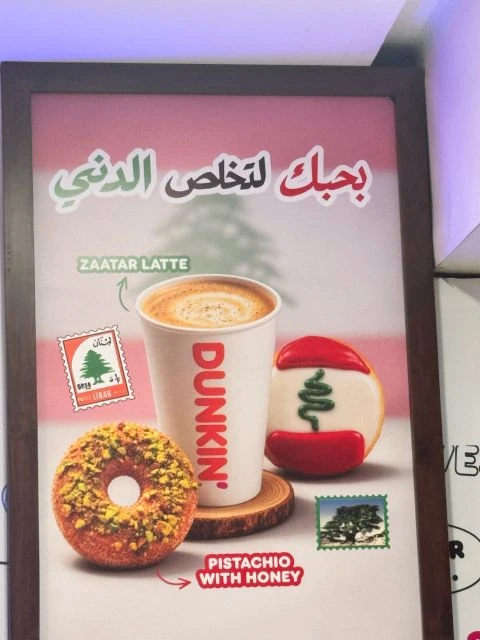
That is the paradox of a bold product innovation. Its distinctiveness makes people look; that same distinctiveness can make them reluctant to buy.
I could have laughed, ordered my usual drink, and forgotten about the Zaatar Latte. Instead, I asked the branch supervisor a question.
This was not a random employee interaction. I had been a customer at the shop she manages for more than two years. Over time, I had come to trust her judgment.
“Is it actually worth trying?” I asked.
She did not respond with a rehearsed sales pitch or a list of promotional claims. She told me to try it. If I did not like it, she said, I could get another drink. And she confidently added that she thought it was good.
So I ordered it.
And I liked it.
The interesting part is not simply that a Zaatar Latte can taste good. The interesting part is that I almost certainly would not have bought it without that conversation.
A poster introduced the product. A person helped close the sale.
That distinction deserves far more attention from cafés, restaurants, and retail businesses than it usually receives.
Product innovation creates two opposing forces: curiosity and uncertainty
When a business introduces a conventional product, customers can draw on previous experiences. A cappuccino is familiar. A chocolate doughnut is familiar. Customers have a working expectation of taste, texture, and value.
When the product breaks category expectations, the decision becomes more difficult. What does a Zaatar Latte actually taste like? Is it sweet, savory, herbal, or salty? Is the combination genuinely enjoyable, or mainly a marketing stunt? Is it worth giving up the dependable order I already know I like?
The customer does not necessarily think through these questions consciously, but the uncertainty can influence the decision.
Consumer research discusses food neophobia, a tendency to avoid unfamiliar foods. It is not a diagnosis of every skeptical customer, nor does it mean that unusual flavor combinations will fail. It is a useful framework for understanding why unfamiliar products face an adoption hurdle. A 2024 review of consumer response to novel foods maps the behavioral barriers and drivers that sit behind acceptance and refusal[1].
Importantly, a Zaatar Latte is not the same kind of innovation as cultivated meat or a new food technology, which feature in much of the research. The general lesson is narrower: unfamiliarity can increase hesitation, and a customer’s existing frame of reference matters.
The Zaatar Latte is a clever example of familiar ingredients in an unfamiliar format. Zaatar is not alien to Lebanese consumers. The coffee combination is. The brand has a cultural point of entry, but it still needs to explain why the combination works.
A provocative name can win attention. It cannot guarantee trial.
The marketing implication
Businesses should separate three outcomes that often get confused:
- Awareness: Did customers notice the product?
- Understanding: Do customers have a credible expectation of the product experience?
- Trial: Are customers confident enough to actually purchase it?
An Instagram post or in-store poster can contribute to the first two. The third may require tasting, explanation, a recommendation, or a reduction in perceived risk.
If a campaign generates reactions but few orders, the creative concept may not be the only problem. The gap could be between customer interest and purchase confidence.
The most valuable asset in that exchange was accumulated trust
I did not buy the drink merely because a supervisor said it tasted good. I bought it because this particular supervisor said it tasted good.
The relationship mattered.
For more than two years, I had interacted with the same shop and developed a positive impression of the person managing it. That history changed the meaning of her recommendation. A stranger making the same statement might have sounded like someone trying to hit a sales target. Coming from someone whose judgment I trusted, it carried more weight.
This is relationship marketing in a very practical form.
Brands sometimes reduce loyalty to points, rewards, discounts, or membership tiers. Those mechanisms can be useful, but loyalty also develops through repeated experiences of competence, reliability, and personal recognition.
There is a difference between brand trust and interpersonal trust. A brand may look reliable because of its size, reputation, or operational consistency. An employee may become credible because of direct customer experience. When both types of trust align, an unfamiliar purchase can feel less uncertain.
Academic work in Psychology & Marketing has examined how frontline retail employees sharing product-related information affects customer trust in the retailer [2]. We could not open the full paper, so we are not quoting its findings here. What we can say from our own reading of the encounter is that customers react not only to what employees say, but also to whether their intent feels helpful or manipulative.
That is why a good recommendation is not simply “You must buy this.”
It is closer to: “I understand your hesitation. Here is what I think you might like about it.”
The compounding value of familiar faces
A café might measure employee productivity through orders processed per hour. That is necessary, but incomplete. A long-serving, customer-facing employee can also accumulate relational value that is hard to see on a daily sales report.
Customers remember who gets their order right, who responds well when something goes wrong, and whose suggestions can be trusted. These seemingly small encounters influence whether customers return and whether they are willing to venture beyond their habitual purchases.
This does not mean every employee must become a close friend of every customer. It means continuity and consistency can become commercial assets.
A manager who builds trust over two years may be able to influence a decision that a single paid advertisement cannot.
One simple offer changed the perceived downside
The second major factor was the supervisor’s offer: if I did not enjoy the new drink, I could have another one.
Notice what changed.
Before the offer, I faced a small but real possibility of paying for something I would dislike. After the offer, that concern became less important. I still had to decide whether to try an unusual flavor, but the financial downside felt lower.
This is best understood through perceived-risk reduction. It is related to behavioral-economics discussions of loss aversion, though this single interaction cannot establish which psychological mechanism dominated my choice.
The amount at stake was not large. Yet the mental comparison was straightforward: why spend money on an uncertain drink when I already know a familiar one will satisfy me?
Consumers often make these small trade-offs quickly. The bigger the novelty, the more appealing a reassuring option may become.
The supervisor did not need to discount the Zaatar Latte. She reduced my hesitation by making the trial feel safe.
A price promotion and a trial assurance are not the same strategy. A discount lowers the cost of buying. A replacement promise reduces concern about a disappointing outcome. Both can affect adoption, but they address different objections.
Important operational qualification
I am describing an offer made to me at this branch, not claiming that Dunkin’ operates a company-wide replacement policy. For a business seeking to replicate the principle, employees should only offer swaps or refunds that management has explicitly authorized. An unapproved promise can damage trust when the business cannot honor it.
The better lesson is to develop clear, economically sustainable trial policies. Possibilities include:
- Small samples when feasible and food-safe.
- A defined replacement policy for eligible promotional items.
- Menu descriptions that explain unfamiliar flavors honestly.
- Staff recommendations tailored to customers’ existing preferences.
- Limited-time bundles that make trial easier without obscuring the standalone product’s value.
The goal is not to remove all business risk. It is to remove unnecessary customer anxiety at the point of decision.
Frontline employees are part of your marketing distribution system
Marketing teams frequently plan product launches around a familiar sequence: develop the offer, design the packaging, photograph the product, produce social content, run advertisements, and measure impressions and engagement.
But what happens when a customer reaches the counter?
What does the cashier say if someone asks whether the product tastes strange? Can the barista describe its flavor? Does the supervisor know which customer preferences make the product a good fit? Can anyone explain why the product exists beyond repeating the campaign slogan?
If not, there is a disconnect between the promotional campaign and the purchase experience.
A marketing promise has to survive the last few feet before the transaction.
A brand might spend money making customers curious, only for hesitation to go unanswered in-store. This is especially relevant for products that require explanation, not simply display.
For everyday products, speed may be the dominant customer need. For a surprising limited-edition drink, a thirty-second conversation can be more valuable than another generic upselling prompt.
The frontline therefore has a dual role: fulfilling orders and, when appropriate, helping customers make informed choices.
This is not an argument for aggressive sales tactics. Poorly timed pressure can damage the customer experience. Effective consultative selling means recognizing uncertainty, giving credible information, and allowing the customer to decide.
That is the distinction between order taking and customer guidance.
Order taking: “What would you like?”
Customer guidance: “Are you curious about the Zaatar Latte? It has an unusual flavor profile. Let me help you decide whether it suits your taste.”
Neither is universally superior. The right behavior depends on queue length, customer cues, operational capacity, and the product’s complexity. But an organization that trains only for transaction speed may miss valuable moments of influence.
The service-profit chain: why staff capability is a growth issue
The interaction also connects with the service-profit chain, introduced in a landmark 1994 Harvard Business Review article by James Heskett and colleagues [3].
The framework links internal service quality and employee conditions with the quality of service customers experience, their satisfaction and loyalty, and ultimately business outcomes.
In practice, a café controls several of its inputs: training, tools, support, retention and performance management. That is our own reading of the framework, and Harvard Business School Online publishes a later explainer of it [4]. Empirical work has tested the chain in high-contact service settings. In a survey of 210 high-contact service shops in Hong Kong, Yee, Yeung and Cheng (2011) reported that most of the postulated relationships were highly significant [5]. That is one study in one market, and the chain should not be treated as a guaranteed causal formula for every business.
This matters for cafés because the customer experience is not delivered by campaign artwork. It is delivered through an operating system: recruitment, training, shifts, management, product knowledge, quality control, and employee discretion.
If management introduces a new product but gives staff no training, the marketing team is effectively asking employees to support a launch without the information needed to do so.
The result can be awkward. A customer asks, “Is this actually good?” An unsure employee says, “I don’t know, I haven’t tried it.” The customer orders the usual latte instead.
Nothing dramatic happens. There is no complaint, no viral criticism, and no obvious system failure. Just one missed trial. Repeated across hundreds of encounters, those quiet moments can influence launch performance.
That is why launch readiness should not be assessed solely by whether the promotional materials arrived on time.
What product training should actually include
When a café launches an unfamiliar drink, staff training must go beyond memorizing the product name and ingredients.
A practical launch briefing can answer six questions:
What does it taste like? Employees need a precise, honest description, ideally based on first-hand sampling when possible. “Amazing” is not a flavor profile.
Who is likely to enjoy it? Some people actively seek novelty. Others prefer familiar, sweeter drinks. Employees should understand both possibilities.
Who might not enjoy it? Credibility grows when a recommendation acknowledges fit. Not every customer needs to be sold the new product.
What question will customers ask first? For Zaatar Latte, “Does zaatar actually work with coffee?” is predictable. A prepared, natural answer is more helpful than a scripted slogan.
What happens if a customer dislikes it? The team should know the approved remedy, if any, and the limits of its authority.
When is it appropriate to recommend it? Staff should distinguish a curious customer from someone who wants a quick transaction.
Managers can make this concrete with short tasting sessions, role-play, and a one-page product brief. The point is not to turn every cashier into a salesperson. It is to help them become competent guides when customers need guidance.
Train for judgment, not robotic repetition
A script can establish baseline consistency, but customers are sensitive to interactions that sound artificial.
Imagine every employee being required to ask, “Would you like to try our delicious innovative Zaatar Latte today?” The line becomes background noise. It also ignores whether the person is interested.
Better training builds a small repertoire of useful, truthful responses. The employee can then adapt to the customer:
- A curious customer may want an explanation.
- A skeptical customer may want reassurance.
- A regular customer may appreciate a personalized recommendation.
- A customer in a hurry may prefer no additional conversation.
Good service is the ability to recognize which interaction is appropriate.
The hidden risk: over-selling can destroy the trust that makes recommendations work
There is an important counterargument to this story.
If frontline recommendations are commercially powerful, why not train employees to push every new or high-margin product aggressively?
Because the trust that makes a recommendation valuable is also fragile.
When every suggestion is driven by a sales incentive, customers may begin to question employee motives. A recommendation becomes less credible if the customer believes the employee is mainly trying to increase the bill.
That is particularly damaging for repeat customers. The long-term value of the relationship can be greater than the contribution margin from a single extra beverage.
The supervisor’s recommendation worked for me precisely because it did not feel like pressure. It felt like guidance from someone I knew.
Businesses should therefore evaluate staff recommendations on more than immediate upsell volume. If customers try new items but consistently regret the purchase, short-term trial numbers can conceal a weakening experience.
Responsible recommendation systems should favor product fit, satisfaction, and repeat business over indiscriminate selling.
How cafés can measure whether frontline recommendations work
The commercial question is not whether this one interaction was memorable. It is whether a similar approach can consistently help the right customers discover products they enjoy.
That requires measurement.
A café can start with trial rate: the percentage of relevant customer transactions that include the new item. It can compare performance before and after training, while accounting for promotions, pricing, weather, dayparts, and branch differences.
Next comes customer satisfaction with the trial. Are people enjoying the new product? Do they finish it, complain, request replacements, or purchase it again? No single indicator is perfect, but together they create a stronger picture.
Then comes repeat purchase. A high first-week sales spike is not enough to prove sustained demand. Customers may order once out of curiosity and never return to the product.
And finally there is contribution margin. Sampling, replacements, food waste, training time, and ingredients all have costs. More trial is not automatically more profit.
Here is a simple illustration. These are modelled figures on stated assumptions, not Dunkin’ data and not a measurement.
Suppose a café has 1,000 relevant orders during a promotional period. Before staff training, 4% include the new drink, or 40 orders. After training, the trial rate reaches 7%, or 70 orders. That is 30 additional trials.
If the contribution margin per drink is $2.00 before the incremental cost of training and any replacement policy, those additional orders represent $60 of gross contribution. The business must then subtract additional campaign, training, sampling, or replacement costs to evaluate the true financial impact.
Those numbers are intentionally simple. They illustrate why conversion rate, satisfaction, and unit economics must be examined together.
A stronger evaluation would pilot the approach across comparable branches, include a control group where feasible, and monitor repeat purchases. Training may help, but the experiment should test the hypothesis rather than assume the outcome.
What this means beyond coffee shops
The principle applies to any business where a customer confronts a product they do not fully understand.
A cosmetics advisor recommending an unfamiliar skincare product. A restaurant server explaining a seasonal dish. A pharmacy employee helping a customer understand an over-the-counter option within appropriate professional boundaries. A furniture consultant describing a new material. A retail associate introducing a new device feature.
In each case, a campaign can create interest while the frontline interaction provides clarification and confidence.
The same challenge appears in digital commerce, although the mechanism is different. Online stores do not necessarily have a trusted supervisor on hand. They may need high-quality product explanations, authentic reviews, customer-service access, interactive guidance, or well-designed trial policies to address uncertainty. Our CRO checklist for MENA e-commerce stores covers where those answers belong on a product page.
AI assistants can help answer product questions and scale some of that guidance, but a system should not pretend to have personally tasted a beverage or invent guarantees. Credibility still depends on accurate information and transparent boundaries.
Across physical and digital retail, the larger strategic question remains the same:
What is stopping an interested customer from feeling confident enough to buy?
The answer may not be another advertisement.
A practical launch playbook for restaurant and retail operators
Before releasing the next unfamiliar or innovative product, businesses can organize launch preparation into five phases.
Phase A: Understand the hesitation
Ask prospective customers what feels unfamiliar, risky, unappealing, or confusing. Do not assume the marketing team already knows. Customer interviews, tasting sessions, and simple surveys can uncover objections that creative teams miss.
Phase B: Translate the product into understandable language
Replace vague praise with concrete descriptions. Use comparisons thoughtfully, without promising an experience the product does not deliver. A culturally familiar ingredient can create an entry point, but customers still need to understand the new format.
Phase C: Equip the frontline
Allow employees to taste the item where feasible. Explain intended customer fit, common questions, service recovery rules, and the commercial objective of the launch. Managers must be able to answer questions, not only supervise stock and shifts.
Phase D: Reduce avoidable friction
Where financially practical, consider samples, introductory portions, transparent descriptions, and clearly authorized remedies. Each mechanism should have a cost model and operational policy.
Phase E: Measure the complete adoption journey
Track awareness, customer questions, trials, satisfaction, repeat purchase, waste, and contribution margin. Use findings to improve the product and the customer experience, rather than simply declaring the campaign a success because it generated attention.
This process makes marketing accountable to adoption and customer value, not merely visibility.
Why the Lebanon context matters
The Dunkin’ poster did something interesting with Lebanese cultural cues. Zaatar is deeply familiar, and the visual identity uses recognizable Lebanese references. It invites consumers to see a familiar flavor in a new context.
That creates a strong conversation starter, especially among friends who have shared assumptions about what belongs in coffee and what does not.
But cultural familiarity is not the same as consumption familiarity. Recognizing zaatar does not mean customers can imagine how it will taste in a latte. We looked at the wider habit in why Lebanese consumers buy what their parents bought.
This is where local retail teams can add real value. They hear the jokes, objections, comparisons, and questions customers express in their own words. They can tell marketing teams whether people are intrigued, confused, skeptical, or delighted.
A headquarters campaign sees impressions and sales totals. A branch supervisor hears why the purchase did or did not happen.
Businesses should establish feedback loops so frontline observations inform product descriptions, creative material, staff training, and even product development.
The counter is not only a place of transaction. It is a source of qualitative market intelligence.
What Dunkin’ got right in this particular interaction
The strongest part of my experience was not the novelty of the product. It was the human execution around it.
The supervisor listened to an actual objection. She understood I was hesitant. Her existing relationship with me gave her recommendation credibility. She expressed confidence without turning the exchange into a hard sell. And she offered reassurance that made trying something new feel easier.
From my perspective as a customer, those elements came together exceptionally well.
I appreciate that experience, and I think other operators can learn from it. But it is important to be precise: one positive interaction does not prove what Dunkin’ teaches across its network, how frequently staff behave this way, or whether the replacement offer is standard policy. Those questions would require direct verification.
What the encounter does show is how much influence a capable employee can have in a moment when advertising alone is not enough.
It also suggests a useful leadership question: If the customer had asked a different employee the same question, would the answer have been equally useful?
That is the difference between an exceptional individual and a repeatable organizational capability.
Conclusion: the campaign started the conversation; trust completed the transaction
I walked into Dunkin’ expecting coffee. I saw an unfamiliar Zaatar Latte and, like my friends, initially found the idea amusing. I could have stuck with what I knew.
Instead, one conversation with a supervisor I trusted changed the decision.
A good product deserves good promotion. But promotion is only one piece of the adoption process. Customers also need understanding, confidence, and, sometimes, a knowledgeable human being who can tell them what they are actually buying.
For businesses launching new products, the lesson is not to ask staff to push harder. It is to equip them to guide better.
Because you can design the most creative campaign, produce a beautiful in-store display, and build a product that gets people talking.
But if your team cannot confidently and honestly answer the customer’s simplest question, “Is it worth trying?”, you may lose the sale at the very last moment.
Sometimes your most important marketing asset is the person standing behind the counter.
Sources and what we could not confirm
The opening anecdote is a first-person account. The sources below support the broader concepts. They do not independently verify the interaction or establish Dunkin’ operational policies. Each entry says which claim it supports.
- Consumer Response to Novel Foods: A Review of Behavioral Barriers and Drivers (2024), via PubMed Central. Supports only the statement that research reviews the behavioral barriers and drivers of consumer response to novel foods. We confirmed the title and year. We did not open the full text, so we do not cite its specific findings.
- Park (2023), The influence of frontline employee self-disclosure about products in a retail store on customer trust in the retailer in the context of service encounters, Psychology & Marketing. Supports only the statement that this topic has been studied in a peer-reviewed journal. We confirmed the title, journal, year and DOI. We could not open the full text or confirm the author list, so we do not cite its findings.
- Heskett, J. L., et al., Putting the Service-Profit Chain to Work, Harvard Business Review (March-April 1994). Supports the origin of the service-profit chain framework. The framework description is ours, in one sentence.
- Harvard Business School Online, Explaining the Service-Profit Chain: How Quality Drives Profit. A later explainer of the same framework. We did not open it, and its publication date is not confirmed, so we cite it for nothing beyond existing.
- Yee, R. W. Y., Yeung, A. C. L., & Cheng, T. C. E. (2011), The service-profit chain: An empirical analysis in high-contact service industries, International Journal of Production Economics, 130(2), 236-245. Supports the statement that a survey of 210 high-contact service shops in Hong Kong found most of the postulated relationships highly significant, as reported in the abstract on EconPapers.
Editorial note: this article expresses an independent customer experience and marketing analysis. It is not sponsored by Dunkin’ and does not claim access to the brand’s internal training or operating procedures. The 1,000-order example is a modelled illustration with stated assumptions, not data from any company.