 Byblos Horizon
AI Marketing
The AI Marketing Stack for Lean Teams
Mohamad Haidar
Founder of Byblos Horizon
Published January 22, 2026 · 10 min read · Updated September 17, 2026
The reason a small MENA marketing team can now compete with a mid-sized regional one is not that AI writes better copy than a senior writer. It doesn't. It's that AI takes the ops overhead of a marketing operation (creative variants, briefs, translations, customer replies, reports) and turns it from a bottleneck into a pipeline. Here's the stack we actually run, and the workflows that make it earn back, for founder-led brands with marketing teams of 2 to 5 people.
Layer 1: The core LLM
You need one primary large-language-model provider with an enterprise-grade contract, and it needs to be the one your team touches every day. ChatGPT Team / Enterprise, Claude for Teams, or Google Workspace with Gemini are the three defensible defaults. Pick one and standardise. Two competing tools with two prompt libraries is worse than one imperfect tool with a disciplined workflow.
Layer 2: Brand voice and prompt discipline
Raw LLM output sounds like every other brand using raw LLM output. The single highest-leverage investment for a lean team is a well-written brand-voice document (tone, do's and don'ts, examples, forbidden phrases) and a prompt library that reuses it. Every content generation prompt starts by loading brand voice and target audience: no exceptions.
In Arabic-first workflows this matters even more. Ship an Arabic voice document alongside the English one, and always end with a human editorial pass by a native speaker. See the Arabic-first Shopify guide for why.
Layer 3: Creative variants at scale
The concrete win for most e-commerce brands is variant creative. One good static ad brief → 20 variants in 30 minutes with tools like Midjourney, Photoshop's generative features and Runway. One good video hook → eight edits with Descript or Opus.
This is the single most measurable AI ROI most brands will see this year. Paid media punishes stale creative; a team that ships 40 variants a week instead of four cuts CPMs and lifts CTR by numbers you can actually put on the invoice.
Layer 4: Customer service and WhatsApp
An LLM-backed WhatsApp assistant connected to Shopify catalogue and order data handles the first-touch service window on autopilot, availability, sizing, shipping, order status, returns, in Arabic and English. Humans handle only real edge cases. This is usually the highest-margin single AI deployment in an MENA e-commerce brand; see the full case in the ROI of WhatsApp automation.
Layer 5: Retention and personalisation
Klaviyo's built-in AI segmentation, plus LLM-drafted email variants, plus a proper testing cadence, moves owned-channel revenue meaningfully. Cross with a WhatsApp BSP for the coordinated retention picture in the Klaviyo flows every store should run.
Layer 6: Internal ops (the silent multiplier)
The unglamorous layer where lean teams punch heaviest. Meeting notes, weekly reports, brief generation, analytics summaries, customer research synthesis. Notion AI, Fathom, Granola, or a lightweight internal Claude project can save 5 to 8 hours per person per week. That's a headcount of leverage across a team of five, without hiring.
Workflows that actually earn
Tools without workflows are just SaaS bills. The workflows we standardise for lean teams:
- Weekly creative sprint: 20 static variants, 8 video edits, briefed once, executed with AI tooling.
- Daily WhatsApp queue triage handled by the AI assistant; human takes only escalations.
- Monthly retention email calendar drafted by AI, edited by human, tested by segment.
- Post-campaign analysis auto-summarised from GA4 + ad platforms into a written brief for the next test.
- Weekly customer-feedback synthesis from reviews, WhatsApp and support into a founder-readable digest.
What it costs
Realistic tooling budget for a lean MENA marketing team running the above:
- Core LLM (ChatGPT Team or Claude Teams): $25 to $60/user/month.
- Creative tools (Midjourney, Runway, Descript): $50 to $150/month total.
- WhatsApp BSP + LLM integration: $100 to $400/month + usage.
- Klaviyo + WhatsApp orchestration: standard retention stack costs.
- Analytics/ops (Notion AI, Fathom, custom): $50 to $200/month.
Total: $300 to $1,500/month depending on team size. The bigger cost is the time to design the workflows and write the prompts, and that time is the actual investment.
Where it goes wrong
Teams that treat AI as "let's use ChatGPT more" get almost nothing. Teams that treat it as an operating change, new workflows, new roles, evals, feedback loops, get real leverage. The tooling is the easy part. The operating change is the whole game.
We build this out with clients as part of our AI marketing, AI automation and AI marketing agency engagements.
Frequently asked questions
Do we need to hire an AI specialist?
Usually not. A senior marketer with LLM fluency and an operations mindset beats a specialist with no marketing context. Buy training and tools before you buy headcount.
Is ChatGPT enough or do we need a proper stack?
ChatGPT alone runs on prompts and copy-paste. A proper stack has orchestration, memory, brand voice guardrails, evals and integration with Shopify/Klaviyo/WhatsApp. The gap between the two is where operational leverage lives.
How much should we budget for AI tools?
For a small MENA marketing team, $300 to $1,500/month in tooling is typical. The bigger cost is time: designing the workflows, writing the prompts, evaluating outputs.
What about data privacy?
Choose providers with clear data-processing agreements. Never feed raw customer PII into a public LLM without consent. Regional data residency (KSA, UAE) is available from the enterprise tiers of most major providers.
Want us to design the stack for your team? Book a consultation.
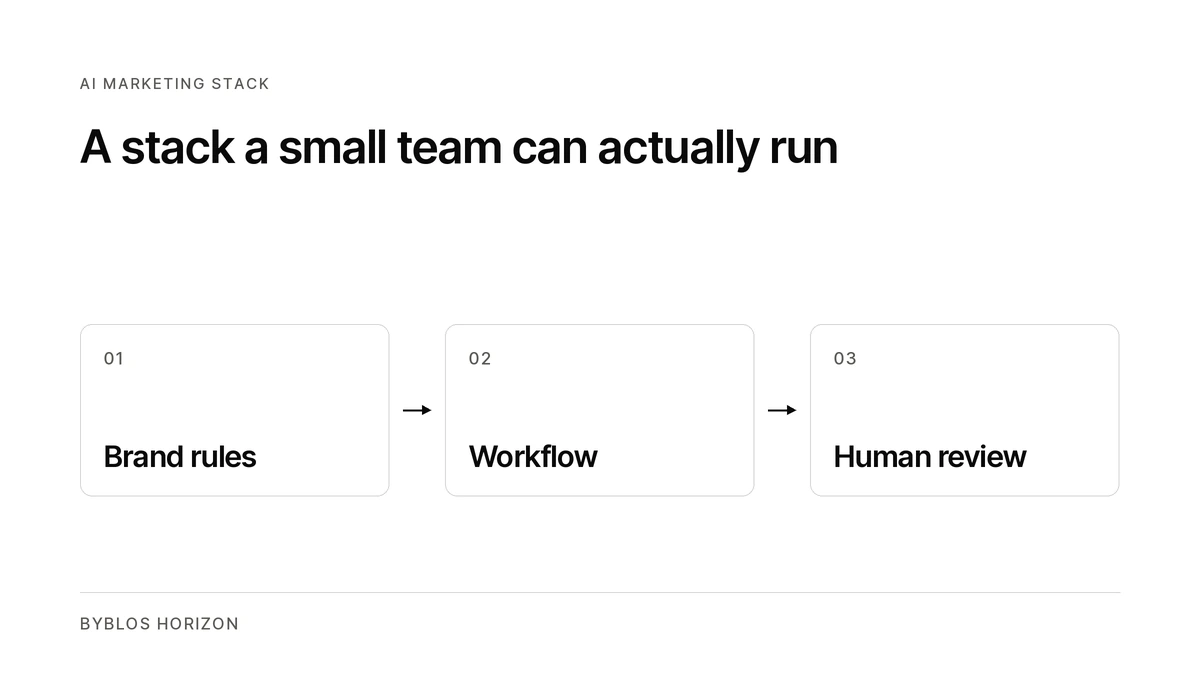
Practical next steps
Move from a tool list to a controlled operating system:
- design repeatable workflows around real tasks.
- add brand and review controls to content production.
- connect the stack to a wider marketing programme.
Sources
- WhatsApp describes its platform for business messaging at scale. WhatsApp Business Platform.
- Klaviyo documents email automation, segmentation and personalisation capabilities. Klaviyo email marketing.
- W3C provides the standards used to review accessible digital output. W3C accessibility standards.