MENA Market Insights
Could Luckin Coffee Succeed in Lebanon? A Founder’s Analysis
Research date: 29 September 2026
Mohamad Haidar
Founder of Byblos Horizon
Published September 29, 2026 · 21 min read
I tried Luckin Coffee in New York and immediately thought of Lebanon. The shop was small, the coffee was great, and ordering was remarkably simple. I selected my drink and paid through the app, collected it and continued my day. I did not need to interact with the barista to place the order.
My first reaction was that this concept could take off very quickly back home. After examining the business and Lebanon’s existing coffee market, I still see an opportunity. I am more careful about the word “easily.” Luckin could compete for frequent takeaway purchases, provided its local pricing, locations and operating reliability make the experience worth repeating.
Working in e-commerce makes me pay attention to the entire purchase. How much effort does the customer make? Where can payment fail? What brings someone back after the first offer? Luckin made those questions feel relevant to something as ordinary as buying a coffee. Bringing that experience to Lebanon would require a serious look at everything supporting it.
Key findings
- The opportunity is frequent, convenient takeaway. A compact pickup format could compete for predictable daily drinks with a short, reliable collection, but only if local pricing, locations and reliability make repeat purchases worthwhile. It has much less to offer customers who want a seat or a long café visit.
- Lebanon already has capable competitors and digital ordering. Dunkin Lebanon’s app advertises wallet recharge, QR payment, loyalty and pickup ordering, and brands such as Starbucks, Stories, Café Younes and Kalei serve different coffee occasions. Advertised features are not proof of how reliably every branch fulfils orders.[4, 5, 6, 7, 8]
- Local pricing, infrastructure and repeat economics decide the case. Published Lebanese menus show wide price ranges even within one brand; electricity, water, connectivity and maintenance must be budgeted at each site; and in an illustrative model a shop with $9,000 monthly fixed costs needs roughly 143 to 273 daily transactions depending on contribution per sale.[9, 10]
- There is no verified public quotation for Lebanese franchise rights. Territory availability is unconfirmed, and Luckin has not announced a Lebanese launch. The roughly $40,900 figure derived from Luckin’s annual report covers only average renovation and coffee-machine costs for its own stores.[1, 2, 18]
What impressed me about the Luckin app and checkout
On my visit, choosing, ordering and paying felt connected. I did not have to repeat my order at a till. For someone moving through New York and wanting a coffee along the way, that convenience matters.
The commercial attraction is straightforward. A direct ordering channel can connect purchases to a customer account, make reordering easier and help a business understand which customers return. It also creates a place to offer promotions without having to buy an advertisement for every subsequent transaction. Those advantages depend on customers continuing to use the service.
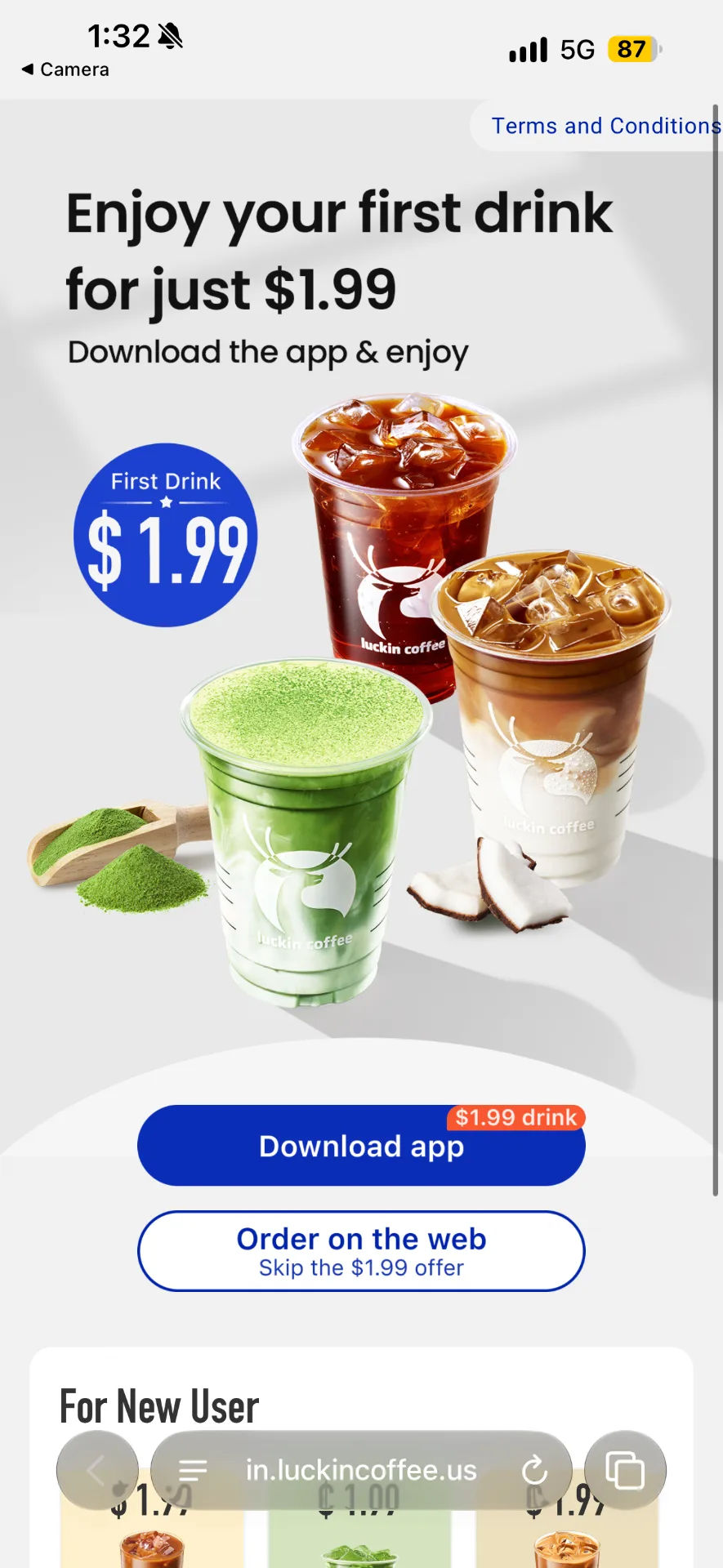
The $1.99 first-drink offer in my screenshot is a good example of an acquisition incentive. It gives someone a reason to try the app and the product. It tells us very little, by itself, about the normal selling price, the margin on that order or the cost of keeping the customer.
I would assess the offer through subsequent purchases: how many first-time buyers return, how often, at what effective price and with how much contribution left after costs. An app download followed by one discounted coffee is an expensive result if the customer never returns.
There is also an important distinction in my experience. The ordering and payment were automated; I did not establish that the shop was staffless. Preparation, cleaning, replenishment and customer problems still require people. I would not describe a smooth checkout as evidence of artificial intelligence either. Good transaction design already creates substantial value.
Luckin’s operating model: impressive scale, economics that need scrutiny
Luckin’s 2025 annual report says pickup outlets represented 99.1% of its self-operated stores at year-end. It describes the format as typically 20 to 60 square metres with limited seating. That helps explain why the small shop I visited felt intentional.[1]
Its unaudited second-quarter 2026 results reported 36,310 stores and revenue growth of 28.5%. They also reported a 5.3% decline in comparable self-operated store sales. The company attributed that decline primarily to a demanding comparison with the previous year’s delivery-platform subsidies.[2]
The network has since grown: on 28 September 2026, Luckin announced its 100th Singapore store and said its global footprint exceeded 38,000 locations. That newer store count should not be confused with the reporting date of the quarterly financial figures.[22]
Store-level and group-level margins are different measures
The second-quarter release reported a 21.3% operating margin for self-operated stores and a 13.4% group GAAP operating margin. These measure different things; neither is a forecast of the return a Lebanese franchisee would earn. The release also defines monthly transacting customers to include people whose purchases were paid entirely with free coupons.[2]
I take that as a reason to look beyond expansion headlines. New stores can increase total revenue while existing locations face pressure. A Lebanese operator would need mature-store results from a comparable international market, the assumptions behind them and a clear account of who funds promotions.
Luckin announced its first two US pickup stores in New York in July 2025. Its own announcement described this as an early step in international expansion. My positive visit in 2026 is a customer observation, not a profitability study of that expansion.[3]
Coffee chains in Lebanon: capable competitors already exist
The first weakness in a simple “bring the app to Lebanon” argument is that local customers already have digital coffee options. Dunkin’s Lebanese app advertises wallet recharge, QR payment, loyalty rewards and pickup ordering. Its version history records an expanded pickup feature in August 2025. This establishes advertised functionality; it does not tell me how reliably every branch fulfils an order.[4]
The competitive field also includes businesses serving different reasons for buying coffee. Starbucks maintains a Lebanese store directory. Stories’ website reports 22 locations in its 2025 timeline and emphasizes food and social visits. Café Younes lists neighbourhood cafés as well as locations at AUBMC, the Academic and Clinical Center, Beirut Digital District and BAU’s Tripoli campus. Kalei combines cafés with a coffee and training business.[5, 6, 7, 8]
| Competitor or format | Evidence of its offer | Implication for a newcomer |
|---|---|---|
| Dunkin Lebanon | App payment, loyalty and pickup ordering | Digital convenience already has an incumbent |
| Starbucks Lebanon | A locally listed international café network | International branding alone is insufficient differentiation |
| Stories | Coffee, food and a social setting | A pickup shop competes for some occasions, not the entire visit |
| Café Younes | Roasting, cafés and institutional locations | Several attractive repeat-purchase locations are already contested |
| Kalei | Cafés, wholesale coffee, equipment and training | Local coffee expertise and supply capabilities already exist |
Sources: operator websites and app descriptions. This is a selection of competitors, not a ranking or a complete census. The implications are my assessment.[4, 5, 6, 7, 8]
I would also count bakery counters, roadside coffee, workplace machines and coffee prepared at home as substitutes. Someone buying a daily drink on the way to work is deciding among a different set of alternatives from someone meeting friends for two hours.
That is why I would narrow the opportunity to customers who value a predictable drink and a short, reliable collection process. A compact shop has much less to offer someone who wants a seat, a meeting space or a long café visit. The same person can want both experiences on different days.
Coffee prices in Beirut: the comparison needs to be local and fair
It would be misleading to compare Luckin’s introductory US offer with a Lebanese café’s full menu price and declare a permanent advantage. The useful comparison is the regular price of a similar drink, its size, the service included and the actual cost of collecting it. I have written separately about why coffee and daily costs in Beirut have become so expensive.
Café Younes provides a concrete example. The 2026 menus linked from its official website list the following prices, inclusive of VAT. The roaster menu is linked to Hamra Roaster; the café menu is linked to several branches, including Sodeco.[9, 10]
| Drink and stated size | Hamra Roaster menu | Café menu linked to Sodeco |
|---|---|---|
| Espresso regular | $2.50 | $3.30 |
| Caffè latte regular | $3.50 | $5.00 |
| Caffè latte medium | $4.10 | $6.00 |
| Caffè latte large | $4.70 | $7.00 |
These are published menu prices checked on 29 September 2026, not mystery-shop receipts or national averages. Size labels are the menus’ own; no assumption is made about equal drink volumes across brands.
The variation within one brand is revealing. Lebanon already has different formats and price points. A new takeaway operation needs to compare itself with convenient everyday alternatives as well as premium seated cafés. It cannot base its whole pricing story on the most expensive latte someone has seen in Beirut.
I would also test taste and willingness to pay with the intended customers. My enjoyment of one drink does not establish demand for an entire menu. A limited range of familiar coffees and a few distinctive drinks would be easier to test, cost and keep in stock than a large launch menu, if the brand permits that approach.
The Lebanon coffee market exists, but its size should not be invented
World Bank WITS data, drawing on UN Comtrade, records Lebanon’s 2024 imports of unroasted, non-decaffeinated coffee at approximately $91.0 million and 18.5 million kilograms. Brazil represented roughly 87% of the reported value, calculated from the same table.[11]
Those figures demonstrate a substantial coffee supply trade. They do not measure coffee-chain revenue. Imported beans can enter retail packs, homes, workplaces, hospitality and products later exported. Converting the import total into a café market value would require assumptions about processing, destinations, margins and consumption that this dataset does not supply.
The economic context also matters. The World Bank’s August 2026 outlook projects a 6.4% contraction in Lebanon’s economy and 17.5% inflation for the year following renewed conflict. It identifies pressure on tourism, household consumption and supply chains. Those are projections, not completed-year outcomes, and they supersede the more optimistic outlook published in January.[12]
My implication for an investor is to model interrupted trading, weaker demand and higher replenishment costs before committing to a rapid rollout. Busy individual cafés can coexist with a difficult national economy. Neither observation cancels the other.
Coffee ordering apps and digital payments in Lebanon
Lebanon has usable digital payment infrastructure. Whish advertises a merchant wallet gateway for online purchases, QR payments through compatible POS systems and wallet funding through agents or cards. OMT Pay advertises QR payments at supported stores. These are available building blocks; they are not confirmation that Luckin has integrated with either service.[13, 14]
For a local launch, I would want to see the entire payment process demonstrated. Can a customer fund the payment method easily? Does a successful charge create exactly one order? Can a failed order be refunded promptly? In what currency does the merchant settle, at what fee and after how many days?
Payment acceptance is not customer acceptance
A person may use a wallet for transfers and still prefer cash for a coffee. Someone with a foreign phone number may struggle with account verification. A first-time visitor may leave when asked to install another app. These are testable customer situations, not reasons to assume that everyone will reject digital ordering.
I would seek a brand-approved web or assisted-ordering option during a pilot and measure its effect. A digitally recorded cash payment or a permitted wallet top-up could help some customers, but each creates handling and reconciliation work. A local franchisee cannot assume it is free to change the brand’s payment model.
The best checkout is the one the customer can complete reliably. In Lebanon, that may require more flexibility than I needed during my New York visit.
Electricity, water and refrigeration belong in the customer experience
The World Bank’s electricity programme documents the need to restore grid services and reinforce the system. A funded improvement programme should not be treated as a promise of uninterrupted supply to a particular shop.[15]
Before approving a lease, I would require an electrical load assessment for the coffee machine, refrigeration, ice production, ventilation and ordering equipment. Backup capacity, voltage protection, fuel or battery costs and maintenance must be included in the budget. Solar may contribute where space, storage and approvals allow it; its suitability needs to be designed around the site.
Water deserves the same attention. Supply continuity, filtration, storage, drainage and ice production affect both the drink and the equipment. A cheap lease can become expensive if the premises need extensive electrical or plumbing work.
Refrigeration failure has another cost: ingredients may become unusable even while the ordering app keeps accepting purchases. The system therefore needs a practical way to suspend unavailable products or pause orders. A smooth screen is valuable only when the shop can honour the promise behind it.
Connectivity, locations and pickup access at the exact address
Ogero’s published service terms make last-mile delivery subject to technical feasibility and availability; advertised copper speeds also depend on line quality and distance. That is a reason to inspect the connection at the premises rather than assume that a neighbourhood label guarantees service.[16]
I would test connectivity during opening hours, provide a backup connection where feasible and establish a procedure for paid orders when the connection drops. Two subscriptions are not independent protection if both depend on the same failing infrastructure or power supply. Payment reconciliation and a clear recovery process matter as much as the number of connections.
The physical collection route also needs testing. Saving time at the counter means little if the customer spends several minutes finding parking or crossing a difficult road. Office entrances, hospital approaches, campus access and legal stopping space should influence site selection alongside rent and visibility.
Hamra, Achrafieh, Badaro and institutional clusters are sensible areas to investigate, not ready-made investment recommendations. Café Younes’ listed hospital, campus and business-district locations already show that established operators understand these occasions. Each candidate site needs counts of accessible target customers by time of day and an assessment of competing offers.[7]
Imports, sourcing, maintenance and staffing for a small coffee shop in Lebanon
Lebanon has coffee capabilities to build on. Kalei advertises wholesale green and roasted coffee, private-label services, training and equipment. Barista Espresso describes local production and equipment installation and maintenance services. Their presence demonstrates an existing ecosystem, without establishing that any supplier is approved by Luckin.[8, 21]
A franchise agreement would determine which beans, ingredients, packaging and machines must come through designated suppliers and which can be purchased locally. Those decisions affect lead times, working capital and resilience. A locally available substitute may be commercially attractive yet contractually unusable.
I would cost every imported item to the point where it is usable in the store, including freight, clearance, applicable taxes, storage, spoilage and minimum order quantities. The quoted price of a bag of beans is only one input. Recipe-specific powders, syrups and alternative milks can create their own stockout problems. The same landed-cost logic runs through what Lebanese businesses really pay to move goods.
Maintenance needs a similarly concrete answer. Who repairs the installed machine in Lebanon? Which spare parts are held locally? What happens to orders while it is out of service? A small menu depending on one production machine can concentrate operational risk.
The labour argument also needs care. Removing an ordering step may reduce counter work, but staffing still has to cover peak preparation, cleaning, stock receipt, breaks and training. I would measure drinks completed per paid staff hour, order accuracy and peak waiting time before assuming a particular payroll saving. Local labour costs and operating conditions may make the return on expensive automation different from New York.
Coffee shop operating costs in Lebanon and break-even scenarios
I would begin with contribution per transaction: net sales after discounts and indirect taxes, less ingredients, packaging, payment charges and other transaction-related costs. Delivery costs and contractual royalties must be included where applicable. The amount left has to support rent, staff, utilities, maintenance and overhead. This is the same discipline I apply to transaction economics and profitability in Lebanese e-commerce.
The table below is an illustrative sensitivity test. It is not a Luckin forecast, a supplier quote or a claim about average Lebanese café costs. It assumes 30 trading days and shows the daily transactions required to cover monthly fixed operating costs, rounded up.
Illustrative model
| Assumed monthly fixed costs | $1.10 contribution per transaction | $1.60 contribution per transaction | $2.10 contribution per transaction |
|---|---|---|---|
| $6,000 | 182 | 125 | 96 |
| $9,000 | 273 | 188 | 143 |
| $12,000 | 364 | 250 | 191 |
Calculation: monthly fixed costs divided by contribution per transaction, then divided by trading days. These are operating break-even levels, before recovery of setup capital, financing costs and income tax. Fixed costs would need to include an appropriate allocation of shared overhead; variable costs would need to include the actual franchise terms.
This is why I would be cautious about permanent discounting. It can create volume while leaving too little contribution to fund the operation. Opening-week queues and social impressions do not answer that question.
Delivery needs its own calculation. Toters already provides a local ordering and delivery channel. I would obtain an actual merchant proposal and include commissions, promotion funding, packaging and refunds rather than insert an assumed industry-wide fee. A single delivered coffee and a prepaid pickup purchase can have very different economics.[20]
Luckin Coffee franchise cost in Lebanon: what the published evidence says
There is no verified public Lebanon franchise quotation in the sources reviewed, and Lebanese territory availability is unconfirmed. Luckin’s official site directs partnership enquiries to partnerships@luckincoffee.com.[18]
There is recent regional investor interest. On 10 September 2026, Abu Dhabi’s Mubadala announced an agreement to make a minority investment alongside Centurium in a transaction with an aggregate value of approximately $1 billion. The announcement does not establish a Lebanon development agreement or available Lebanese franchise rights. The aggregate transaction value should not be presented as Mubadala’s separately disclosed contribution.[23]
The Malaysia precedent
Hextar’s November 2024 announcement describes exclusive national rights, a ten-year initial agreement and development-schedule obligations. It explicitly mentions a franchise fee and startup costs but does not disclose their amounts. That is evidence of a negotiated country arrangement, not a public price list for Lebanon.[17]
Luckin’s annual report separately describes its Chinese retail partnership model as having no franchise fee. Applying that statement to overseas country rights would be an error.[1]
Partial cost benchmarks from Luckin’s own stores
That figure is not the full cost of a store or a Lebanese franchise. It does not establish the price of territory rights, all equipment, deposits, local infrastructure work, opening inventory, training, freight, professional fees or the cash needed during ramp-up. Large corporate procurement averages may also be unavailable to a new country operator.
Territory uncertainty and contract questions
I would separate the investment into country entry, individual outlets and liquidity. Country entry includes any rights fee, required guarantees, localization and shared operating setup. Each outlet needs its own premises, equipment and opening budget. Liquidity needs to cover inventory, settlement timing, launch losses and possible interruption. Some costs are shared; others rise with every branch.
The contract questions can change the answer more than a fit-out estimate: minimum opening commitments, royalty basis, mandatory sourcing, who funds discounts, who owns local customer data and what happens if trading is interrupted. I would ask for a complete term sheet, market-specific cost guidance and comparable franchisee results. Local legal, tax, food-service, import and payment reviews would then turn those terms into a usable Lebanese budget.
Luckin’s history also belongs in due diligence. In December 2020, the SEC announced that the company agreed to a $180 million penalty to settle accounting-fraud charges. That historical settlement does not establish a problem with today’s accounts, but it reinforces the need to assess current audited reporting, controls and enforceable contractual protections.[19]
What a measured Lebanese pilot would need to demonstrate
I would first establish whether Luckin is interested in Lebanon and whether it would permit a limited pilot. The apparent attractiveness of a small shop does not mean the company will offer one-store rights or accept a slow development schedule.
If permitted, I would test one or two different catchments: for example, a location serving regular workplace or hospital demand and one serving a student or neighbourhood routine. Opening timing would depend on safe access, utilities and supply continuity. A measured pilot is preferable to a lease commitment built around an assumed recovery.
I would run it long enough to observe several repeat-purchase cycles after the launch offer, ideally across three to six months and different demand conditions. The measures would include payment completion, time from order acceptance to collection, repeat purchasing by customer cohort, net selling price, contribution, stockouts, downtime and waste. Cohorts matter because a new batch of discounted first-time buyers can conceal weak retention.
The expansion condition would be sustained demand at the intended normal pricing, with a sufficient margin above operating break-even and evidence that the result can be reproduced. A second outlet should add enough new demand to justify itself after accounting for customers diverted from the first.
I would also compare the franchise with a locally developed concept using existing Lebanese coffee and payment capabilities. A local brand would need to build recognition, recipes, quality control and operating discipline. It might gain more flexibility over suppliers, payment options and rollout. The franchise deserves its fees only if its brand and system produce enough additional value for the local operator.
I still like the experience I had in New York. Good coffee, an excellent app and an easy payment process made a small purchase feel effortless. I can see customers in Lebanon wanting that convenience too.
What would convince me to invest is the ability to deliver it repeatedly: at a price customers accept, through a payment method they use, from a shop that can keep operating and earn enough to support itself. I would be interested in proving that case. I would not confuse my first good coffee with having proved it already.
Frequently asked questions
How much would a Luckin Coffee franchise cost in Lebanon?
No verified public Lebanese franchise quotation was found in the sources reviewed. Luckin’s 2025 annual report gives two partial benchmarks for its self-operated stores: average renovation and decoration of RMB192,000 and coffee-machine procurement of RMB86,000, together about $40,900 at the RMB6.798 rate in its second-quarter 2026 release. That figure excludes territory rights, deposits, local infrastructure work, inventory, training, freight, professional fees and ramp-up cash, so it is not a Lebanese franchise price.
Are Lebanese franchise rights confirmed as available?
No. Lebanese territory availability is unconfirmed, and Luckin has not announced a Lebanese launch. Its official website directs partnership enquiries to partnerships@luckincoffee.com. Mubadala’s September 2026 minority investment does not establish Lebanese rights either.
Could an app-based coffee model work in Lebanon?
Possibly, for customers who value a predictable drink and a short, reliable pickup. Wallet and QR payment services such as Whish and OMT Pay exist, and Dunkin Lebanon already advertises app pickup and payment. Adoption still has to be tested: some customers prefer cash, foreign numbers can complicate verification and first-time visitors may not install another app.
Which coffee businesses would Luckin compete with?
The article’s selection includes Dunkin Lebanon, Starbucks Lebanon, Stories, Café Younes and Kalei, plus substitutes such as bakery counters, roadside coffee, workplace machines and coffee made at home. This is a selection, not a ranking or complete census.
What infrastructure would a Lebanese outlet need?
An electrical load assessment with backup capacity and voltage protection, reliable water with filtration, storage and drainage, refrigeration and ice production, a tested internet connection with a fallback procedure for paid orders, and practical customer access for pickup. Maintenance and local spare parts for the coffee machine are also essential.
How many daily transactions might a coffee shop need to break even?
In the article’s illustrative model, which is not a Luckin forecast, $9,000 of monthly fixed costs and $2.10 contribution per transaction require about 143 transactions a day over 30 trading days. At $1.10 contribution the requirement rises to about 273. These are operating break-even levels before setup capital recovery, financing and income tax.
Research notes and sources
Research checked on 29 September 2026. The personal opening reflects the author’s supplied account and photographs. Store descriptions and app features are operator-reported, not independently tested. The financial sensitivity table is original illustrative arithmetic, not field research. No franchisor quote, supplier tender, landlord offer or primary consumer survey was obtained. Public store directories and menus can lag branch-level conditions; confirm them before an investment decision. A reliable current national coffee-chain sales total or a complete verified store census was not established.
Written by Mohamad Haidar, Founder and CEO of Byblos Horizon. More about the author and Byblos Horizon.
- Luckin Coffee 2025 annual report on Form 20-F. Store formats, partnership models and average renovation and coffee-machine costs, printed pages 68 to 71. Open source
- Luckin Coffee second-quarter 2026 financial results, 3 August 2026. Unaudited company figures and definitions. Open source
- Luckin Coffee US launch announcement, 2 July 2025. Open source
- Dunkin Leb App Store listing and version history. Open source
- Stories Coffee official website and dated growth timeline. Open source
- Starbucks Lebanon official store directory. Open source
- Café Younes official locations and menu links. Open source
- Kalei Coffee wholesale services and location references. Open source
- Café Younes 2026 Hamra Roaster menu, linked from its official locations page. Open source
- Café Younes 2026 café menu linked to Sodeco and other branches. Open source
- World Bank WITS and UN Comtrade. Lebanon imports in 2024, HS 090111, unroasted non-decaffeinated coffee. Open source
- World Bank, Renewed Conflict Derails Lebanon’s Fragile Economic Recovery, 21 August 2026. Open source
- Whish official wallet, funding and payment-gateway descriptions. Open source
- OMT official app and QR payment description. Open source
- World Bank electricity restoration and renewable-energy financing announcement, 3 October 2024. This is project context, not evidence of current site-level uptime. Open source
- Ogero published connectivity terms and availability conditions. Open source
- Hextar Industries master development and operating agreement announcement, 29 November 2024, reproduced in a public filing mirror. Open source
- Luckin Coffee official global website and partnership contact. Open source
- US Securities and Exchange Commission, Luckin Coffee Agrees to Pay $180 Million Penalty to Settle Accounting Fraud Charges, 16 December 2020. Open source
- Toters official service description. No merchant commission rate is inferred. Open source
- Barista Espresso official company profile and service description. Undated profile; production-volume claims were not used. Open source
- Luckin Coffee Singapore 100th-store announcement, 28 September 2026. Open source
- Mubadala minority investment announcement, 10 September 2026. Open source