MENA Market Insights
The Shelf Is the Billboard: Why FMCG Brands Keep Marketing the Wrong Thing
Mohamad Haidar
Founder of Byblos Horizon
Published August 28, 2026 · 9 min read · Updated September 17, 2026
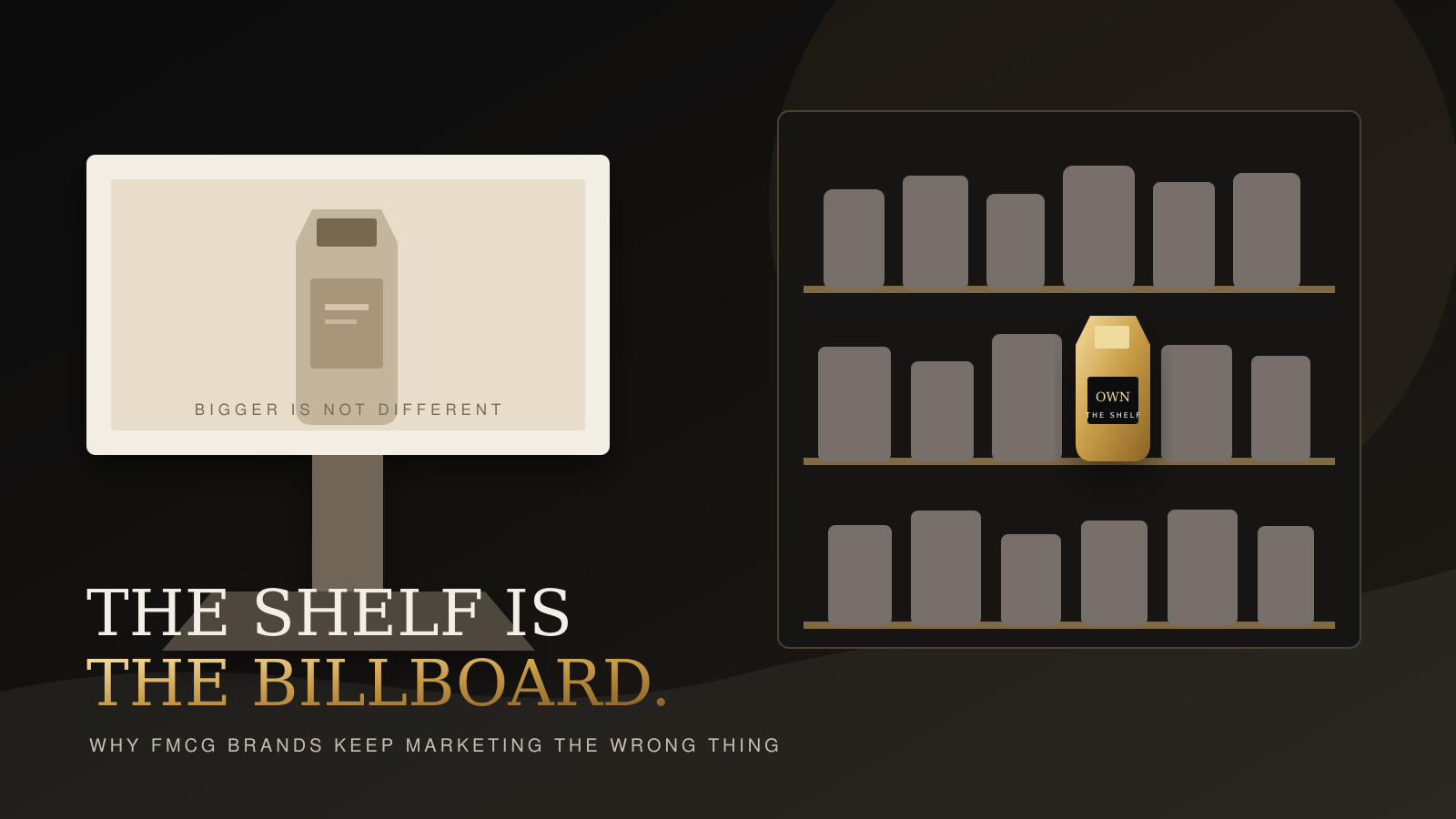
Before buying another billboard, FMCG brands should ask a more uncomfortable question: if the logo disappeared, would anyone recognize the product?
There is a familiar pattern in FMCG marketing.
A company launches a bottle, jar, box or pouch that looks almost identical to everything already sitting in the category. It uses the same shape, the same label structure and often the same visual language as five or ten competitors. Then, instead of fixing the product's ability to stand out, the company purchases a billboard and makes the ordinary package larger.
The result is visibility without distinction.
People may see the advertisement. They may even remember the category. But when they enter the supermarket, they still face a wall of products that look interchangeable. The campaign has created awareness without giving the shopper a clear reason, or even a reliable visual cue, to choose that particular brand.
This is not an argument against outdoor advertising. Billboards can build familiarity, signal scale and support a product that is already distinctive and widely available. The problem is one of sequence. Too many brands buy reach before they have built recognition, distribution or shelf conversion.
For an FMCG product, the shelf is not simply where the marketing ends. It is where the marketing is judged.
Eight manufacturers, one recurring problem
I have visited or dealt with nearly eight manufacturers across Lebanon, Türkiye and Spain while exploring different product opportunities. The factories were not identical. Their scale, capabilities and markets differed. But one pattern appeared repeatedly: manufacturers often offered remarkably similar stock packaging.
The same bottle could be presented to several companies. The formula, label and logo could change, but the underlying silhouette remained familiar. From a manufacturing perspective, this makes sense. Existing moulds reduce development time, minimum order quantities and capital expenditure. Standard components are easier to source and replace.
From a branding perspective, however, convenience can become camouflage.
If a brand chooses the same bottle as the rest of the category, applies a predictable label and then produces an AI-generated visual of that bottle, it has not created a new campaign idea. It has reproduced the same weakness in a more polished format.
The critical test is simple:
Remove the logo from the package. Could a shopper still identify the brand from its shape, colour system, structure or other distinctive assets?
If the answer is no, the company does not yet have a billboard problem. It has a product-recognition problem.
Research on visual attention supports the underlying principle. Eye-tracking studies have found that brand and product cues are leading drivers of attention and choice on a supermarket shelf, while the visual ecology of competing packages affects what shoppers notice. Packaging is not neutral wrapping. It is part of the decision environment. (Food Quality and Preference; Journal of Business Research)
The market is large, but it is becoming harder to win
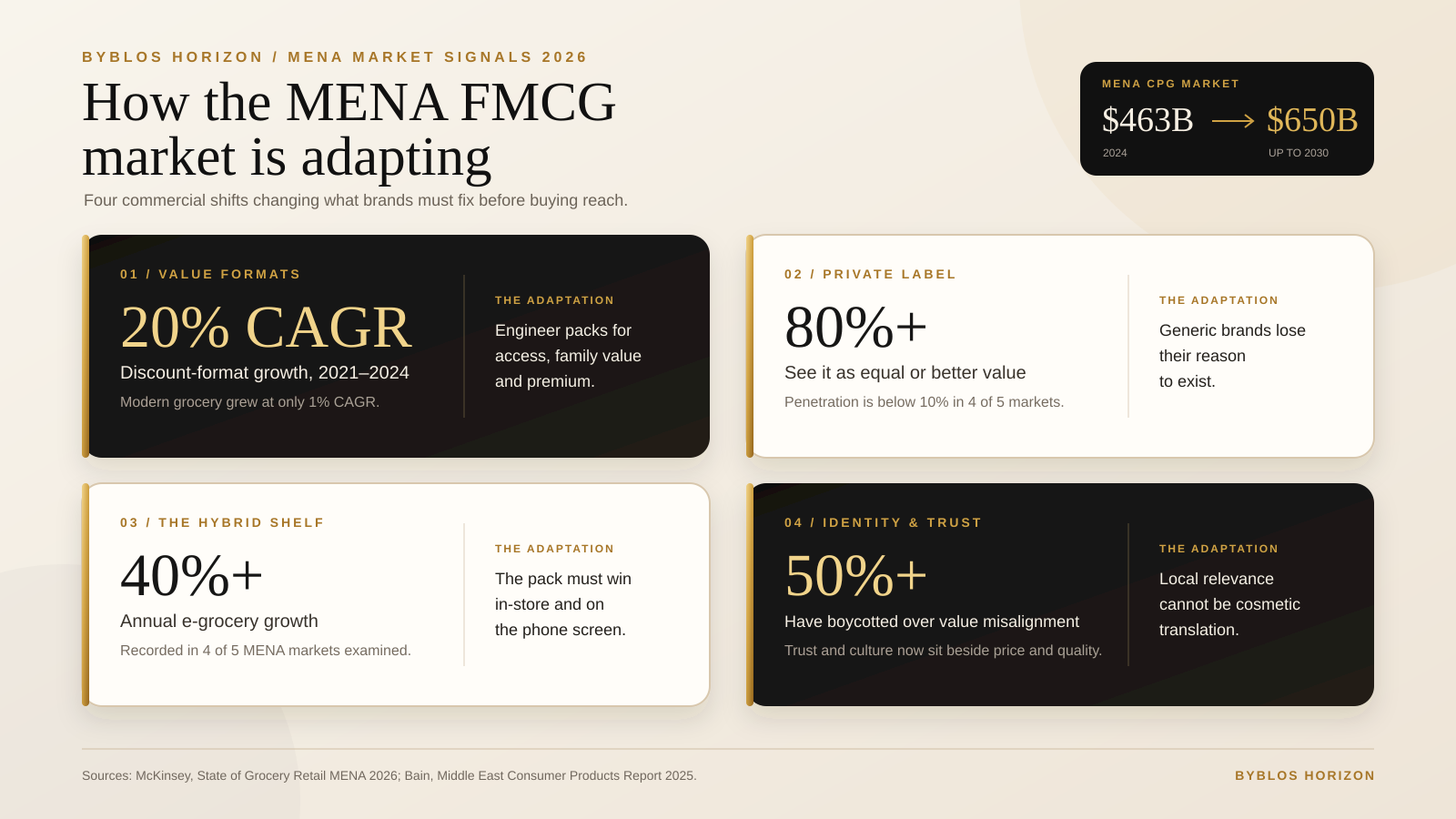
The opportunity in MENA is substantial. Bain estimates that the region's consumer packaged goods market reached approximately $463 billion in 2024 and could grow to as much as $650 billion by 2030. Food and beverage represented roughly $200 billion of the 2024 total. But a growing market does not make every product competitive. Logistics, labour, raw materials and regulatory complexity continue to pressure margins. (Bain & Company)
At the same time, consumer behaviour is fragmenting.
Some shoppers are looking for the lowest acceptable price. Others are willing to pay more for quality, convenience, health, identity or a clear premium proposition. The dangerous place for a brand is the middle: not cheap enough to win on value, not different enough to command preference and not memorable enough to survive comparison.
This is especially relevant in Lebanon. Consumers have become exceptionally skilled at comparing price, quantity and perceived quality. The market is crowded with imported brands, established local names, private-label-style alternatives and products created through similar regional or international manufacturers. A generic package with a respectable logo is no longer enough. It is the same dynamic we described in why Lebanese consumers buy what their parents bought.
When purchasing power is under pressure, branding does not become irrelevant. It becomes less forgiving. Every visible element must communicate what the product is, whom it is for and why it deserves its price.
How the MENA retail market is adapting
The old model was relatively straightforward: manufacture a product, secure distribution, negotiate shelf placement, buy broad awareness and repeat. That model is being disrupted from several directions.
1. Value is becoming more sophisticated
Value no longer means only "the cheapest product." It can mean a smaller accessible pack, a larger family pack with a better unit price, a healthier product that remains affordable, or a premium item whose difference is immediately understandable.
McKinsey's 2026 grocery research across Egypt, Saudi Arabia, Morocco, Qatar and the UAE found that discount formats grew at a 20% compound annual rate between 2021 and 2024, while total modern grocery in those markets grew at only 1%. Price was also the largest source of shopper dissatisfaction. (McKinsey & Company)
Brands therefore need portfolio architecture, not one package for everyone. A company may need an entry pack, a core product, a family format and a clearly premium variation. Using the same design and simply changing the weight is not always sufficient; each format has a different job at the shelf.
2. Private labels are becoming credible competitors
In the same McKinsey survey, more than 80% of respondents considered private-label products equal or superior to branded alternatives and better value for money. Yet private-label penetration remained below 10% in four of the five markets studied.
That gap represents an opportunity for retailers, and a warning for manufacturers.
If a product looks generic, communicates no proprietary advantage and competes mainly on price, shoppers have little reason not to choose the retailer's own brand. A national or regional brand must earn the premium through distinctive assets, reliable quality, innovation, trust or cultural relevance.
The logo alone cannot carry that weight.
3. The shelf is becoming omnichannel
The "shelf" is no longer only a metal fixture inside a supermarket.
It is also a category page on a grocery application, a sponsored result in a retailer's search engine, a product thumbnail on a quick-commerce platform, a promotion inside a loyalty application and a retargeting message powered by first-party purchase data.
Online grocery grew by more than 40% annually between 2019 and 2024 in four of the five MENA markets examined by McKinsey. Physical grocery remains dominant, but shoppers are increasingly hybrid. This means packaging must work twice: from several metres away in a store and at thumbnail size on a phone.
Retail media is developing alongside this change. IAB MENA now publishes regional guidance on using retailer data and media across the omnichannel journey. McKinsey describes retail media as nascent in MENA but gaining momentum through stronger loyalty data, e-grocery traffic and in-store technology such as screens, smart shelves and promotional kiosks. (IAB MENA; McKinsey & Company)
The infrastructure is no longer theoretical. Majid Al Futtaim's Precision Media already sells search, display, off-site, in-store and targeted-sampling solutions using Carrefour and SHARE shopper data. The important development is not merely another advertising format; it is the possibility of connecting exposure more closely to actual shopping behaviour. (Majid Al Futtaim Precision Media)
4. Identity and trust are affecting product choice
MENA consumers are not responding only to price and convenience. Bain reports that more than half have boycotted brands over a mismatch in values, around three times the reported rate among US or European consumers in its study.
This means global creative cannot simply be translated and distributed. Brands need to understand how family habits, local identity, cultural cues, health expectations and trust operate in each market.
Lebanon provides a particularly strong example. Many supermarket choices are inherited: consumers buy what their parents bought, trust products that have remained present through instability and interpret familiarity as reduced risk. A new product cannot defeat that behaviour with reach alone. It needs trial, availability, credibility and repetition at the point of purchase.
What should come before the billboard?
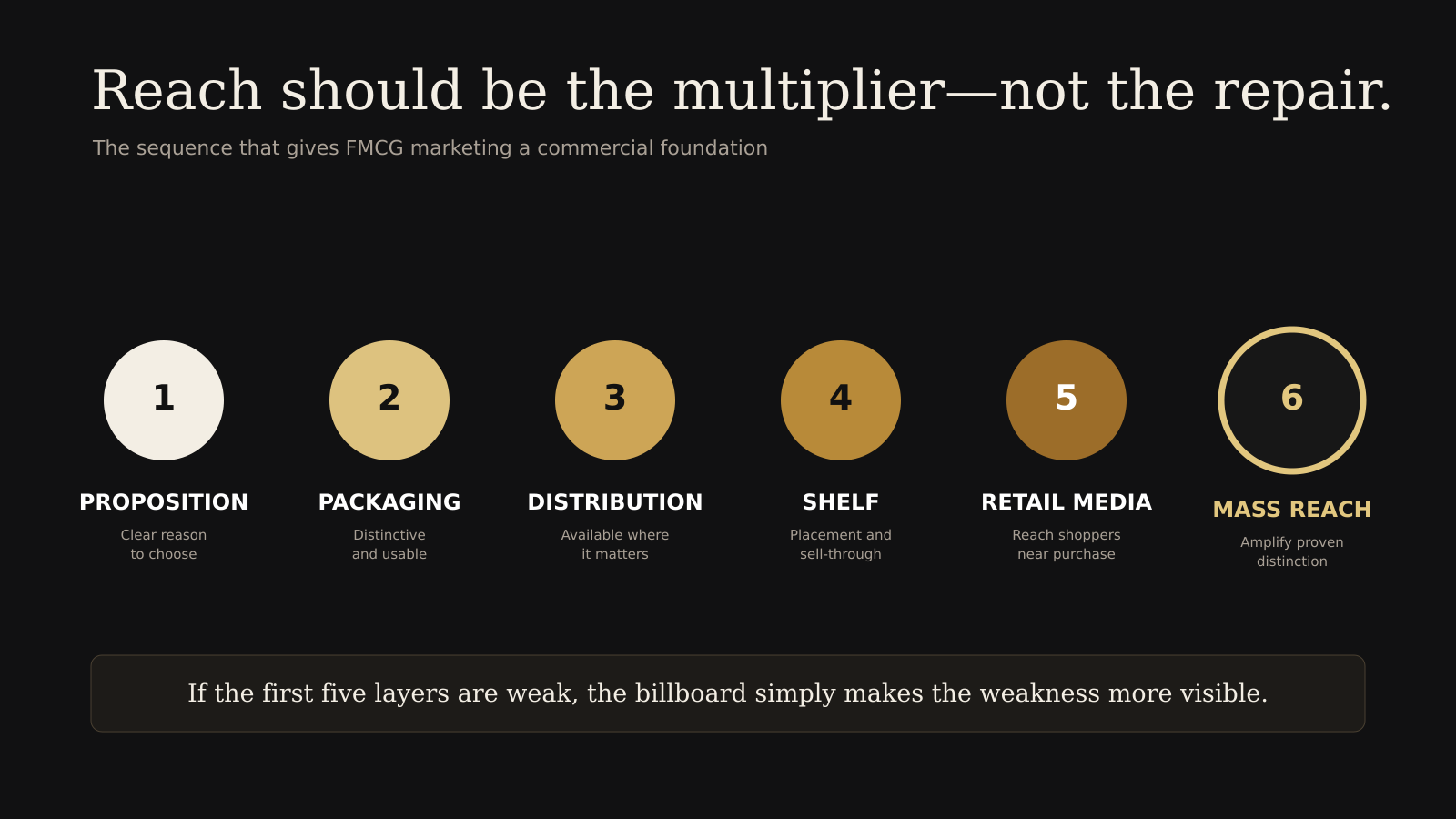
1. Audit the category in the real store
Do not begin inside a boardroom with the package displayed alone on a white background. Place it beside the ten products it will actually compete against.
Photograph the shelf from three distances. Reduce the image to phone-screen size. Remove the brand names and ask people what they remember. Check whether the colour, silhouette and hierarchy remain distinctive under ordinary supermarket lighting.
A package can look beautiful in a presentation and disappear completely in retail.
2. Decide what is genuinely proprietary
Distinctiveness does not always require an expensive custom bottle mould. The advantage may come from a structural label, an unusual closure, a consistent block of colour, a bold name, recognisable typography, a tactile material or an unmistakable flavour system.
But something must belong to the brand.
The objective is not to make the package strange. It is to make it identifiable, usable and commercially defensible.
3. Build distribution around sell-through, not sell-in
Entering 100 retailers is not automatically better than performing strongly in 30.
A company can celebrate distribution while products remain badly positioned, inconsistently replenished or absent from the branches that matter. Track availability by location, days out of stock, shelf position, facings, promotional compliance, sell-through velocity, returns and collections. We covered the full evaluation model in the distribution trap.
Distribution is not the number of doors that accepted the product. It is the number of doors where the product can be found, noticed and purchased repeatedly.
4. Invest at the moment of decision
For an unfamiliar product, targeted sampling, end-cap displays, shelf communication, bundles, retailer search visibility and app-based promotions may do more than undifferentiated mass reach.
These activities are not automatically superior. They must be measured. Compare participating stores with control stores, examine incremental units rather than total sales and watch whether the uplift continues after the promotion ends.
The advantage is proximity to purchase. The message reaches consumers while they are choosing, not hours or days before.
5. Use outdoor advertising when it has a clear job
Once the product is distinctive, stocked and supported, outdoor advertising can become powerful.
A billboard can introduce a genuinely new package, establish a category position, support a major launch, announce wide availability or build mental availability for a brand with sufficient physical availability. It can also reinforce a visual asset that shoppers will recognise later.
But the creative must do more than display the pack beside a slogan.
If the package is conventional, the idea must be unconventional. If the message is ordinary, the product must be visually remarkable. If neither is true, the brand is paying to enlarge its similarity.
A practical 90-day shelf-first plan
- Days 1 to 15: Diagnose. Audit three to five retailers across different formats. Record price, placement, facings, competitive promotions, availability and packaging similarity. Interview store managers, merchandisers and a small number of shoppers.
- Days 16 to 35: Fix the proposition. Clarify the target customer, value equation and reason to choose. Test package recognition, message hierarchy and product-thumbnail performance. Decide whether the problem requires a complete redesign or stronger distinctive assets.
- Days 36 to 65: Prove sell-through. Concentrate on a manageable group of branches. Improve shelf execution, run controlled sampling or promotions, train merchandisers and monitor weekly velocity and stockouts.
- Days 66 to 90: Scale intelligently. Expand the retail program, add retailer-owned digital placements and use broader media to amplify what has already demonstrated conversion. Outdoor should now have a defined audience, geographic relationship to distribution and measurable commercial purpose.
The real marketing question
The question is not whether billboards work.
The question is whether the brand has earned the right to scale its visibility.
In a market filled with similar products, expensive reach cannot replace a clear proposition. AI can produce a cleaner campaign visual, but it cannot manufacture distinctiveness that the product itself does not possess. Distribution can place a product in more stores, but it cannot guarantee that shoppers will notice or repurchase it.
The strongest FMCG brands connect every layer: product, package, price, availability, shelf, retail data and mass communication. They adapt their formats to purchasing power, their message to local identity and their media to the changing path to purchase. That is the same logic behind why virality does not sell and relevance does.
Before approving the next billboard, visit the supermarket.
Stand in front of the category. Look at the product from five metres away. Then ask the only question that matters:
If I did not already know this brand, would I see it, understand it and choose it?
If the answer is no, the next marketing investment should begin at the shelf. If you want a second opinion on where your brand actually stands in its category, our team runs shelf and market audits from Beirut and across MENA, or you can book a consultation.
Frequently asked questions
What is retail media in MENA?
Retail media in MENA is advertising bought inside a retailer's own ecosystem: search and display placements on grocery apps and websites, off-site campaigns powered by loyalty data, in-store screens, smart shelves and targeted sampling. It connects ad exposure more closely to real purchase behaviour than broad awareness media.
Why do FMCG billboards often fail to drive sales?
A billboard amplifies whatever the product already is. If the package looks like every competitor on the shelf, outdoor advertising creates awareness of the category without giving shoppers a visual cue or a reason to choose that specific brand.
How can an FMCG brand test whether its packaging is distinctive?
Remove the logo and ask whether shoppers can still identify the brand from shape, colour system, structure or typography. Then photograph the package on a real shelf beside its ten closest competitors, from three distances, and shrink the image to phone-screen size.
What matters more, sell-in or sell-through?
Sell-through. Listing a product in 100 retailers is not better than performing strongly in 30 if the product is badly placed, inconsistently replenished or absent from the branches that matter. Track availability, days out of stock, facings, velocity and collections by location.
Are private labels a real threat to FMCG brands in MENA?
Yes. More than 80% of shoppers surveyed by McKinsey across five MENA markets rated private-label products as equal or superior to branded alternatives and better value, while penetration stayed below 10% in four of those markets. That gap is a warning for brands competing mainly on price.
When should an FMCG brand buy outdoor advertising?
Once the product is visually distinctive, reliably stocked and proven to convert at the shelf. At that point a billboard can introduce a new package, establish a category position or build mental availability that physical availability can actually service.
Practical next steps
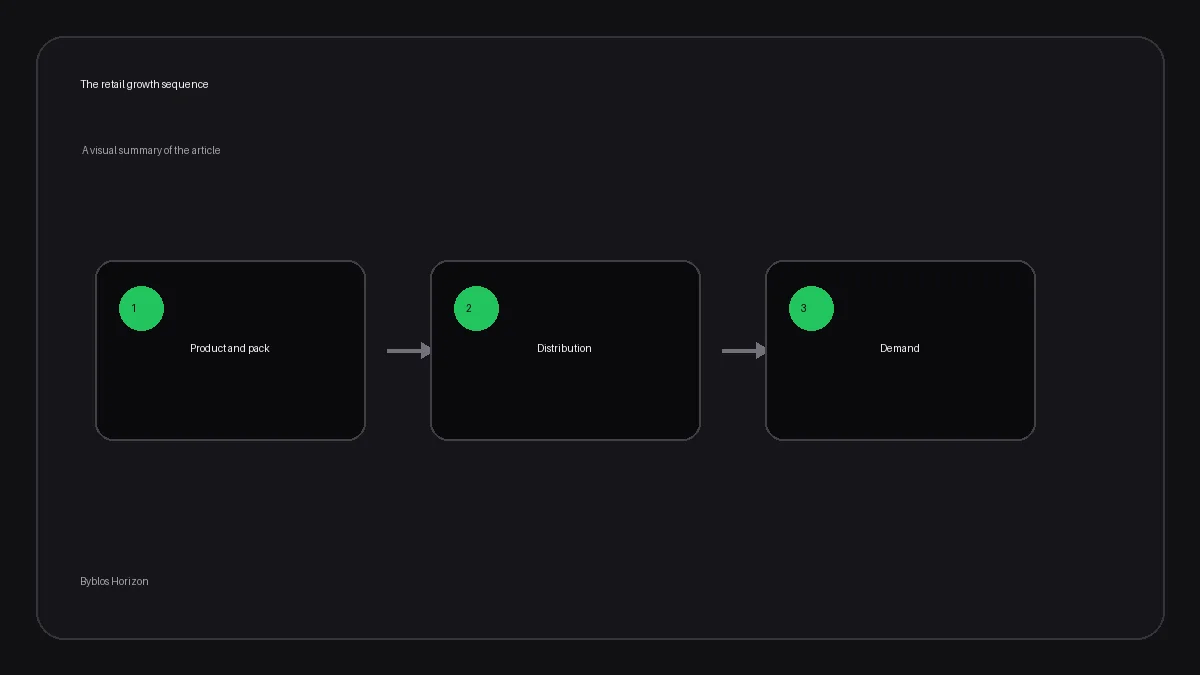
The same sequence can be applied through these commercial workstreams:
- make the digital shelf easier to understand.
- connect demand generation to product availability.
- plan growth across MENA markets.
Sources
- World Bank data provides market-size context for national economies. World Bank GDP data.
- Google documents conversion measurement for meaningful customer actions. Google Analytics conversion documentation.
Related services
Related articles